

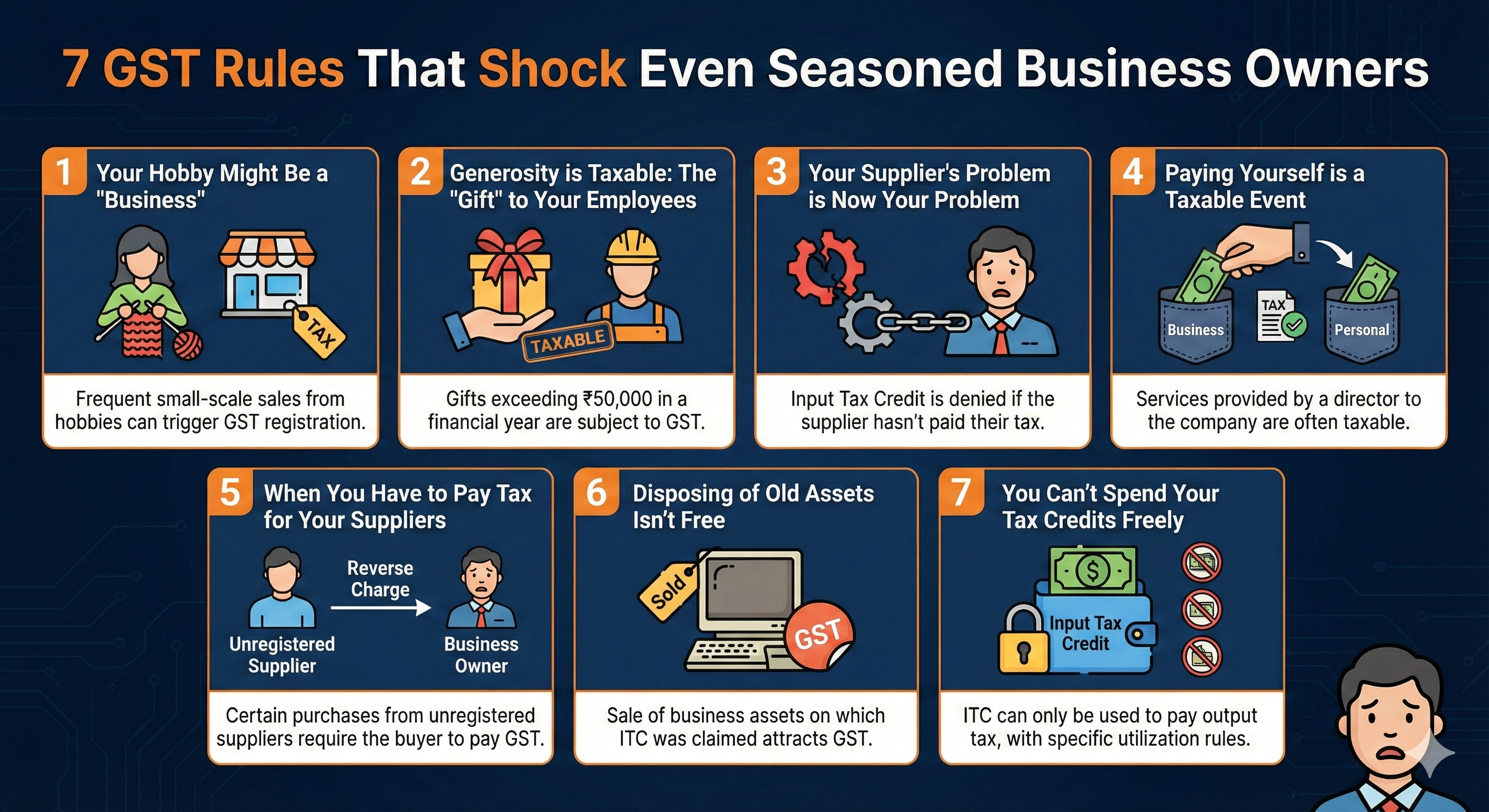
 Most business owners are familiar with the fundamental principles of the Goods and Services Tax (GST): collect tax on supplies, claim input tax credits, and file returns on time. While these basics form the foundation of compliance, the GST framework is layered with nuanced and often counterintuitive rules that can lead to unexpected tax liabilities, operational friction, and significant business risks if overlooked.
This article deconstructs seven of the most surprising and impactful provisions hidden within India's GST framework. By understanding what these rules are and, more importantly, what they mean in a strategic context, businesses can better mitigate hidden risks and ensure their compliance strategies are truly comprehensive.
Your Hobby Might Be a "Business"
The definition of "business" under GST is far broader than its common usage. The law includes not only typical commercial activities like trade and manufacturing but also extends to unconventional transactions that most would consider one-off events or personal hobbies.
The Central Goods and Services Tax Act, 2017, provides this surprisingly wide definition:
Business: any trade, commerce, manufacture, profession, vocation, adventure, wager or any other similar activity.
Why This Matters
The inclusion of terms like "adventure" and "wager" is what makes this definition so startling. It challenges the conventional understanding that a business requires continuous or regular activity. This broad scope creates a compliance risk for the burgeoning creator economy and gig workers. It means a consultant’s occasional side project, a freelancer testing a new service, or an individual selling a high-value personal asset could technically fall under the GST net, forcing an evaluation of tax obligations for activities they would never classify as a formal business.
Generosity is Taxable: The "Gift" to Your Employees
In a counter-intuitive twist, a gift from an employer to an employee can be treated as a taxable "supply" under GST. This rule addresses explicitly transactions between "related persons," a category that includes the employer-employee relationship.
According to a proviso in Schedule I of the CGST Act, gifts from an employer to an employee are considered a supply if their value exceeds fifty thousand rupees in a financial year.
Why This Matters
This rule turns a gesture of goodwill into a potential tax liability. Companies that offer high-value rewards, such as a new iPhone as a sales incentive, must carefully track the aggregate value of these items per employee for each financial year. If the ₹50,000 limit is exceeded for any individual, the employer may be required to pay GST on the gift's value, turning a well-intentioned reward into a compliance issue.
Your Supplier's Problem is Now Your Problem
A business's ability to claim and retain Input Tax Credit (ITC) is not absolute. One of the most challenging conditions is that the ITC is directly dependent on the supplier fulfilling their own tax obligations. If your supplier fails to pay their taxes to the government, the credit you have already claimed can be reversed.
Rule 37A of the CGST Rules, "Reversal of input tax credit in the case of non-payment of tax by the supplier," codifies this dependency. If a supplier fails to file their GSTR-3B return and pay the associated tax, the recipient must reverse the ITC they claimed on that supplier's invoices.
Why This Matters
This rule imposes a significant and unexpected risk on businesses, making them partially responsible for the tax compliance of their entire supply chain. A business can do everything right—receive goods, possess a valid invoice, and pay its supplier—but can still be penalised for the non-compliance of that supplier. This necessitates implementing robust vendor due diligence processes, such as periodically checking a supplier's filing status on the GST portal, as a direct consequence of this rule.
Paying Yourself is a Taxable Event
Under GST, if a company operates in multiple states, each registration is treated as a "distinct person," even if all share the same Permanent Account Number (PAN). This legal fiction means that transactions between these different branches or offices are treated as supplies between separate legal entities.
Schedule I of the CGST Act states that the "Supply of goods or services or both between... distinct persons as specified in section 25" is considered a taxable supply even if made without consideration—that is, even if no money changes hands.
Why This Matters
This rule has profound implications for businesses with a national footprint. For example, transferring stock from a warehouse in Maharashtra to a branch in Karnataka is treated as a taxable supply. The Maharashtra office must issue a tax invoice and pay GST on the transfer. While the Karnataka office can claim this as ITC, the rule forces companies to tie up working capital by paying GST on internal stock movements. This creates a tangible cash flow impact beyond a simple compliance task.
When You Have to Pay Tax for Your Suppliers
The Reverse Charge Mechanism (RCM) is a rule that completely flips the standard flow of tax payments. Normally, the supplier of goods or services is liable to pay GST. Under RCM, however, the liability shifts to the recipient.
The GST Act defines this concept as follows:
Reverse charge: the liability to pay tax by the recipient of goods or services is liable to pay the tax instead of the supplier. This is used to ensure that the tax is paid even when the supplier is not registered under GST.
Why This Matters
RCM is a crucial but often overlooked aspect of GST. In specific, notified situations—such as receiving legal services from an advocate or transportation services from a Goods Transport Agency—the buyer is responsible for calculating the GST, depositing it directly with the government, and handling all related compliance. This places the burden squarely on the recipient, a complete reversal of the normal process that can catch uninformed businesses off guard.
Disposing of Old Assets Isn't Free
When a business disposes of old assets, such as outdated computers or machinery, it may seem like a simple write-off. However, under specific conditions, GST law treats this disposal as a taxable supply, even if the asset is given away for free or scrapped for no value.
This rule is found in Schedule I of the CGST Act, which states that the "Permanent transfer or disposal of business assets where input tax credit has been availed on such assets" is treated as a supply, even if made without consideration.
Why This Matters
The rationale for this rule is to prevent tax leakage. Since the business received a tax benefit in the form of ITC when it originally purchased the asset, the government recovers that tax when the asset permanently leaves the business. This ensures that the tax benefit is nullified if the asset is no longer used for taxable activities. Therefore, giving away an old office laptop on which ITC was claimed triggers a GST liability.
You Can't Spend Your Tax Credits Freely
Input Tax Credit is a crucial asset, but its utilisation is not a free-for-all. GST law mandates a strict sequence for using available credits to pay off tax liabilities. A business cannot simply use any available credit to pay any GST liability; there is a specific hierarchy that must be followed.
Based on Section 49 of the CGST Act and its associated rules, the utilisation follows a clear waterfall mechanism:
-
First, the Input Tax Credit on account of integrated tax (IGST) must be exhausted. It is used first to pay IGST liability.
-
Any remaining IGST credit can then be used to pay Central Tax (CGST) and State Tax (SGST) liabilities, in any order and in any proportion.
-
Only after the IGST credit is fully utilized can the CGST credit be used. CGST credit can pay for IGST and CGST liabilities, but it cannot be used to pay SGST.
-
Similarly, SGST credit can only be used after the IGST credit is exhausted. It can be used to pay for IGST and SGST liabilities, but not CGST.
Why This Matters
This mandated order adds a significant layer of complexity to tax payment and financial planning. It prevents businesses from strategically using credits to preserve cash balances in a particular ledger. Companies must carefully manage their credit utilisation to ensure they are following the legally mandated sequence, as failure to do so can lead to incorrect tax payments and compliance issues.
Conclusion: Beyond Basic Compliance
The seven rules deconstructed here highlight a critical truth: effective GST compliance goes far beyond the surface-level tasks of collecting tax and filing returns. From taxing employee gifts and internal stock transfers to making businesses liable for their suppliers' errors, the law is filled with provisions that require deep understanding and proactive management.
These complexities underscore the need for constant vigilance and expert guidance. As GST continues to evolve, what hidden compliance risks might be sitting in your company's books?
GST on Bakery Items | GST on Dry Fruits | Legal Name of Business in GST | GST Registration Search by Name | Biscuit GST Rate
About the Author

- ★★
- ★★
- ★★
- ★★
- ★★

Check out other Similar Posts

CFO Weekly Digest
A weekly newsletter delivering sharp insights, strategic analysis, and critical updates on business, finance, and compliance — designed exclusively for CFOs and Finance Leaders
Masters India is a GST Suvidha Provider (GSP) appointed by Goods and Services Tax Network (GSTN), a Government of India enterprise.
 Procapitus Business Park, 4th Floor, D 247/4A, Sector 63 Rd, Noida, Uttar Pradesh 201301
 info@mastersindia.co




Certified