

1. Introduction: What is an E-Way Bill and Why Does It Matter?
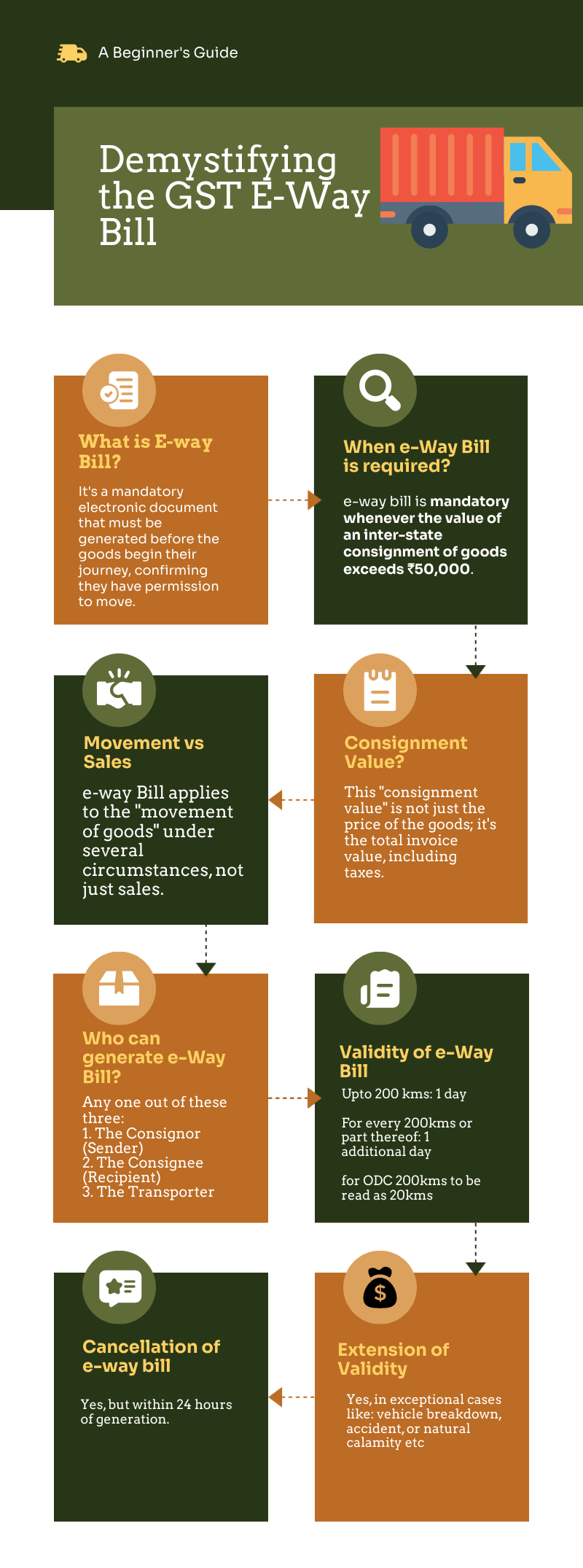
Imagine you're sending a valuable package across the country. The e-way bill is like its official travel ticket or hall pass. It's a mandatory electronic document that must be generated before the goods begin their journey, confirming they have permission to move.
In simple terms, the Goods and Services Tax (GST) e-way bill is an electronic document required for the movement of goods from one place to another within India.
Its primary purpose is twofold:
-
Ensuring Compliance: It serves as proof that the goods being transported are in compliance with GST law.
-
Tracking and Transparency: It allows tax authorities to track the movement of goods, which is a powerful tool to curb tax evasion and ensure that all legitimate taxes are paid.
Understanding the e-way bill system is a fundamental step in navigating the world of GST compliance. Let's break down when you need one and how the system works.
2. The Golden Rule: When is an E-Way Bill Required?
The core principle is straightforward: an e-way bill is mandatory whenever the value of a consignment of goods exceeds ₹50,000.
This "consignment value" is not just the price of the goods; it's the total invoice value, including taxes. It is calculated by adding the following components:
| Component | Explanation |
| Value of Goods | The price paid or payable for the goods, as declared on the invoice. |
| Applicable GST (CGST, SGST, or IGST) | The total Central, State, or Integrated tax amount charged on the invoice. |
This rule applies to the "movement of goods" under several circumstances, not just sales:
-
In relation to a 'supply': This is the most common scenario, such as a sale of goods.
-
For reasons other than a supply: This includes sending goods for repairs, to an exhibition, or for replacement. In these cases, an e-way bill is generated based on a delivery challan.
-
For inward supply from an unregistered person: If a registered business buys goods worth over ₹50,000 from an unregistered person, an e-way bill is still required.
However, there are specific situations where an e-way bill is not required, even if the value exceeds ₹50,000. Key examples include:
-
The transport of Liquefied Petroleum Gas (LPG) for household supply.
-
Postal baggage is being transported by the Department of Posts.
-
Jewellery and precious metals.
Now that we know when a bill is needed, let's look at who is responsible for creating it.
3. The "Who" and "What": Generating Your E-Way Bill
Generating the e-way bill is a shared responsibility. The primary parties involved are:
-
The Consignor (Sender): As the person causing the movement of goods, the sender (usually the supplier) is typically responsible for generating the e-way bill.
-
The Consignee (Recipient): If the consignor has not, the person receiving the goods can also generate the e-way bill.
-
The Transporter: If neither the consignor nor the consignee generates the e-way bill, the transporter is responsible for generating it before moving the goods.
To generate the bill, you'll need specific information ready. The key details fall into three categories:
| Information Category | Examples |
| Supplier & Recipient Details | The GSTIN of both the supplier and the recipient. |
| Goods Details | HSN (Harmonised System of Nomenclature) code, description, and value of the goods. |
| Transportation Details | Transporter ID, transport document number (like an LR/RR number), and vehicle number. |
The official online portal is the most common way to generate an e-way bill. For businesses with many shipments, a bulk generation facility is available, and for convenience on the go, it can also be done via SMS.
Once generated, an e-way bill has a limited lifespan.
4. The Lifespan of an E-Way Bill: Validity and Cancellation
The validity period of an e-way bill is directly linked to the distance the goods are scheduled to travel. Longer distances are granted a longer validity period, as detailed below.
| Distance | Validity Period |
| Up to 200 km | 1 Day |
| For every 200 km or part thereof thereafter | 1 Additional Day |
| Up to 20 km (for Over Dimensional Cargo) | 1 Day |
| For every 20 km or part thereof thereafter (for ODC) | 1 Additional Day |
A crucial point to understand is how a 'day' is calculated for validity purposes. It is not a 24-hour period from the time of generation. Instead, the first day ends at midnight of the day immediately following the date of generation.
For example, if an e-way bill is generated at 11:58 PM on March 14th, its first day of validity ends at 11:59 PM on March 15th.
Can validity be extended? Yes. In exceptional circumstances, such as a vehicle breakdown, accident, or natural calamity, the transporter can extend the validity period by updating the reason for the extension on the portal.
Can an e-way bill be cancelled? Yes. If the goods are not transported or are not transported as per the details furnished, the e-way bill can be cancelled electronically within 24 hours of its generation.
These rules cover the basics, but what about more complex, real-world business situations?
5. Navigating Common Practical Scenarios
Here’s how the e-way bill system adapts to some frequent business transactions:
-
"Bill To, Ship To" Transactions This occurs when the invoice is sent to one party (the "Bill To" party), but the goods are delivered to another (the "Ship To" party). In this common drop-shipping scenario, precision is key. The GSTIN and name of the billing party are used in the "Bill From" fields, while the full shipping address of the 'Ship To' party is entered in the "Ship To" fields.
-
Goods Sent for Job Work When a business sends materials (inputs) or machinery (capital goods) to a job worker for processing, an e-way bill is required based on a delivery challan. The principal must ensure the goods are returned within a specific timeframe: 1 year for inputs and 3 years for capital goods.
-
Goods Rejected by the Buyer If a recipient rejects a shipment, the goods must be sent back with a new e-way bill. The recipient can generate this bill. If they refuse to cooperate, the original supplier can generate the e-way bill to bring the goods back, listing themselves as the "consignee" for the return journey. The supplier must also issue a credit note to adjust their tax liability. This credit note is also crucial for the supplier to accurately report the sales return in their GSTR-1, ensuring their tax records are complete and correct.
-
Transhipment (Changing Vehicles) If goods are moved from one vehicle to another during transit, a new e-way bill is not required. The transporter must simply update the new vehicle details in Part B of the existing e-way bill on the portal.
Following these procedures is crucial, as failure to comply can lead to serious consequences.
6. When Things Go Wrong: Common Mistakes and Consequences
Non-compliance with e-way bill rules is taken very seriously by tax authorities. It can lead to the detention of goods and the vehicle (under Section 129 of the GST Act) or even confiscation (under Section 130). Releasing the goods often requires paying significant amounts of tax and penalties.
However, the legal system also recognises that genuine human errors happen. Courts have consistently made a distinction between major violations intended to evade tax and minor, bona fide clerical mistakes.
While you must be diligent, courts have often treated the following types of clerical errors leniently, especially when the underlying documents (like the tax invoice) were correct and there was no evidence of fraudulent intent:
-
Typographical errors in the vehicle number (e.g., DL1 AA 3552 instead of DL1 AA 5332).
-
An expired e-way bill during transit due to a genuine, unforeseen delay like a vehicle breakdown.
-
Incorrectly mentioning CGST/SGST instead of IGST on the delivery challan when the main tax invoice was correct.
-
Minor mistakes in the invoice number mentioned on the e-way bill.
The key takeaway is to ensure that all your core documents, especially the tax invoice, are accurate and accompany the goods. While you should aim for perfect e-way bill generation, an honest mistake without the intent to evade tax is viewed very differently from a deliberate contravention of the law.
7. Key Takeaways: Your E-Way Bill Checklist
To help you stay compliant, here is a simple checklist summarising the most critical points:
-
Check if consignment value exceeds ₹50,000 (Goods Value + GST).
-
Ensure all details (GSTINs, HSN, vehicle no.) are correct before generating.
-
Generate the e-way bill before the movement of goods begins.
-
If the vehicle changes, update Part B immediately.
-
If generated in error, cancel it within 24 hours.
-
Always carry the e-way bill (or its QR code) and the tax invoice with the goods.
Modify e-Way Bill after 72 hours | e-Way Bill for Job Work | Multiple Vehicles for Single Invoice (e-Way Bill) | Update Mobile/OTP Number on e-Way Bill Portal | Intra-state Job Work e-Way Bill
About the Author

- ★★
- ★★
- ★★
- ★★
- ★★

Check out other Similar Posts

CFO Weekly Digest
A weekly newsletter delivering sharp insights, strategic analysis, and critical updates on business, finance, and compliance — designed exclusively for CFOs and Finance Leaders
Masters India is a GST Suvidha Provider (GSP) appointed by Goods and Services Tax Network (GSTN), a Government of India enterprise.
 Procapitus Business Park, 4th Floor, D 247/4A, Sector 63 Rd, Noida, Uttar Pradesh 201301
 info@mastersindia.co




Certified