
GST Section 128A: Delay in SPL-02 Waiver Application

As corporate financial leaders, we frequently find ourselves walking a tightrope. We balance complex operational realities against the rigid, unforgiving timelines of tax authorities. In the Indian indirect tax landscape, procedural delays have historically been fatal to tax reliefs and amnesty benefits.
However, a landmark ruling by the Hon’ble Karnataka High Court in the case of Akshaya Borewells v. Assistant Commissioner of Central Tax and Central Excise [Writ Petition No. 102788 of 2026 (T-RES) | 17-Apr-2026 | (2026) 42 Centax 349 (Kar.)] has brought a wave of relief. The Court re-established a core legal tenet: procedural technicalities cannot be allowed to throttle substantive justice.
For CFOs, tax directors, and finance heads, this judgement offers critical insights into statutory interpretation, strategic dispute management, and the remedies available under the GST appeals and revision framework.
The anatomy of the dispute: A communication gap
The case highlights a classic corporate governance challenge, missing a statutory window due to administrative gaps and unseen communications.
The audit and the demand
- The background: The petitioner, a registered works contractor, underwent a departmental audit for the period from July 2017 to March 2020.
- The issue: The department observed that common Input Tax Credit (ITC) was utilised for both taxable and exempted supplies, triggering a reversal requirement under Section 17(2) of the CGST/GGST Act, a common area of scrutiny during a GST audit under Section 65.
- The action: Accepting the findings, the company had already paid the reversed ITC amounting to ₹41,01,146/- via Form GST DRC-03, although GST payment is not acceptance of liability where the underlying dispute continues to be contested.
The breakdown in communication
Following the payment, the department issued a Show Cause Notice (SCN) and subsequently passed an Order-in-Original (OIO), confirming an interest liability of ₹3,64,761/- under Section 50(1), despite the taxpayer later raising issues commonly seen in cases involving tax paid under protest in GST.
Crucially, the OIO was neither served physically to the taxpayer nor uploaded onto the GST portal. The company only learned about the outstanding liability much later through an email notification, underscoring the importance of monitoring GST notices and departmental communications.
The amnesty hurdle and the department’s rigid stance
By the time the company realised the interest demand existed, the GST Council had introduced a waiver scheme under Section 128A (via Notification Nos. 20/2024 & 21/2024-Central Tax). This scheme provided a waiver of interest and penalties for legacy disputes spanning FY 2017-18 to 2019-20, provided full tax dues were cleared by March 31, 2025.
The timeline disconnect
The notification stated that a taxpayer may file the waiver application within three months from the notified date (which effectively established the deadline as June 30, 2025).
- The company cleared its tax dues within the mandated timeframe.
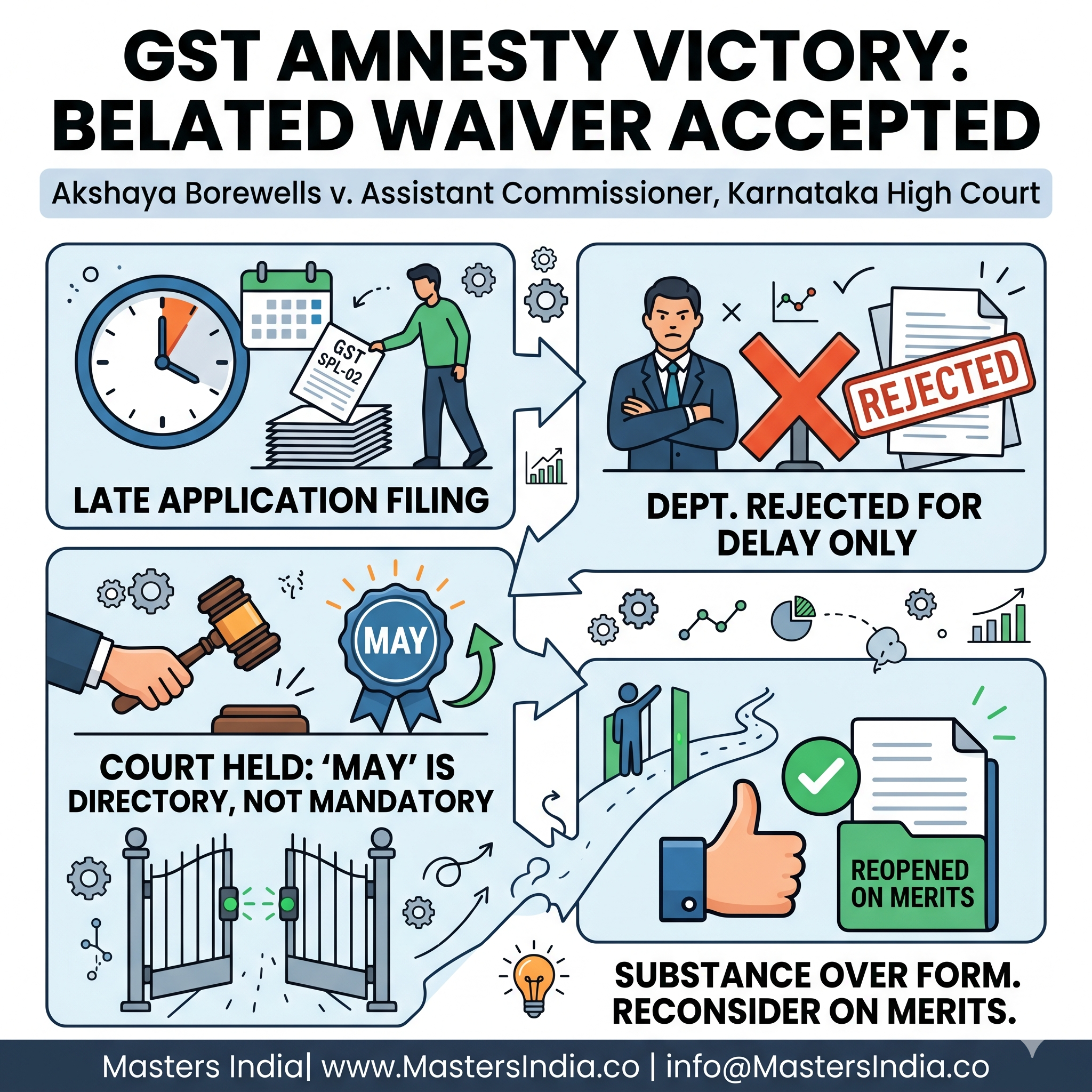
- Due to the delay in discovering the OIO, the waiver application in Form GST SPL-02 was filed on July 18, 2025, roughly 18 days late.
- The tax authorities summarily rejected the application via Form GST SPL-07, citing the delay as the sole ground for rejection.
The judicial turning point: 'May' vs. 'shall'
The matter moved to the Karnataka High Court, where the primary question was whether a minor procedural delay could invalidate a taxpayer's right to an extraordinary statutory waiver scheme.
Directory, not mandatory
The High Court set aside the rejection order, holding that the department had committed a fundamental legal error by interpreting a flexible guideline as an absolute statute of limitation.
- Statutory phrasing: The Court emphasised that the notification used the word 'may' regarding the three-month application filing window.
- The legal distinction: In statutory interpretation, 'shall' denotes an absolute mandate, while 'may' is generally enabling and directory.
- The ruling: The Court held that treating this window as a rigid, mandatory limitation was legally untenable. The department was directed to evaluate the waiver application purely on its technical merits, completely disregarding the belated filing date.
Corporate finance takeaways: Reading between the lines
For finance departments navigating the closure of legacy GST disputes, this judgement sets a powerful precedent:
- Substance over form: If the core substantive requirement of an amnesty scheme (such as paying the principal tax demand) is met, minor timeline lapses in filing forms should not bar the benefit.
- A weapon against portal glitches: The judgement acknowledges that lapses in serving orders or portal upload failures are legitimate grounds for courts to condone minor compliance delays.
Lessons in wisdom: A note for senior financial leaders
In my decades of navigating corporate finance, tax litigations, and boardrooms, I have realised that tax management is rarely just about numbers; it is fundamentally about governance, vigilance, and the art of statutory interpretation.
When you look at this judgement, do not view it merely as an 18-day condonation of delay. View it as a lesson in structural risk mitigation.
Here are a few practical rules of thumb I highly recommend implementing within your financial frameworks:
- Never equate "not on portal" with "does not exist": Do not rely solely on the GST portal’s dashboard visibility. Over the years, I have seen multi-million rupee demands slip through due to IT glitches or notices being buried in secondary tabs. Establish a rigorous protocol where your tax teams actively check registered emails and sub-portals weekly.
- Master the vocabulary of the law: As a CFO or finance director, you must train your teams to look closely at statutory words. The difference between 'may' and 'shall' can save your company crores in unnecessary litigation. When a department rigidly rejects a claim based on a 'may' clause, challenge it immediately.
- Pay the principal, fight the procedure: If there is a legitimate tax liability, clear the principal amount first. Settling the core tax debt shifts the equitable balance in your favour before any judicial forum. Courts are far more sympathetic to honest taxpayers who have cleared their dues but stumbled on a procedural deadline, compared to those who hold back the state's revenue.
- Litigation is an asset management exercise: do not let your tax teams drag out disputes out of pure ego. When amnesty windows like Section 128A open up, treat them as strategic opportunities to clean up the balance sheet. A closed tax file is a liability off your books and precious hours returned to your core business operations.
What does the Akshaya Borewells ruling mean for Section 128A relief?
The ruling reinforces that GST amnesty schemes are intended to reduce legacy litigation, not create fresh disputes over minor procedural lapses. Where a taxpayer has met the substantive condition by clearing the required tax dues, a short delay in filing the waiver application should not automatically defeat the relief when the prescribed timeline is directory rather than mandatory.
For CFOs and tax teams, the wider lesson is equally important: monitor portal notices, registered emails and departmental communications closely, understand the wording of statutory deadlines, and treat amnesty windows as opportunities to close old exposures. Strong internal GST controls can reduce the need for litigation altogether. Masters India can support businesses with GST compliance workflows, reconciliations and notice-management processes.
About the Author

- ★★
- ★★
- ★★
- ★★
- ★★

Check out other Similar Posts

CFO Weekly Digest
A weekly newsletter delivering sharp insights, strategic analysis, and critical updates on business, finance, and compliance — designed exclusively for CFOs and Finance Leaders
Masters India is a GST Suvidha Provider (GSP) appointed by Goods and Services Tax Network (GSTN), a Government of India enterprise.
 Procapitus Business Park, 4th Floor, D 247/4A, Sector 63 Rd, Noida, Uttar Pradesh 201301
 info@mastersindia.co




Certified