
GST Intermediary Services: Section 13(8)(b) and Export of Services

Imagine you are an Indian entrepreneur running a marketing firm. You’ve secured a major client in Germany, perform all the work for them, and are paid in valuable, convertible foreign exchange. In any other industry, this is a clear-cut export. However, the Indian tax authorities may disagree, viewing your international success as nothing more than a local sale.
This scenario is the high-stakes reality for many businesses caught in the legal crossfire of the Dharmendra M. Jani vs. The Union of India (2023) 72 GSTL 448 (Bom.) case. At its heart is a fight over the "Place of Supply." For Indian service exporters that act as a bridge between foreign brands and local markets, the outcome of this case will determine whether their export of services under GST remains viable under the current legal framework.
The fiction of the "location" (Section 13(8)(b))
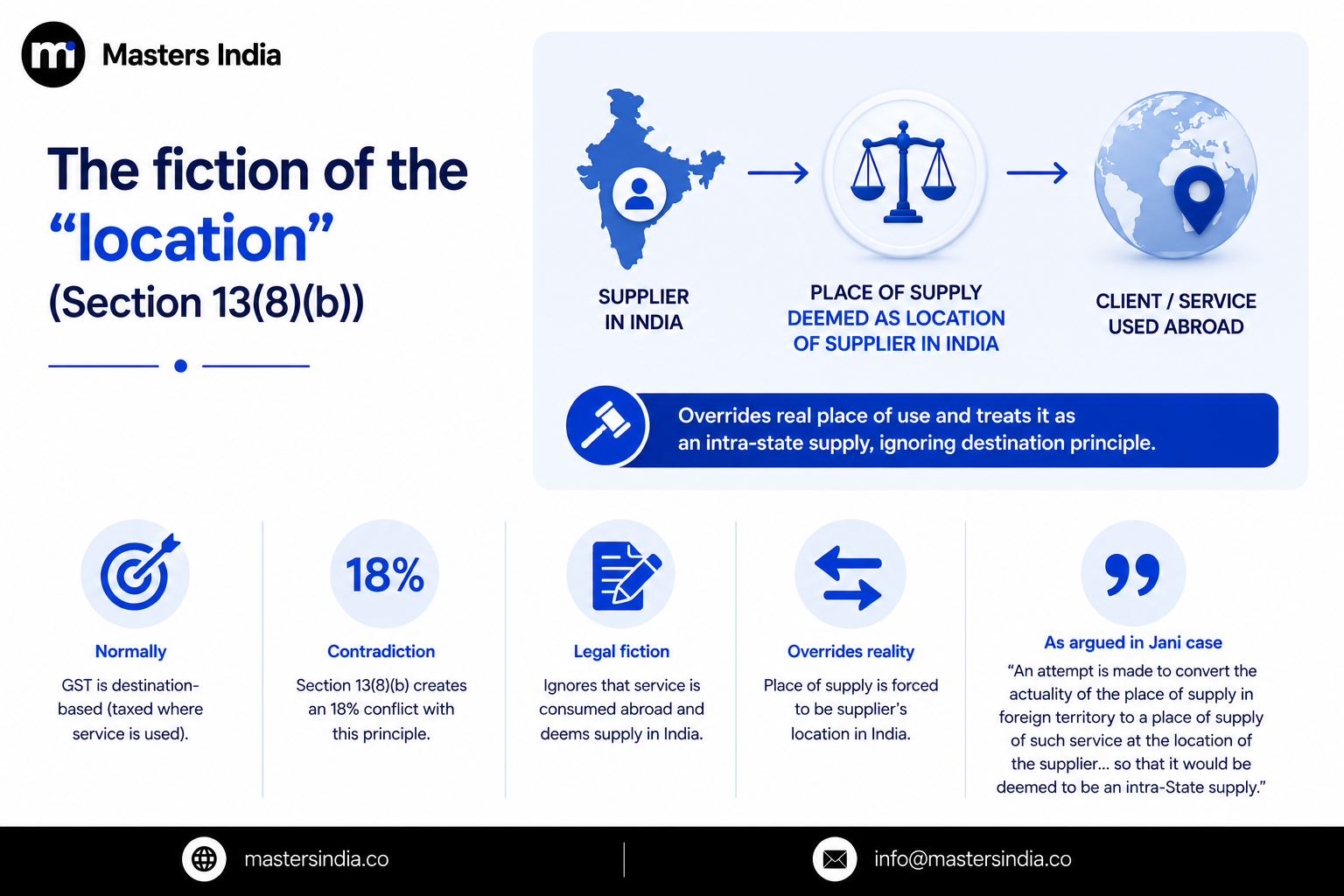
The legal conflict stems from Section 13(8)(b) of the IGST Act, which employs a "deeming fiction" to override reality. Usually, GST is a destination-based consumption tax, meaning it should be taxed according to the place of supply under GST. But for intermediaries, this section forces the place of supply to be the location of the supplier in India, regardless of where the client is.
For a system sold as a "destination-based" tax, Section 13(8)(b) is a glaring, 18% contradiction. It legally ignores the fact that the service is consumed abroad and treats it as an intra-state supply. As the petitioners in the Jani case argued, this provision overreaches by fundamentally rewriting the nature of the transaction:
"An attempt is made to convert the actuality of the place of supply in foreign territory to a place of supply of such service at the location of the supplier... so that it would be deemed to be an intra-State supply."
The "intermediary" label: a high-stakes classification
Your tax liability often hinges entirely on how your service contract is worded. The Revenue department closely scrutinises whether your commission is "dependent on orders placed by Indian customers" to decide if you are a "simplicitor agent" or an "intermediary." This is a distinction that costs millions.
To understand the risk, consider the Revenue's perspective:
- Intermediaries: These are entities that "facilitate or arrange" a supply between two parties rather than providing the core service themselves.
- Peculiar nature: The Revenue argues that because these services often involve matching foreign sellers with Indian buyers, they deserve a unique tax treatment that keeps them within the Indian tax net.
Think of it this way: Are you merely providing marketing research for a German principal (a simplicitor agent), as many businesses providing services to international clients from India do, or are you the one actually matching that German seller with an Indian buyer? If it’s the latter, you are likely an "intermediary" in the eyes of the taxman, turning your expected tax-free export into an immediate 18% hit (9% CGST + 9% SGST).
The ghost of triple taxation
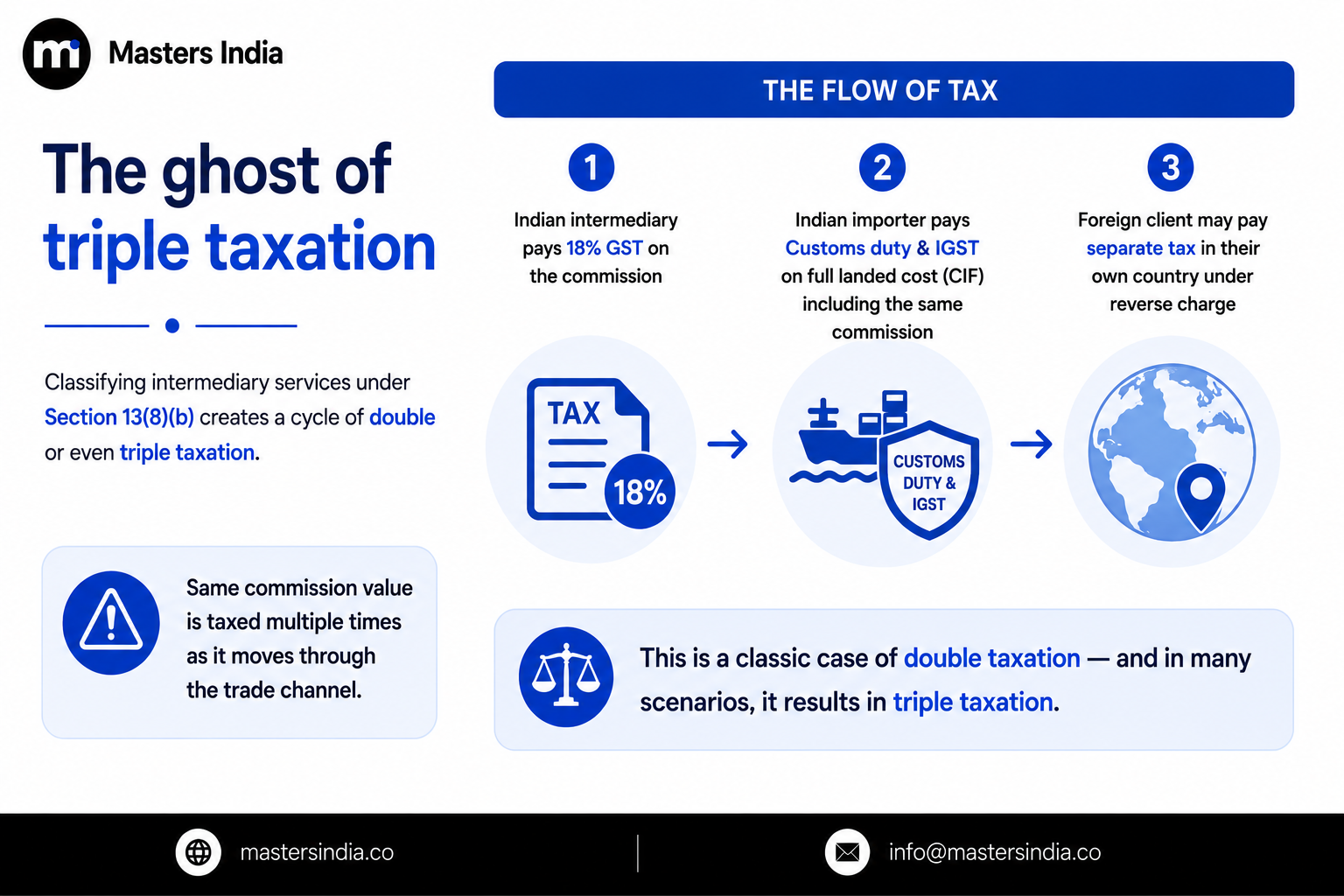 The petitioners argue that this classification creates a destructive cycle of double or even triple taxation. Because the intermediary’s commission is often built into the price of the imported goods, the same amount of money is taxed repeatedly as it moves through the trade channel.
This flow of tax typically follows a punishing path:
- The Indian intermediary pays 18% GST on the commission earned.
- The Indian importer pays Customs duty and IGST on the full landed cost (CIF) of the goods, which already includes that same commission.
- The foreign client may pay a separate tax in their own country under a reverse charge mechanism.
This isn't just a theoretical problem; it's a structural flaw. The petitioners rightly pointed out that this is a "classic case of double taxation" where the same value is taxed as both a service and a component of imported goods.
“Make in India” as a tax strategy?
In a surprising defense, the Revenue argued that taxing intermediaries supports the "Make in India" program. Their logic is protectionist: by taxing the agents who facilitate imports, the government makes those imports more expensive. In theory, this should incentivize foreign companies to manufacture locally in India to avoid the extra tax burden.
However, this reveals a massive policy paradox. The government is essentially taxing the very service exporters who bring foreign exchange into the country as a way to punish foreign manufacturers. It is worth asking if this "service-sector sacrifice" is a sustainable or fair way to grow domestic manufacturing, especially when it penalizes India’s most competitive global service providers.
A house divided: the judicial cleavage
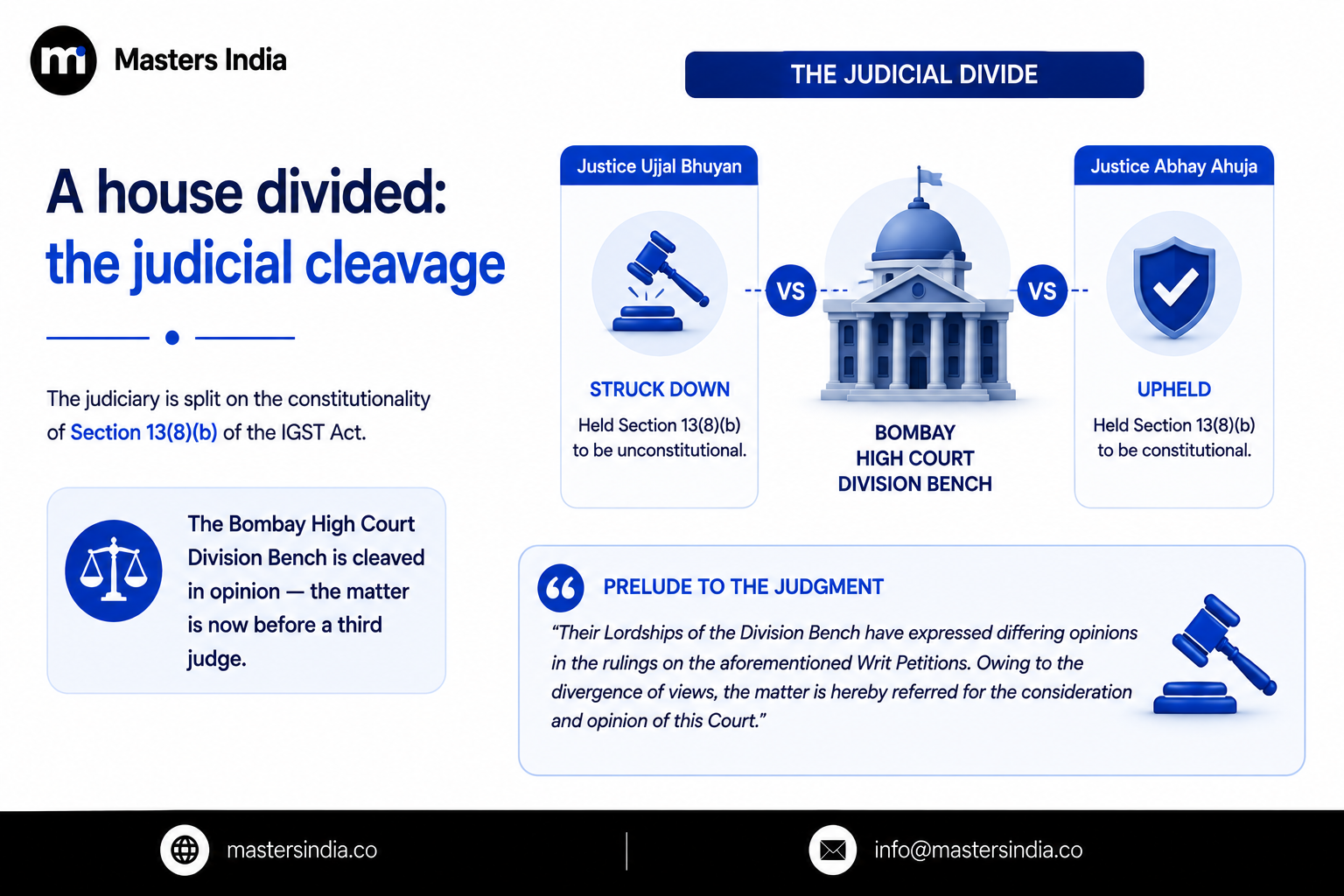 The judicial system itself is at a standstill over this issue. When the challenge reached the Division Bench of the Bombay High Court, there was a profound "cleavage of opinion" between the two presiding judges. Justice Ujjal Bhuyan struck the provision down as unconstitutional, while Justice Abhay Ahuja upheld it entirely.
Because the bench "spoke in different voices," the matter remains unresolved and has been referred to a third judge. This disagreement is captured in the Prelude to the judgment:
"Their Lordships of the Division Bench have expressed differing opinions in the rulings on the aforementioned Writ Petitions. Owing to the divergence of views, the matter is hereby referred for the consideration and opinion of this Court.”
What does Section 13(8)(b) mean for service exporters?
The battle over Section 13(8)(b) highlights a fundamental tension between Parliament's power to set tax rules and the constitutional protections of Article 286, which limit taxation of exports. For global marketing and promotion firms, understanding the place of supply rules for imports and exports is important while this uncertainty remains a major hurdle to doing business.
If the law can ignore where the money comes from and where the client is located, an important question remains: does the concept of "export of services" still work for the Indian intermediary? Until the courts provide a final answer, many Indian businesses remain caught in a legal framework that can treat their global success as a local GST liability.
For businesses navigating GST classification and export compliance, stronger processes and the right tax technology can help manage this uncertainty. Masters India provides GST compliance and tax technology solutions to help businesses manage complex GST requirements with greater confidence.
About the Author

- ★★
- ★★
- ★★
- ★★
- ★★
Check out other Similar Posts

CFO Weekly Digest
A weekly newsletter delivering sharp insights, strategic analysis, and critical updates on business, finance, and compliance — designed exclusively for CFOs and Finance Leaders
Masters India is a GST Suvidha Provider (GSP) appointed by Goods and Services Tax Network (GSTN), a Government of India enterprise.
 Procapitus Business Park, 4th Floor, D 247/4A, Sector 63 Rd, Noida, Uttar Pradesh 201301
 info@mastersindia.co




Certified