Masters India
Masters India
Products
Tools
Resources
Company

Chapter 1: Principles of Tax Refund (Section 54)

Principles of Tax Refund (Section 54)

Overview of Tax Refunds

Overview of Tax Refunds

A tax refund represents the government’s return of excess tax payments made by an individual or business. This mechanism ensures that taxpayers are not burdened with more tax than legally mandated, thereby upholding a fair and accurate tax system. In the context of Goods and Services Tax (GST), Section 54 of the CGST Act, 2017, primarily governs the framework for tax refunds.

Scope of GST Refunds under Section 54

Scope of GST Refunds under Section 54

Section 54 of the CGST Act delineates various scenarios under which a registered person can claim a refund of tax paid. The scope is comprehensive, encompassing several critical situations:

Refund of tax paid on zero-rated supplies: This includes tax on outward supplies of goods or services exported from India or supplied to a Special Economic Zone (SEZ) developer or unit.

Refund of tax paid on input or input services: Applicable when these are utilized in making zero-rated supplies.

Refund of tax on deemed exports: Specific supplies notified by the Government that are treated as exports for benefit purposes, including refunds.

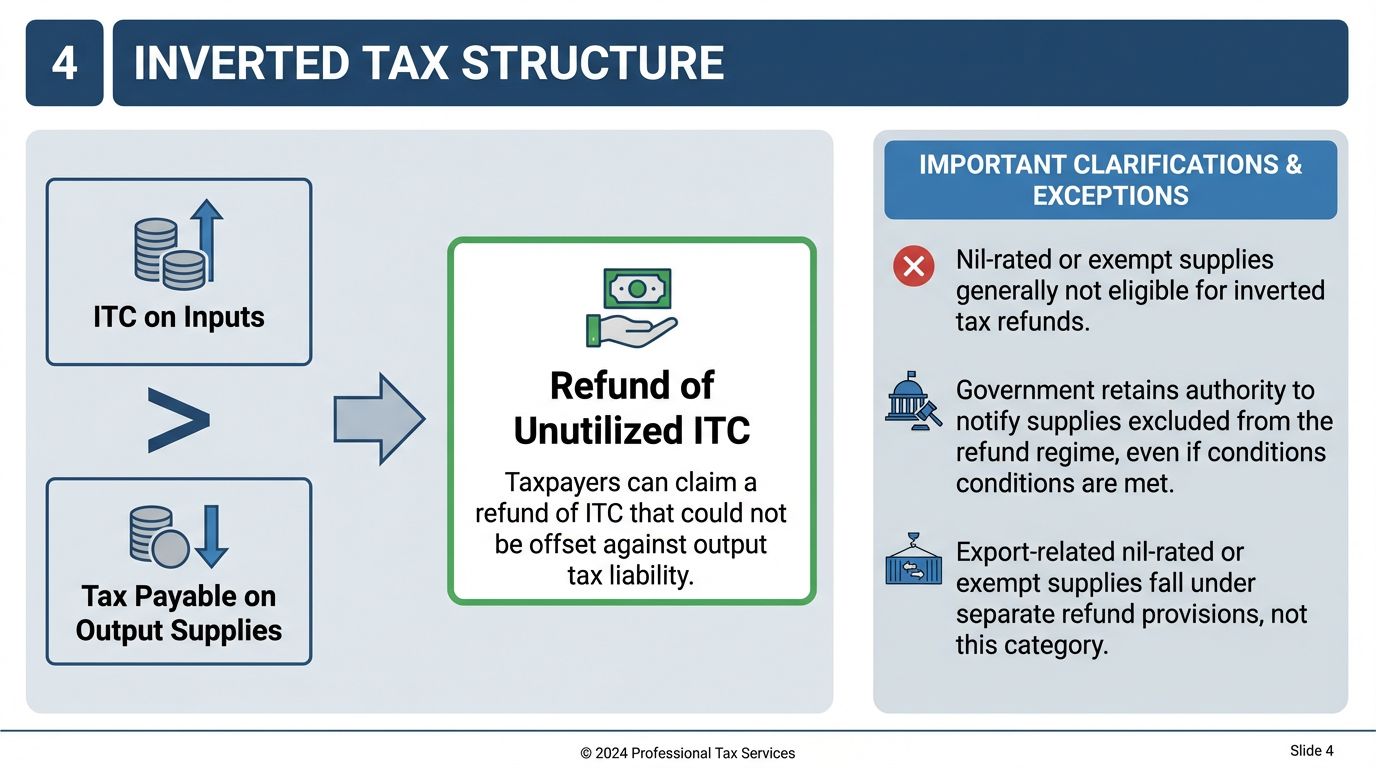
Refund of unutilized Input Tax Credit (ITC): Allows businesses to reclaim accumulated ITC that cannot be offset against their output tax liability.

All these refund types, including any export incentives provided via refund, are managed under Section 54.

Refund of Tax on Zero-Rated Supplies

Refund of Tax on Zero-Rated Supplies

Zero-rated supplies are those eligible for a zero tax rate. These primarily include:

Export of goods or services from India.

Supply of goods or services to an SEZ developer or unit.

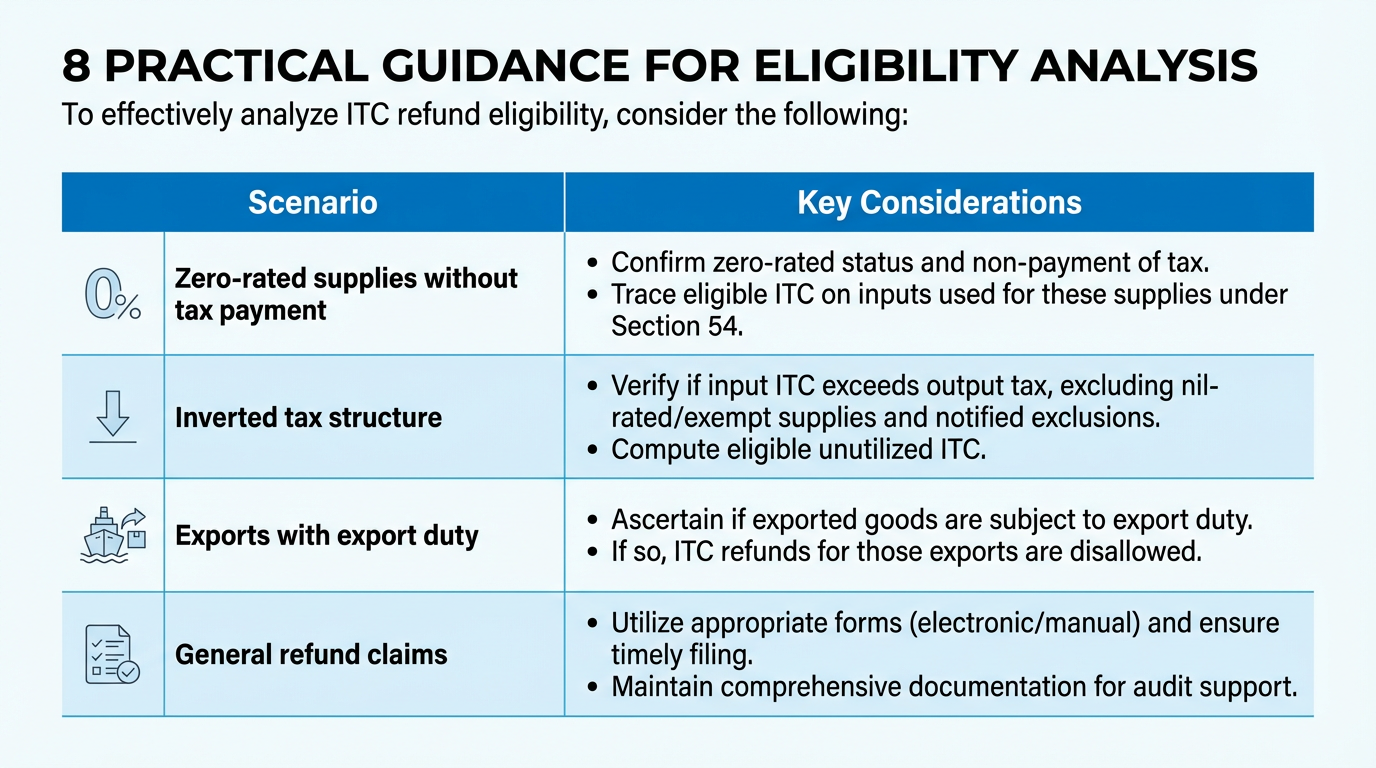
Registered persons engaged in zero-rated supplies can claim a refund of the tax paid on such supplies. Alternatively, they may opt to supply goods or services under a Letter of Undertaking (LUT) or bond without payment of integrated tax, in which case they can claim a refund of the unutilized ITC attributable to these zero-rated supplies.

Refund of Unutilized Input Tax Credit (ITC)

Refund of Unutilized Input Tax Credit (ITC)

Subject to Section 54(10), a registered person may claim a refund of any unutilized ITC at the end of any tax period. This refund is permissible under specific conditions:

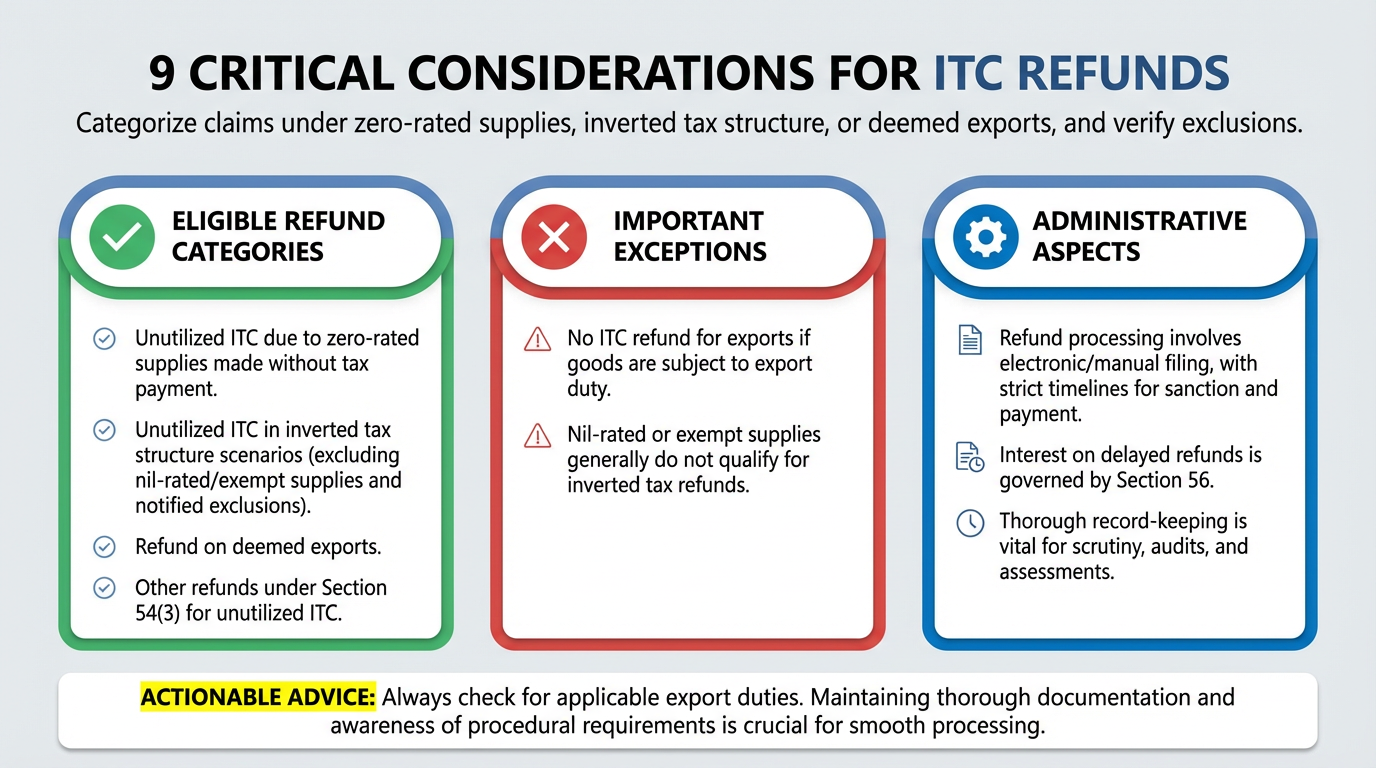
Zero-rated supplies made without payment of tax: When zero-rated supplies (exports or supplies to SEZs) are made by furnishing an LUT or bond, IGST is not paid on these outward supplies. If ITC has accumulated on inputs and input services used for these supplies and cannot be utilized against other output tax liabilities, a refund of this unutilized ITC can be claimed.

Inverted tax structure: This occurs when the tax rate on inputs or input services is higher than the rate on output supplies. If ITC accumulates due to this inverted duty structure (provided output supplies are not nil-rated or wholly exempted), a refund of the unutilized ITC can be claimed.

Exclusions: The Government may notify specific supplies excluded from this provision. Nil-rated or exempted supplies are generally not covered, as the concept of inverted tax implies a rate differential, not zero tax on outputs.

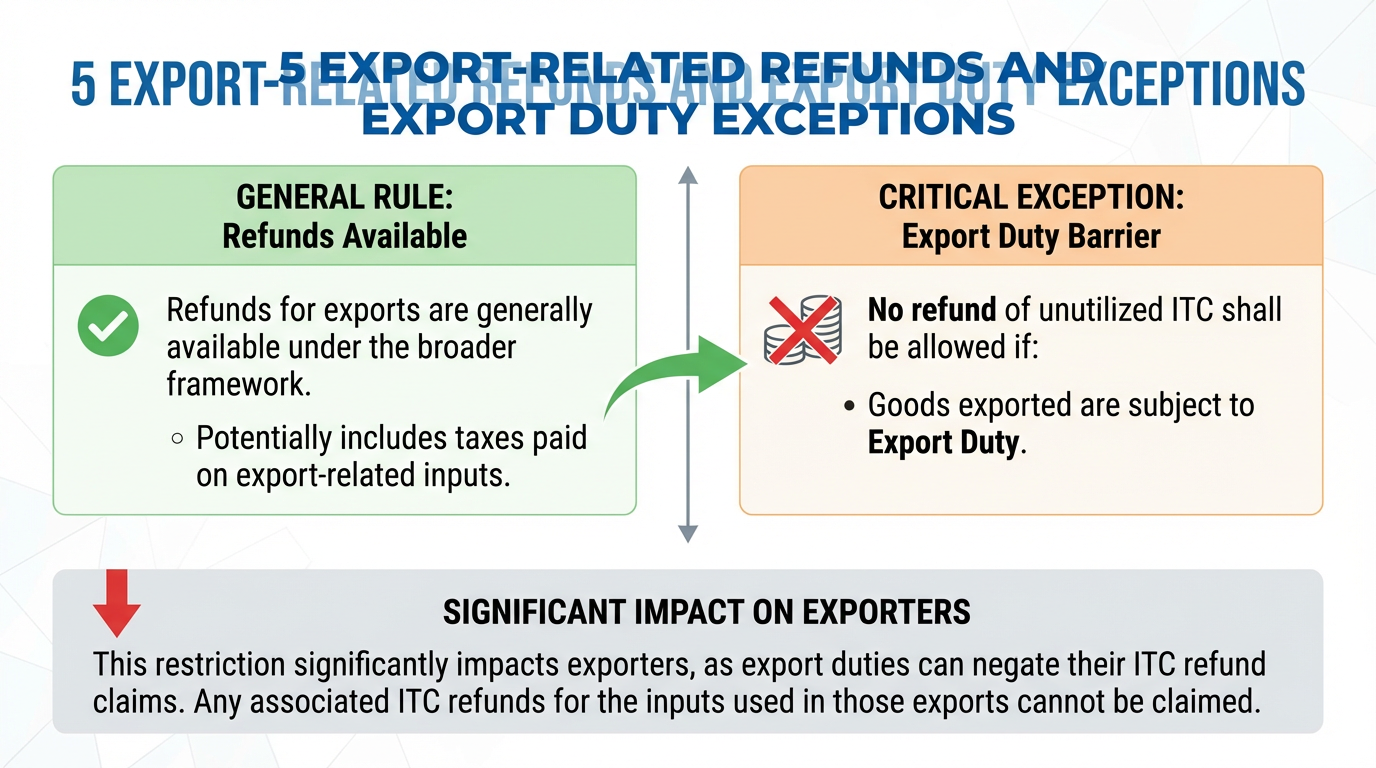
No refund on exports if export is liable to export duty: A critical condition is that no refund of unutilized ITC is allowed if the goods exported from India are subject to export duty.

Refunds on Deemed Exports

Refunds on Deemed Exports

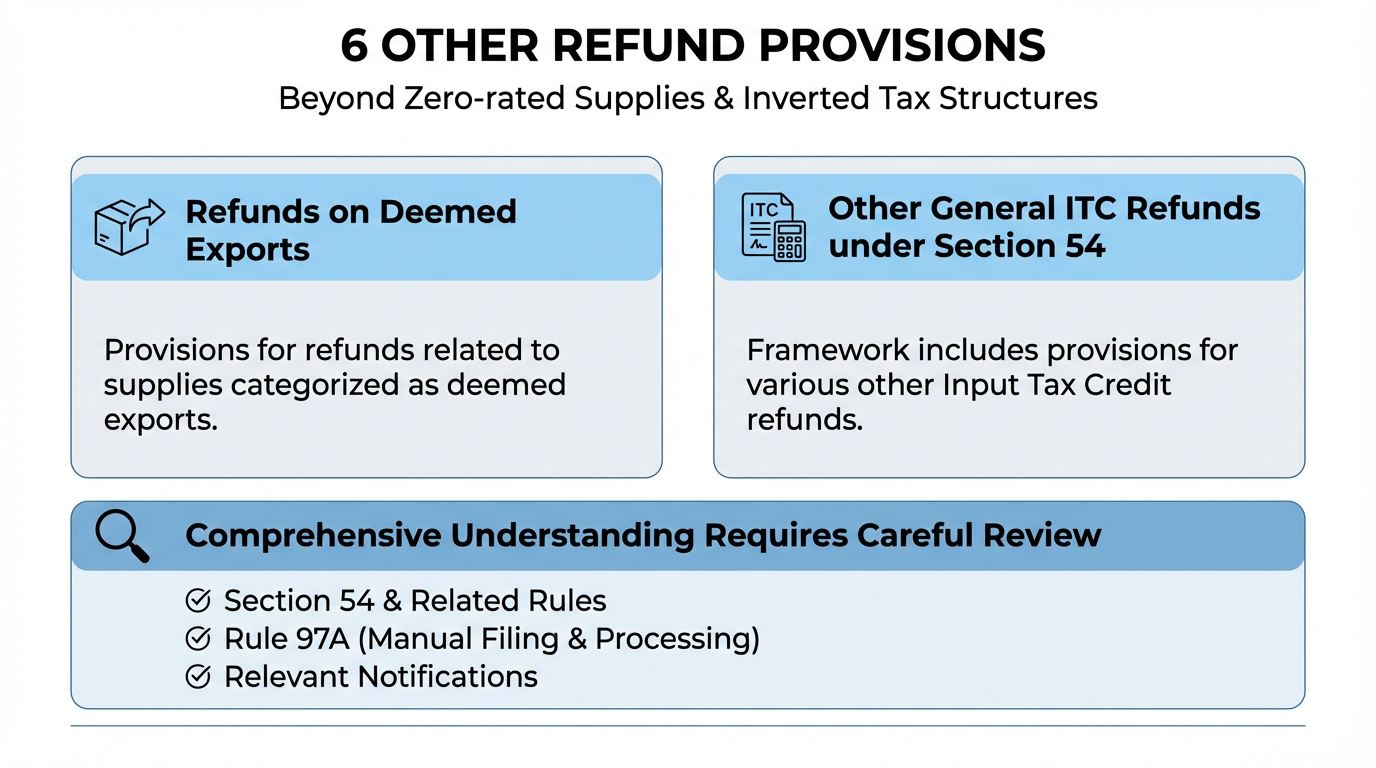
Deemed exports refer to specific supply categories treated as exports for claiming benefits, including tax refunds, as notified by the Government. For instance, supplies to an SEZ developer or unit are considered zero-rated supplies, which fall under the ambit of deemed exports. Other notified supplies may also qualify, allowing the supplier to claim a refund of tax paid.

Manual Filing of Refund Applications

Manual Filing of Refund Applications

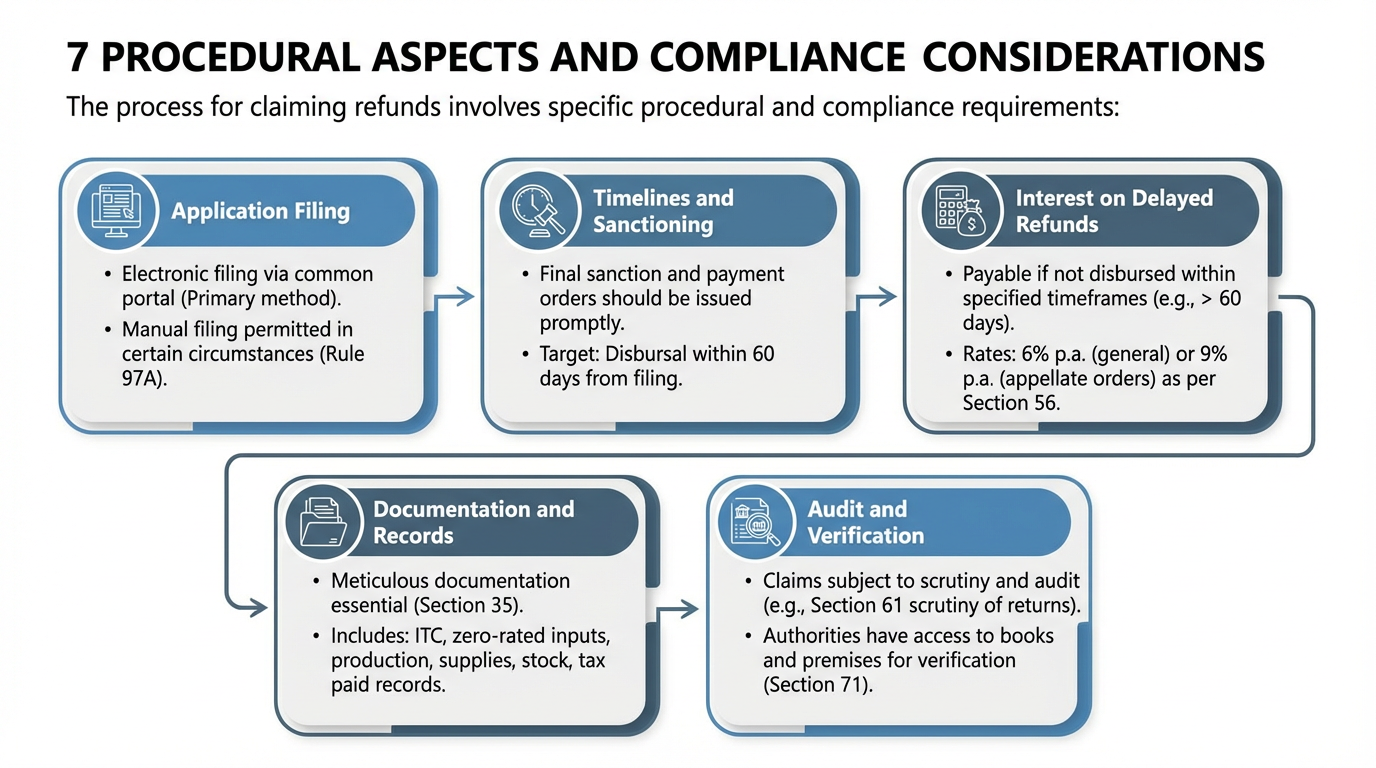
While most GST processes are electronic, Rule 97A of the CGST Rules, 2017, permits manual filing and processing for certain refund-related matters. This allows applications, intimations, replies, declarations, statements, or the issuance of notices, orders, or certificates for refunds to be submitted manually in prescribed forms, notwithstanding the general requirement for electronic filing on the common portal.

Manual Filing of Refund Applications (continued)

Interest on Delayed Refunds
Interest on Delayed Refunds

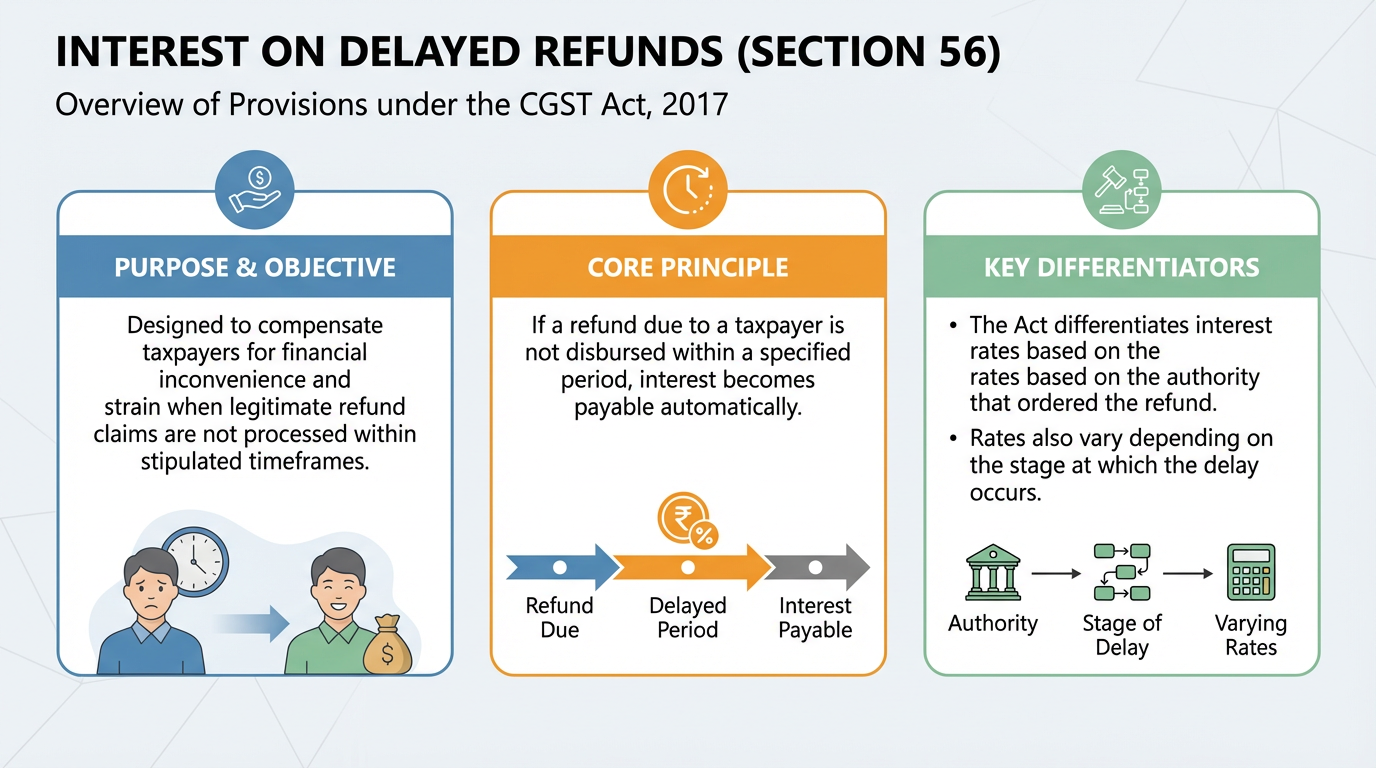
Section 56 of the CGST Act addresses the payment of interest on delayed refunds:

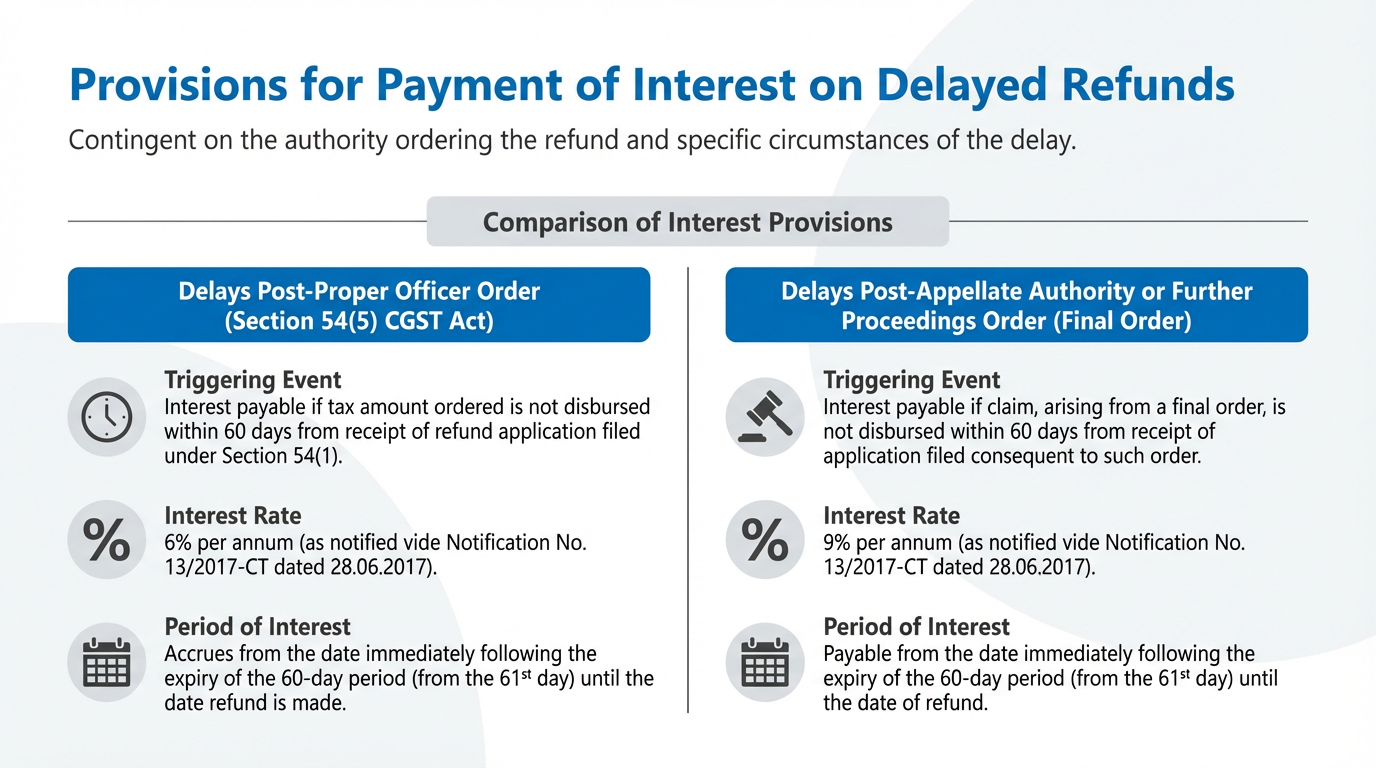
Refunds ordered by Proper Officer: If a tax refund ordered by the Proper Officer under Section 54(5) is not disbursed within 60 days from the application receipt date (under Section 54(1)), interest is payable to the applicant. The interest rate, notified by the Government (e.g.,  per annum), accrues from the day immediately following the -day period until the refund date.

Refunds from Appellate Orders: If a refund claim arises from a final order by an Adjudicating Authority, Appellate Authority, Appellate Tribunal, or Court, and the refund is not disbursed within  days of receiving the application consequent to such order, interest is payable. The interest rate for these cases is also notified (e.g.,  per annum).

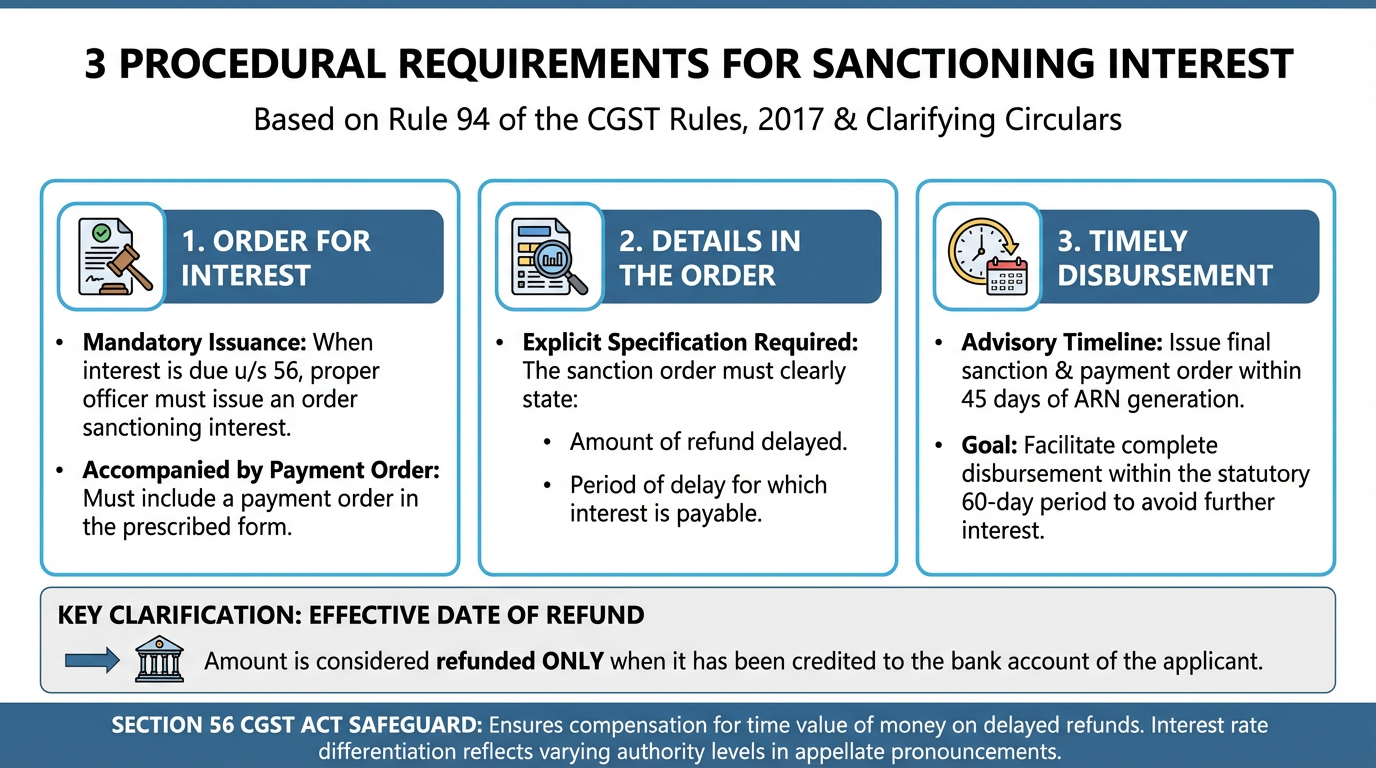
Sanctioning Interest: The Proper Officer must issue an order sanctioning the interest due under Section 56, detailing the delayed refund amount, delay period, and payable interest.

Timely Disbursement: To prevent interest accrual, tax authorities are advised to issue final sanction and payment orders within  days of the Application Reference Number (ARN) generation, ensuring disbursement within the -day limit.

Refund of IGST on Goods Bought by Foreign Tourists

Refund of IGST on Goods Bought by Foreign Tourists

Section 15 of the IGST Act, 2017, provides for the refund of Integrated Tax (IGST) paid by tourists leaving India on goods purchased within the country. This enables eligible non-resident tourists to reclaim tax paid on goods they take out of India. The refund is processed in a prescribed manner, subject to specific conditions and safeguards. A “tourist” is defined as a person not normally resident in India who enters for a stay not exceeding six months for legitimate non-immigrant purposes.

Rate this chapter

0.00 / 5. Vote count: 0

Leave a comment