
Supreme Court GST Judgments: Landmark Cases & Key Observations (Part 1)

A Comprehensive Review of Landmark Cases Pronouncements of the Supreme Court – Part:1
The Goods and Services Tax (GST) regime, although relatively new, has been significantly shaped by the interpretive wisdom of the Supreme Court.
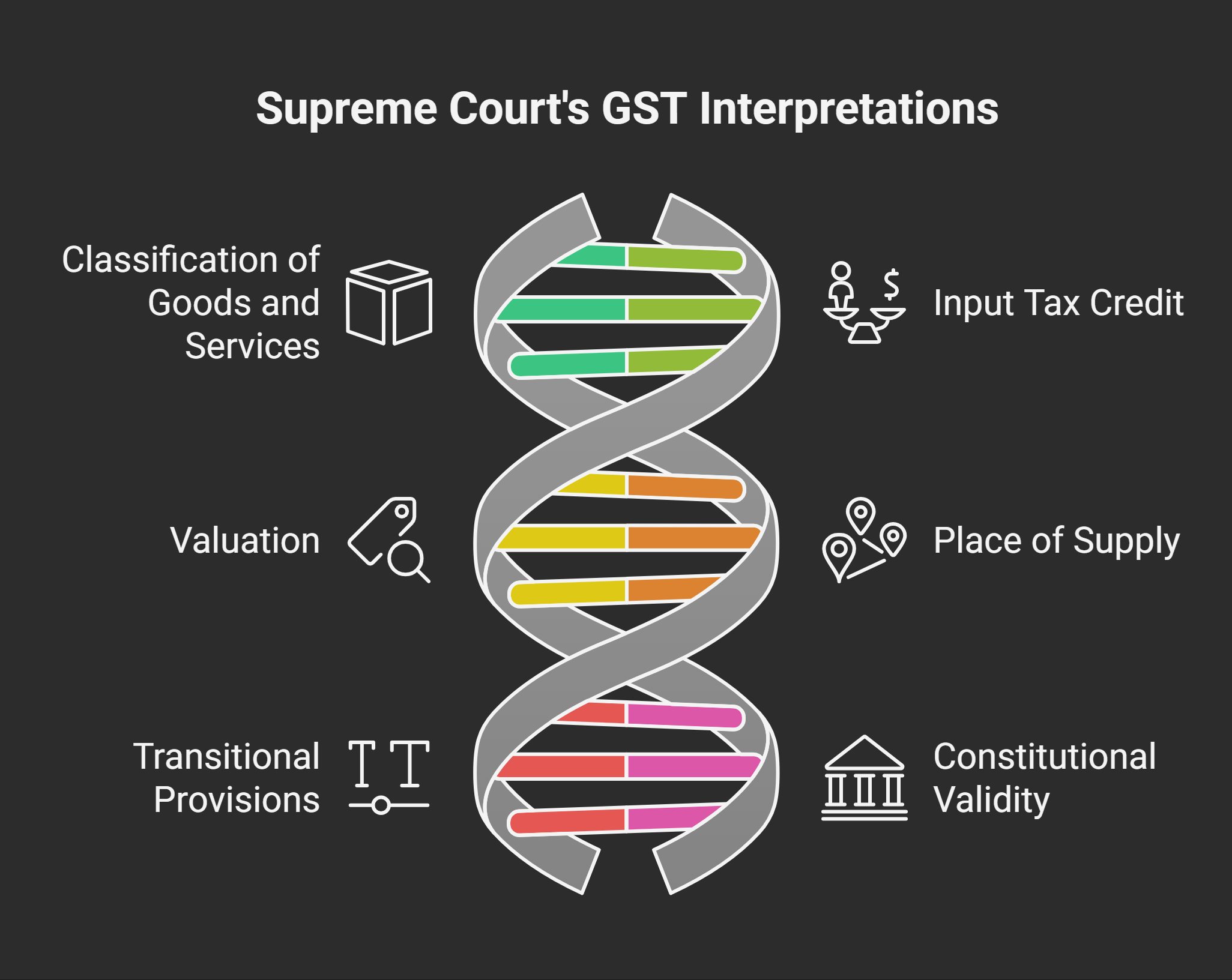
Over the past almost 8 years, the Apex Court has delivered many crucial judgments that illuminate various facets of this complex indirect tax system. It is imperative for us, as legal practitioners, to have a thorough understanding of these landmark decisions. Let's examine the key observations from the Supreme Court.
1. The Sanctity of 'Composite Supply':
First, let’s discuss the principle of 'composite supply'. In Mohit Minerals Pvt Ltd v. Union of India [2022 (61) GSTL 257 (SC)], the Supreme Court definitively held that a levy imposed on the 'service' aspect of a transaction, when it forms part of a 'composite supply', is a violation of Section 2(30) read with Section 8 of the CGST Act. The crux here is that if an Indian importer is already liable to pay IGST on a composite supply, which includes both goods and services like transportation and insurance in a CIF contract, then a separate levy on the 'supply of services' by the shipping line becomes impermissible under Section 8 of the CGST Act. This is a crucial clarification preventing double taxation on what is essentially one integrated transaction.
2. ITC on Self-Assessment Basis:
Next, consider Input Tax Credit (ITC). The case of Bharti Airtel Ltd. v. Union of India [2021 (54) GSTL 257 (SC)] is vital. The Supreme Court emphasised that the primary source for availing of Input Tax Credit (ITC) is the assessee's own records, including agreements, invoices, challans, receipts, and books of accounts. These are the foundational documents for self-assessment, including the determination of ITC eligibility. Crucially, the Court clarified that Form GSTR-2A serves merely as a facilitator for informed decision-making during self-assessment, not as the definitive basis for ITC. This reinforces the taxpayer's responsibility and reliance on their own robust documentation.
3. GSTR-3B: A Valid Return for All Purposes:
In the same Bharti Airtel Ltd. judgment, the Apex Court addressed the legal standing of GSTR-3B. Despite its initial characterisation as a stop-gap arrangement, the Court held that GSTR-3B is to be considered a return for all purposes, whether furnished manually or electronically. This ruling brings much-needed certainty regarding the validity and efficacy of GSTR-3B as a statutory return.
4. Rectification of Errors: Permissible, but in Specified Manner:
Continuing with Bharti Airtel Ltd., the Court also elucidated the process pertaining to the rectification of errors. A registered entity is not precluded from the opportunity to rectify omissions or inaccuracies in particulars. Nonetheless, this rectification is permitted solely during the preliminary phases of Forms GSTR1 and GSTR3, and must adhere to the prescribed procedures. This underscores the significance of prompt and compliant error correction within the GST framework.
5. Applying 'Substance Over Form':
A fundamental principle consistently applied by the Supreme Court, even in tax matters, is 'substance over form'. In Northern Operating System [2022-TIOL-48-SC-ST-LB], a service tax judgment but highly relevant to GST, the Court emphasised that the nomenclature of any contract or document is not decisive of its nature. Instead, courts must consider the document as a whole and its overall effect. This means we must look beyond the labels to understand the true nature of the transaction for tax purposes.
6. Revenue Neutrality is Irrelevant:
Also from Northern Operating System, the Supreme Court clarified a significant point: the concept of revenue neutrality is irrelevant when determining tax liability. Whether a particular rate of tax is payable, or if the assessee can claim a refund, does not impact the initial determination of whether a liability arises. This principle ensures that tax obligations are assessed based on the statute, not on the ultimate financial outcome for the exchequer.
7. Non-Extension of E-way Bill Does Not Imply Evasion:
In Satyam Shivam Papers Pvt Ltd. [2022 (57) GSTL 97 (SC)], the Court addressed a common issue. It held that merely on account of the non-extension of the validity of an e-way bill, no presumption can be drawn that there was an intention to evade tax. This is an important protective measure against arbitrary assumptions of tax evasion based solely on procedural lapses.
8. Valuation Governed by Section 15:
Regarding valuation, Skill Lotto Solutions Pvt Ltd. v. Union of India [2020 (43) GSTL 289 (SC)] clearly stipulates that the value of a taxable supply must be determined strictly in accordance with Section 15 of the Act, 2017. The Court emphasised that only what is enumerated in sub-section (2) of Section 15 can be included, and nothing that is not required to be excluded by sub-section (3) can be added through judicial interpretation. This provides a clear framework for valuation, reducing ambiguity.
9. 'Actionable Claims' Are 'Goods':
A very significant pronouncement from Skill Lotto Solutions Pvt Ltd. is that 'actionable claims' fall within the definition of 'goods' under GST. The Court held that the inclusive definition of goods in Article 366(12) does not specifically exclude actionable claims28. Furthermore, it found that the definition of goods under Section 2(52) of the Act, 2017, neither violates any constitutional provision nor conflicts with Article 366(12). The inclusion of actionable claims in the definition of "goods" in Section 2(52) was upheld as legal and constitutional.
10. Refund is a Statutory Prescription:
In VKC Footsteps India Pvt Ltd. v. Union of India [2021 (52) GSTL 513 (SC)], the Supreme Court unequivocally stated that a refund is a matter of statutory prescription. There is no constitutional entitlement to seek a refund. The Court stressed that provisions like Section 54(3) must be interpreted by giving effect to their plain terms, and the Court cannot redraw legislative boundaries based on an ideal. This means refund claims must strictly adhere to the legislative text.
To be continued.
About the Author

- ★★
- ★★
- ★★
- ★★
- ★★

Check out other Similar Posts

CFO Weekly Digest
A weekly newsletter delivering sharp insights, strategic analysis, and critical updates on business, finance, and compliance — designed exclusively for CFOs and Finance Leaders
Masters India is a GST Suvidha Provider (GSP) appointed by Goods and Services Tax Network (GSTN), a Government of India enterprise.
 Procapitus Business Park, 4th Floor, D 247/4A, Sector 63 Rd, Noida, Uttar Pradesh 201301
 info@mastersindia.co




Certified