
Beneficial GST Provisions: Why Restrictive Interpretation Is Not Allowed

In tax litigation and advisory matters, one of the most powerful — yet underused — doctrines is this: an interpretation that unduly restricts the scope of a beneficial provision is to be rejected.
The Supreme Court of India stated this unequivocally in Union of India v. Suksha International & Nutan Gems (1989): acceptance of a restrictive interpretation would take away with one hand what the policy gives with the other. That phrase is not merely eloquent. It is a compass for every tax professional navigating the grey zones of exemptions, notifications, and beneficial schemes.
The principle applies broadly across Indian indirect tax law — Customs, Central Excise, Service Tax, and GST. As a CFO or senior finance professional, understanding this doctrine can mean the difference between claiming a benefit you are legitimately entitled to and surrendering it to an over-cautious or over-reaching interpretation.

Landmark judgements on interpreting beneficial GST provisions
 Indian courts have consistently reinforced this principle through decisive rulings. Here are the three foundational cases every finance professional must know:
Harmonious construction preserves legislative intent
Union of India v. Suksha International & Nutan Gems
1989 (39) ELT 503, 507 (SC) | Civil Appeal No. 8-9 of 1989
Key Principle: A beneficial provision must be interpreted harmoniously. An interpretation that restricts its scope — or nullifies the benefit — is not permissible.
The case concerned Para 185(4) of the Import/Export Policy, which provided incentives to Export Houses through Imprest licences. The Department argued that certain conditions under Clause (7) of the same paragraph would override and negate the benefit.
The Supreme Court firmly disagreed. It held:
-
Clauses (4) and (7) must be read on the basis of harmonious construction.
-
The interpretation suggested by the Department would unduly restrict the scope of a clearly beneficial provision.
-
The policy was designed to promote exports — its interpretation had to advance, not defeat, that purpose.
The lesson for corporate finance teams is straightforward: when two clauses of a policy or statute appear to conflict, always look for an interpretation that preserves the benefit — not one that eliminates it.
Assembly and manufacture must be interpreted separately
Shriram Vinyl & Chemical Industries v. Commissioner of Customs
2001 (129) ELT 278 (SC) | Civil Appeal No. 3940 of 1998
Key Principle: A notification must be construed reasonably and rationally, not in a manner that deprives the taxpayer of the benefit it confers.
This case involved furnace parts imported for modernisation. The taxpayer dismantled existing furnaces and used some recovered parts, some indigenous parts, and some imported parts to reassemble the furnace. The Tribunal denied the benefit of Notification No. 155/86-Cus. on the ground that no 'new article' had come into existence.
The Supreme Court overturned the Tribunal's reasoning. The Court held:
-
The expressions 'initial setting up', 'assembly', and 'manufacture' are each distinct. They cannot be treated as synonymous.
-
'Assembly' is used as the opposite of 'dismantle' — not as a synonym for 'manufacture'.
-
Accepting the Tribunal's view would render the word 'assembly' redundant, which is impermissible in statutory interpretation.
-
The notification does not require a new article to come into existence. Its plain language must be given its natural meaning.
The practical takeaway: when a notification uses multiple terms, each term has independent significance. Departments cannot collapse them into one meaning simply because it suits their case.
Can circulars add conditions to GST notifications?
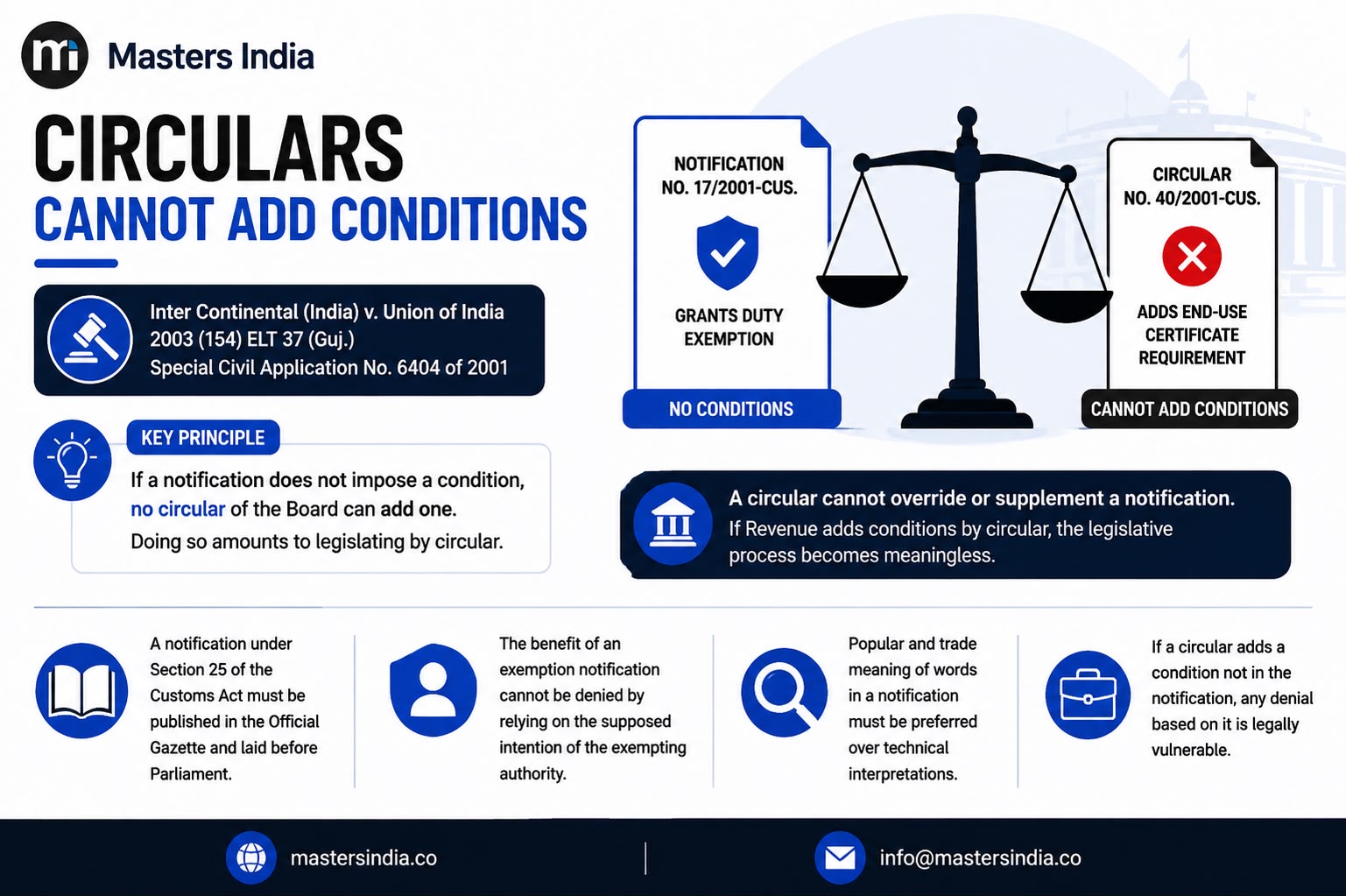 Inter Continental (India) v. Union of India
2003 (154) ELT 37 (Guj.) | Special Civil Application No. 6404 of 2001
Key Principle: If a notification does not impose a condition, no circular of the Board can add one. Doing so amounts to legislating by circular.
Notification No. 17/2001-Cus. granted a customs duty exemption on certain goods. The CBEC subsequently issued Circular No. 40/2001-Cus. requiring importers to produce an end-use certificate from the Central Excise officer — a condition entirely absent from the original notification.
The Gujarat High Court quashed the circular. The reasoning is instructive:
-
A notification under Section 25 of the Customs Act, 1962 must be published in the Official Gazette and laid before both Houses of Parliament. It carries the force of law.
-
A circular cannot override or supplement a notification. If Revenue is allowed to add conditions by circular, the legislative process becomes meaningless.
-
The benefit of an exemption notification cannot be denied by relying upon the supposed intention of the exempting authority.
-
The popular and trade meaning of words used in a notification must be preferred over technical or restrictive interpretations.
For CFOs and Directors of Finance, this judgement has direct operational relevance. If a department official cites a circular to deny a notification-based benefit — and the circular adds a condition not present in the notification — that denial is legally vulnerable.
What this means in practice: A framework for your tax team
These three cases together form a practical framework. When your company claims an exemption, a deduction, or a concessional rate under any notification or beneficial provision — and the department seeks to deny it — here is how this doctrine applies:
| Situation | Your Defense Using This Doctrine |
Department interprets a notification narrowly to deny your exemption claim |
Cite Shriram Vinyl: the notification must be construed rationally, not in a manner that deprives the benefit. |
Two clauses of a policy appear to conflict, and the department picks the clause that harms you |
Cite Suksha International: apply harmonious construction. Advance the purpose; do not defeat it. |
Revenue issues a circular adding conditions not in the notification |
Cite Inter Continental: a circular cannot add conditions to a notification. The circular is ultra vires. |
Department relies on 'supposed legislative intent' to deny a clear benefit |
The courts have held that supposed intent cannot override the plain language of an exemption notification. |
Your words are being re-interpreted against their trade or popular meaning |
Courts hold that the common or trade parlance meaning must prevail over technical re-readings by the Department. |
Red flags: When is your team most vulnerable?
Watch out for these situations where restrictive interpretation is most commonly used — and most aggressively challenged:
-
Exemption notifications with multiple conditions — departments often insist all conditions must be met in a particular sequence or manner not stated in the notification.
-
Notifications amended after you have acted in reliance — retrospective additions through circulars are especially dangerous and litigable.
-
Cases where your activity falls between two defined categories — departments may insist you fall into neither, though courts generally apply the more beneficial reading.
-
Situations involving reuse, partial use, or mixed-use of goods or services — the Shriram Vinyl principle directly applies here.
-
Cases where a long-standing trade practice is consistent with your interpretation — the Inter-Continental principle on trade parlance is particularly powerful here.
What do these interpretation principles mean for businesses?
 Three decades of tax litigation distilled into one truth: the law, in its spirit, is almost always on the side of the honest taxpayer who acts in good faith. It is only the interpretation — and who controls it — that determines the outcome.
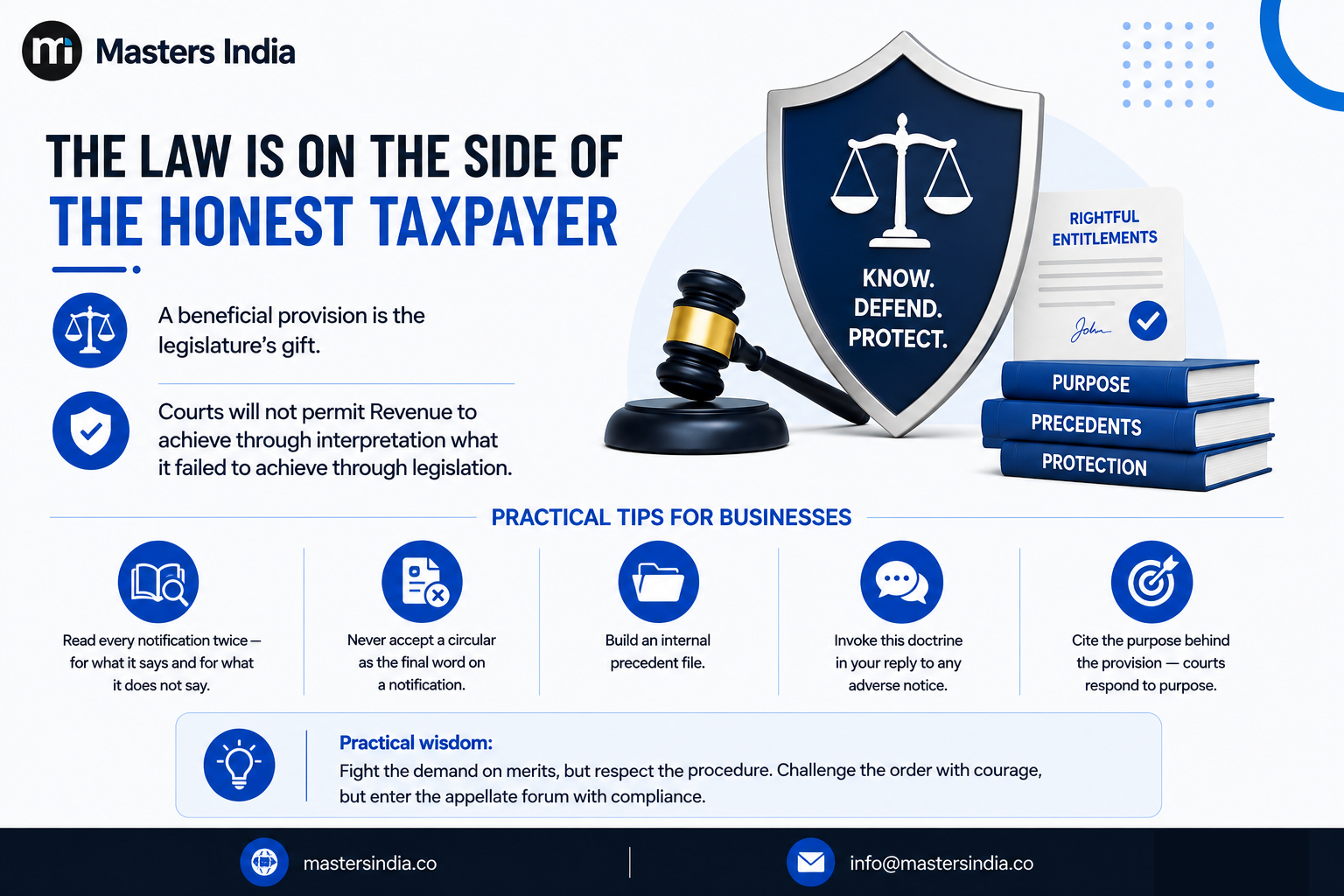
The cases discussed in this article are not just judicial precedents. They are hard-won battles — waged by real taxpayers who refused to surrender a benefit that was rightfully theirs. Each judgement is a reminder that the law was written with a purpose. Courts will not permit Revenue to achieve through interpretation what it failed to achieve through legislation.
A beneficial provision is the legislature's gift. No authority — not the department, not a circular, not even a creative re-reading of the plain text — can unwrap it from the other side of the table.
As a CFO or Director of Finance, your role is not merely to account for tax outflows. It is to guard the company's rightful entitlements with the same rigour you would apply to guarding its revenue. The moment your team reads a notification and asks 'do we qualify?' — the next question must always be: 'Is the department's denial legally sound, or is it merely convenient?'
The difference between a tax paid and a tax contested is not always the strength of your case. It is often the conviction to contest it.
Here is what years of practice have taught:
✦ Practical Tip: Read every notification twice — once for what it says, and once for what it does not say. Revenue often builds its case on silence. Build yours on the plain words.
✦ Practical Tip: Never accept a circular as the final word on a notification. Circulars are guidance — they are not law. If a circular adds a burden not in the notification, it is challengeable.
✦ Practical Tip: Build an internal precedent file. Each time your team encounters a restrictive interpretation from an officer, document it. This pattern becomes your strongest argument before an appellate authority.
✦ Practical Tip: Do not wait for an adverse order to engage your tax counsel. The moment a show-cause notice arrives that seeks to deny a benefit you have been legitimately claiming, invoke this doctrine immediately in your reply.
✦ Practical Tip: When in litigation, cite the purpose behind the provision. Courts respond to purposive arguments. A judge who understands why the legislature created a benefit is far more likely to protect it from being whittled away.
The law rewards those who understand it — not those who fear it. Know your rights. Defend them calmly. Let the judgements speak.
The doctrine that interpretation should not restrict the scope is not merely a litigation strategy. It is a statement of jurisprudential faith — faith that courts exist to give effect to the law's purpose, not to aid its subversion. For every CFO who fights a wrongful demand, every Director of Finance who pushes back on an unlawful circular, and every tax professional who stands in a hearing room and says, 'The law is with us' — this principle is your armour.
Carry it wisely. Use it judiciously. And never let a restrictive interpretation take away what the legislature gave with an open hand.
About the Author

- ★★
- ★★
- ★★
- ★★
- ★★

Check out other Similar Posts

CFO Weekly Digest
A weekly newsletter delivering sharp insights, strategic analysis, and critical updates on business, finance, and compliance — designed exclusively for CFOs and Finance Leaders
Masters India is a GST Suvidha Provider (GSP) appointed by Goods and Services Tax Network (GSTN), a Government of India enterprise.
 Procapitus Business Park, 4th Floor, D 247/4A, Sector 63 Rd, Noida, Uttar Pradesh 201301
 info@mastersindia.co




Certified