
Statutory Enforcement and Recovery under GST: A Comparative Analysis of Sections 73, 74, 120 & 130

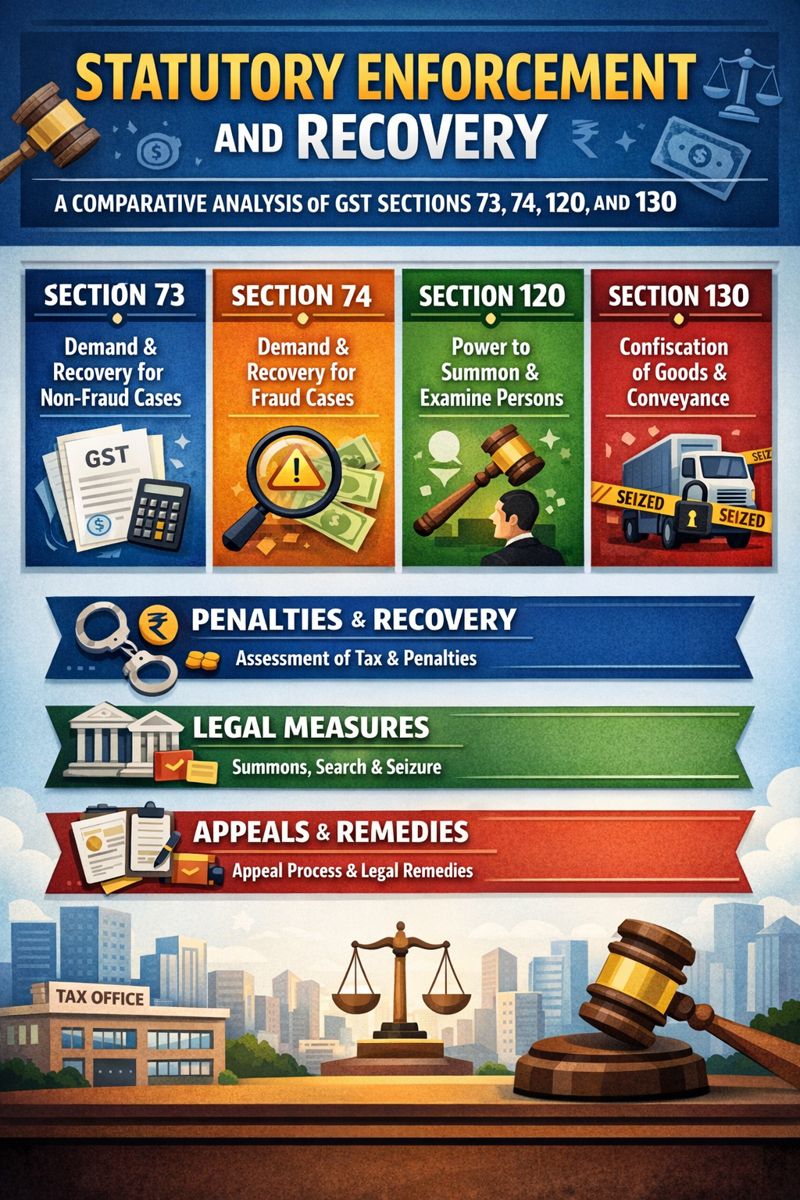
1. Executive Context: The Evolution of GST Enforcement
In the current "Future Proof" business landscape, the pace of change is no longer a linear progression; it is a disruptive force that necessitates a total overhaul of legal preparedness. As business principles relevant to an erstwhile predictable world fall apart, "uncertainty" has become the new certainty. For the modern enterprise, survival is not predicated on the ability to solve problems, but on the capacity to anticipate them. In this high-stakes environment, a fragmented understanding of statutory enforcement is a precursor to "work extinction." Legal preparedness is no longer a back-office compliance function; it is a mandatory strategic moat for survival.
The "Liability Shift" in the GST regime transitioning from a simple revenue collection model to a structurally embedded enforcement mechanism has fundamentally heightened the stakes. What originated as targeted anti-evasion measures have evolved into complex frameworks covering everything from Government-to-Business (G2B) rentals to real estate procurements (TDR/FSI). Furthermore, the "Stricter ITC Conditions" introduced in Budget 2022, particularly the mandate that credit is contingent upon the vendor’s actual tax payment to the Government, have turned Sections 73 and 74 into lethal recovery tools. The distinction between a bona fide error and "suppression" now determines not just a tax demand, but the very continuity of the corporate entity.
2. Determining Culpability: Section 73 (Bona Fide Errors) vs. Section 74 (Fraud and Suppression)
In a regulatory climate where "uncertainty is the new certainty," demand and recovery proceedings under Sections 73 and 74 represent the frontline of administrative enforcement. Culpability is no longer just about the intent to evade; it is increasingly defined by the recipient's failure to audit their own supply chain. Budget 2022 has introduced a "Stricter Provision" environment where the recipient is effectively a guarantor of the supplier’s compliance.
The following table differentiates these sections through the lens of the "Liability Shift" and the new cash-flow constraints:
| Criteria | Section 73 (Bona Fide Error) | Section 74 (Fraud and Suppression) |
| Nature of Default | Inadvertent "short paid liability" or errors in interpretation without intent to evade. | "Wilful default" or "suppression" of facts. Includes systemic failure to disclose RCM. |
| Interest Implications | Standard interest exposure on the delayed payment of tax. | Mandatory "reverse-along-with-interest" (Sec 50) at the point of discovery. |
| ITC & Deeming Fictions | Errors in proportionate ITC reversal under Section 17(3) for RCM outward supplies. | Intentional over-claiming of ITC despite "restricted" status in GSTR-2B. |
| Cash Flow Impact | Managed through routine rectification (now allowed up to 30th Nov). | Severe. Budget 2022 (Sec 1.5) restricts Credit Ledger use, mandating cash payments. |
The "Stricter Provisions" of Budget 2022 have weaponized these recovery sections. For instance, the new requirement to reverse ITC (with interest) if a vendor fails to pay the tax creates a "reverse-now-reclaim-later" trap. Furthermore, under Section 17(3), a "deeming fiction" exists where outward RCM supplies (like Cashew nuts or Raw Cotton) are treated as exempt supplies. Failure to recognize this leads to systemic ITC over-claims, moving a taxpayer from the safe harbor of Section 73 into the high-penalty territory of Section 74 suppression.
3. Judicial and Administrative Discipline: The Role of Section 120
Section 120 acts as the ultimate stabilizer against "interpretative strain" by enforcing adherence to prior judicial decisions. Its strategic utility lies in maintaining "Statutory–Notification Alignment." Without Section 120, the constant influx of "Frequent Notifications" and "Layered Exemptions" would lead to administrative chaos. For the litigation expert, this section is the primary defense against the department filing repetitive, vexatious appeals when a legal principle is already "judicially settled."
However, the rapid "Pace of Change" makes this alignment difficult. When the rate of change on the "outside" (policy shifts and retrospective clarifications) exceeds the rate of change on the "inside" (departmental awareness), the risk of demand increases. Section 120 provides the "parent Act" authority to bind the administration to settled principles, even when "deeming fictions" (such as those in RCM) are introduced. A robust defense strategy leverages Section 120 to ensure that once a position such as the classification of G2B services is settled by a higher forum, the taxpayer is shielded from further harassment on identical legal grounds.
4. Extreme Enforcement: Confiscation and Seizure under Section 130
When non-compliance graduates from error to systemic evasion, the administration invokes Section 130. This section represents the most severe tier of enforcement, providing for the confiscation of goods and conveyances. It is inextricably linked to the "Strict Provisions" for non-compliance highlighted in Budget 2022 (Sec 3.1), where the failure to file returns within prescribed periods leads directly to the "Cancellation of GST Registration."
Under the amended Section 54(10), the Government can now withhold refunds of any kind as a precursor to recovery. If the default remains unaddressed, Section 130 proceedings are triggered.
"Red Flag" Accounting Behaviors
Using the Executive Framework for Accurate GST Diagnosis, the following behaviors are identified as triggers for extreme enforcement:
-
Unaccounted TDR/FSI Transfers: Failing to recognize RCM liability on the transfer of development rights in real estate projects.
-
Misclassification of G2B Rentals: Treating "Renting of Immovable Property" by Government (Entry 5A) as exempt or outside RCM.
-
Systemic Procurement from "Initial Period" Vendors: Engaging with newly registered vendors who default on tax payments, triggering GSTR-2B restrictions.
-
Ignoring Section 17(3) Reversals: Failing to reverse proportionate ITC on outward RCM supplies such as Cashew nuts (unshelled), Tobacco leaves, or Raw Cotton.
-
P&L vs. Return Asymmetry: Significant gaps between expense ledgers and RCM disclosures, signaling "suppression" of taxable events.
5. The "So What?" Layer: Strategic Implications for Business Sustainability
A "fragmented understanding" of recovery provisions is no longer just a technical oversight; it is an existential threat. To remain "Future Proof," organizations must bridge the gap between statutory requirements and the practical realities of financial statement evaluation.
4-Step "Future Proof" Action Plan
-
Line-by-Line Diagnosis: Adopt a "P&L-focused lens." Every expense ledger entry must be tested against RCM notifications early to ensure accurate GST provisioning and avoid Section 74 allegations.
-
Vendor Risk Management: In the post-Budget 2022 era, you are responsible for your vendor's integrity. Implement real-time monitoring of "non-compliant vendors" to prevent the 180-day ITC reversal and the mandatory "reverse-along-with-interest" mandate.
-
Digital/Disclosure Symmetry: 90% of CEOs recognize the digital economy's impact, but only 15% execute a digital strategy (MIT/Capgemini). Use digital tools to ensure "return-level disclosure symmetry," aligning cash flows with ledger-level tax reporting.
-
Agile Learning for Resilience: The 40-day additional time provided by Budget 2022 for ITC is a narrow window. Professionals must adopt "lifelong learning" to navigate "tectonic shifts" in policy, moving from firefighting to anticipating challenges.
Survival requires reinventing internal tax controls; if your internal adaptation fails to match the pace of external regulatory change, your organization faces "extinction."
6. Final Synthesis: Compliance as a Competitive Differentiator
As Sir Edmund Hillary remarked to Mount Everest, "I will come again and conquer you because as a mountain you can’t grow but as a human I can." In the binary world of GST where you are either a "One" or a "Zero" proactive, legally defensible compliance is the only way to conquer the mountain of complexity. Compliance is not a cost center; it is a competitive differentiator.
-
Anticipate, Don’t Firefight: Identify RCM-triggered transactions at the ledger level before they manifest as audit observations.
-
Mandatory Section 17(3) Audits: Perform regular proportionate ITC reversal audits for all outward RCM supplies to mitigate Section 74 risks.
-
Rigorous GSTR-2B Reconciliation: Enforce a "No-Payment-No-Credit" policy with vendors to protect cash flow from the Budget 2022 interest mandate.
-
Legally Defensible Advisory: Link every tax position to the "parent Act" and "judicially settled principles" to ensure an error-free, audit-ready posture.
GST Anti Evasion Department Powers | Powers of GST Officers | DRC-01 | Statement of Facts and Grounds of Appeal Format GST | Valuation Rules Under GST
About the Author

- ★★
- ★★
- ★★
- ★★
- ★★

Check out other Similar Posts

CFO Weekly Digest
A weekly newsletter delivering sharp insights, strategic analysis, and critical updates on business, finance, and compliance — designed exclusively for CFOs and Finance Leaders
Masters India is a GST Suvidha Provider (GSP) appointed by Goods and Services Tax Network (GSTN), a Government of India enterprise.
 Procapitus Business Park, 4th Floor, D 247/4A, Sector 63 Rd, Noida, Uttar Pradesh 201301
 info@mastersindia.co




Certified