
Excess Stock Under GST: Section 130 vs Sections 73 and 74

During GST surveys and searches, excess stock found at business premises often triggers immediate action by the department. A recurring question before finance heads is whether such discrepancies should invite proceedings under the confiscation provisions of Section 130 or under the regular demand provisions of Sections 73 and 74 of the CGST/UPGST Act.
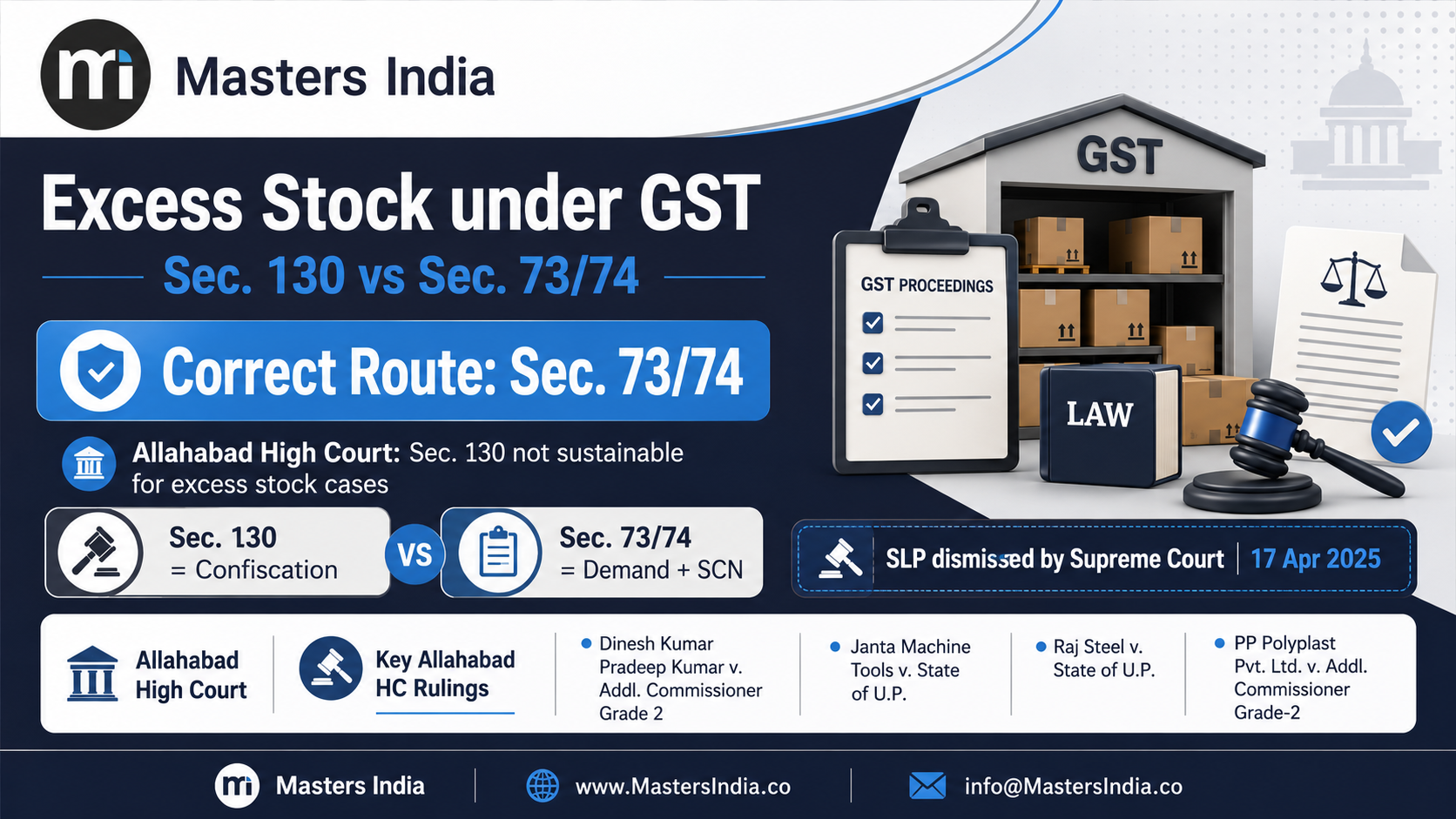
Recent judgments from the Allahabad High Court have consistently clarified this issue. The court has held that excess stock discovered during a survey or search must be addressed through Sections 73 or 74 and not through Section 130. The Supreme Court has also refused to interfere with this view.
Understanding the relevant GST provisions
Section 130 confiscation and penalty
This section empowers authorities to confiscate goods and impose heavy penalties when there is a violation involving evasion, movement without proper documents, or intent to evade tax. It is a stringent, quasi-penal provision aimed at goods themselves (in rem).
Sections 73 and 74 determination of tax
- Section 73 applies to cases other than fraud, wilful misstatement, or suppression of facts.
- Section 74 applies where fraud, wilful misstatement, or suppression is alleged. These sections focus on recovery of tax, interest, and penalty from the registered person through issuance of a show-cause notice (SCN) and adjudication.
The core distinction is that Section 130 targets the goods for confiscation, while Sections 73/74 target the taxpayer for the determination of liability.
Consistent view of the Allahabad High Court
The Allahabad High Court has repeatedly ruled in favour of proceedings under Sections 73/74 for excess stock cases. Key judgements include:
- Dinesh Kumar Pradeep Kumar vs Additional Commissioner Grade 2 (Writ Tax No. 1082/2022, 25 July 2024): Excess stock found during survey must lead to proceedings under Sections 73 & 74, not Section 130.
- Janta Machine Tools vs State of Uttar Pradesh (Writ Tax No. 1503 of 2024, 22 May 2025): Correct recourse after search revealing excess stock is under Sections 73/74.
- Raj Steel vs State of Uttar Pradesh (Writ Tax No. 44 of 2025, 28 May 2025): Only proceedings under Sections 73 or 74 are applicable in cases of excess stock.
- Juhi Alloys Pvt. Ltd. vs State of Uttar Pradesh (Writ Tax No. 1097 of 2024, 19 February 2025): Proceedings under Section 130 not justified for stock discrepancies in case of a registered dealer.
- J.H.V. Steels Ltd. vs Union of India (Writ Tax No. 808/2024, 24 October 2010*): Where excess stock is found, proceedings should be under Section 73 or 74; orders passed under Section 130 do not sustain.
- PP Polyplast Pvt. Ltd. vs Additional Commissioner Grade-2 (Writ Tax No. 1183/2024, 30 July 2024): Impugned order under Section 130 read with Section 122 was set aside; proceedings should have been under Section 73 or 74.
The Department filed an SLP before the Supreme Court against the order in Dinesh Kumar Pradeep Kumar. The SLP (Civil) Diary No. 5879 of 2025 was dismissed on 17 April 2025, thereby upholding the High Court’s view.
Comparison of proceedings: Section 130 vs Sections 73/74
Practical implications for CFOs and finance teams
Excess stock cases are no longer a grey area in Uttar Pradesh and are increasingly being followed as precedent across benches. Initiating proceedings under Section 130 exposes businesses to the risk of immediate seizure and to higher penalties that are harder to contest, making the GST appeal process relevant when challenging an incorrect order.
Finance leaders must therefore ensure internal teams treat stock discrepancies as potential demand cases under Sections 73/74 from day one, including reviewing any GST show-cause notice issued by the department.
How can businesses reduce GST disputes over excess stock?
The larger lesson from excess-stock disputes is that strong controls are more valuable than prolonged litigation. Accurate books, regular physical verification and clear records of inward and outward stock movements can help businesses explain variances through GST reconciliation before they turn into tax disputes.
For CFOs, finance directors and tax heads, every stock difference should be treated as an opportunity for early reconciliation and correction. Quarterly stock checks, surprise physical verification, reliable ERP controls and documented reasons for variances can significantly strengthen the company's position during a GST survey or search.
The objective should not merely be to defend a proceeding under Section 130 or Sections 73/74 but to build systems that reduce the likelihood of such disputes arising. Masters India can support this through GST compliance, reconciliation and technology-led tax workflows.
About the Author

- ★★
- ★★
- ★★
- ★★
- ★★

Check out other Similar Posts

CFO Weekly Digest
A weekly newsletter delivering sharp insights, strategic analysis, and critical updates on business, finance, and compliance — designed exclusively for CFOs and Finance Leaders
Masters India is a GST Suvidha Provider (GSP) appointed by Goods and Services Tax Network (GSTN), a Government of India enterprise.
 Procapitus Business Park, 4th Floor, D 247/4A, Sector 63 Rd, Noida, Uttar Pradesh 201301
 info@mastersindia.co




Certified