
Section 67 of the Central Goods and Services Tax Act, 2017 — Power of Inspection, Search and Seizure: Cash Seizure and Procedural Safeguards

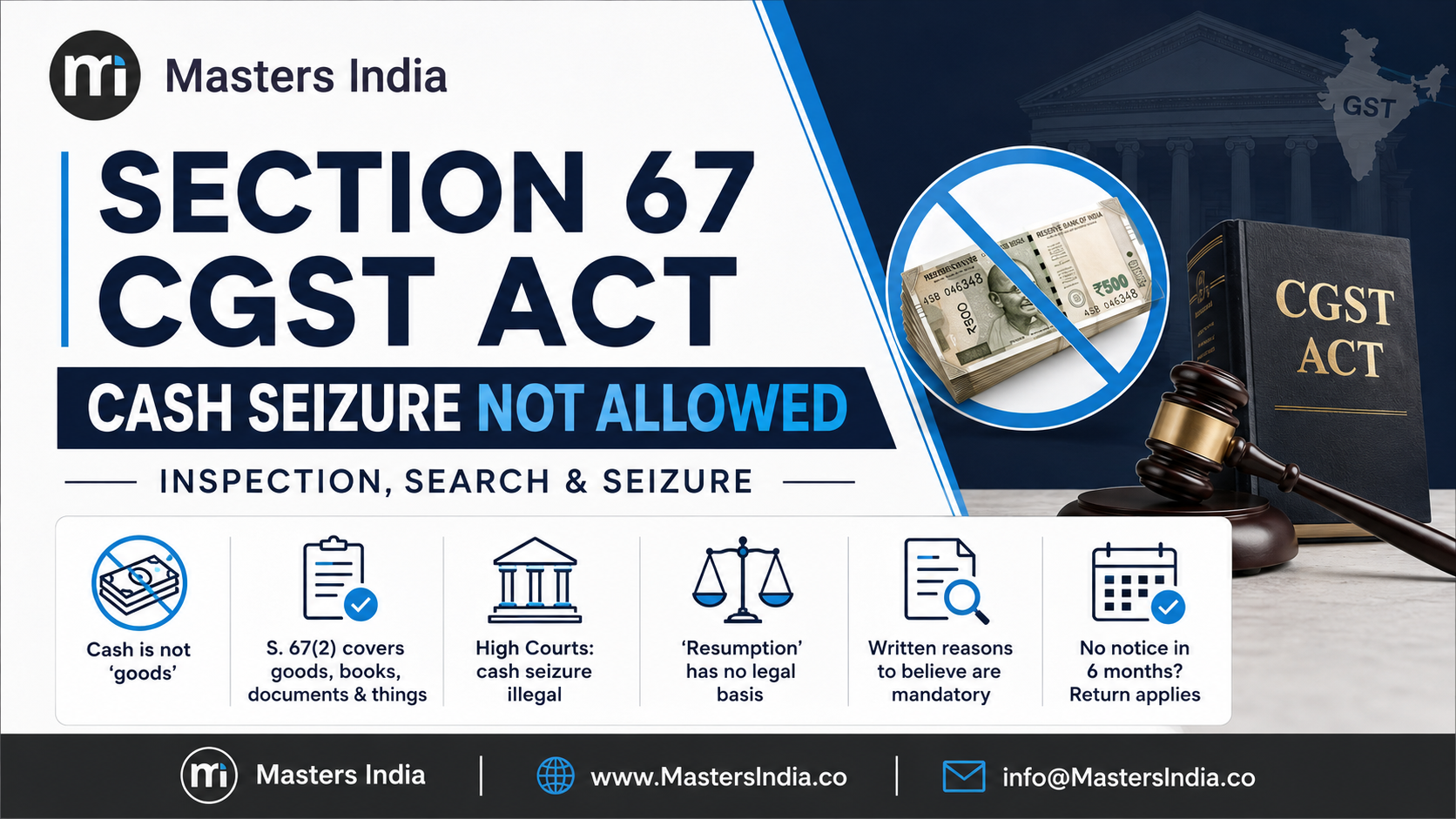
Section 67 of the CGST Act, 2017, empowers a proper officer not below the rank of Joint Commissioner to authorise or personally conduct search and seizure of goods liable to confiscation or documents, books, or things relevant to proceedings under the Act. The scope of this power is strictly circumscribed by statutory language and has been authoritatively interpreted by multiple High Courts.
1. Statutory Text of Section 67(2) — Limited to Specified Categories
Where the proper officer, not below the rank of Joint Commissioner, either pursuant to an inspection carried out under sub-section (1) or otherwise, has reasons to believe that any goods liable to confiscation or any documents or books or things, which in his opinion shall be useful for or relevant to any proceedings under this Act, are secreted in any place, he may authorise in writing any other officer of central tax to search and seize or may himself search and seize such goods, documents or books or things:
Provided that where it is not practicable to seize any such goods, the proper officer, or any officer authorised by him, may serve on the owner or the custodian of the goods an order that he shall not remove, part with, or otherwise deal with the goods except with the previous permission of such officer:
Provided further that the documents or books or things so seized shall be retained by such officer only for so long as may be necessary for their examination and for any inquiry or proceedings under this Act.
Explanatory note:
The power to seize is confined to three categories:
-
goods liable to confiscation,
-
documents,
-
books, or
-
things
The term “things” is not a catch-all; it must be interpreted in context with “goods”, “documents”, and “books”, and must be relevant to proceedings under the CGST Act. Cash does not fall within any of these categories as per judicial interpretation.
2. Cash is Not “Goods” Under the CGST Act
The definition of “goods” under Section 2(52) of the CGST Act, 2017 is:
> “goods” means every kind of movable property other than money and actionable claims; and includes stock and shares, growing crops, grass and things attached to or forming part of the land which are agreed to be severed before supply or under a contract of supply.
Explanatory note: Money is explicitly excluded from the definition of “goods”. Therefore, cash — being money — cannot be classified as “goods” under the Act. This exclusion is foundational to the judicial analysis of cash seizure under Section 67.
3. Judicial Interpretation — Cash Cannot Be Seized Under Section 67(2)
(a) ARVIND GOYAL CA vs. UNION OF INDIA (2023 Taxo.online 86)
-
Petitioner’s Argument: Currency is excluded from “goods” and cannot be a “thing” relevant to GST proceedings. No provision permits the forcible taking of cash.
-
Respondent’s Argument: Cash was merely “resumed”, not seized, under the panchnama.
-
Court’s Holding:
> “Clearly, the petitioners had not handed over the cash to the concerned officers voluntarily. Undisputably, the action taken by the officers was a coercive action. We find no provision in the GST Act that could support an action of forcibly taking over possession of currency from the premises of any person, without effecting the same.”
> “The powers of search and seizure are draconian powers and must be exercised strictly in terms of the statute and only if the necessary conditions are satisfied.”
> “Prima facie, a plain reading of Section 67(2)… indicates that the seizure is limited to goods liable for confiscation or any documents, books or things… Clearly, cash does not fall within the definition of goods.”
(b) BHARATKUMAR PRAVINKUMAR AND CO. vs. STATE OF GUJARAT (2023 Taxo.online 1224)
-
Court’s Holding:
> “Cash, which is seized by the respondent would not form the subject matter of seizure as they are neither goods, documents or things, in as much as under the frame work of the Act… cash cannot be seized under the provisions of Section 67, particularly when it is not shown as stock in trade of the assessee.”
> “The definition of the word ‘goods’ under this Act… excludes money.”
(c) DHANYA SREEKUMARI AND ORS. vs. THE STATE TAX OFFICER (IB) (2023 Taxo.online 782)
-
Court’s Holding:
> “In an investigation aimed at detecting tax evasion under the CGST Act, the Court fails to see how cash can be seized, especially when it is an admitted case that the cash did not form part of the stock-in-trade of the appellant’s business.”
> The writ petition was disposed of, directing the release of seized cash within a week.
(d) SMURTI WAGHDHARE vs. JOINT DIRECTOR (2026 Taxo.online 584)
-
Petitioner’s Argument: Cash is not “goods, documents, books or things” under Section 67(2).
-
Respondent’s Argument: Cash may be a “thing” under the Act.
-
Court’s Holding:
> “The action of the Respondents of seizing the cash… is perverse, arbitrary and without the authority of law.”
> “The provisions of Section 67(2)… do not envisage the seizure of cash… Respondents have not recorded any reasons to believe that the cash was useful or relevant to any proceedings under the CGST Act.”
> “There was no power under which the Respondents could seize the cash from the Petitioner’s premises.”
4. Procedural Safeguards Under Section 67 — Mandatory Compliance
Even if seizures were hypothetically permissible (which it is not for cash), the following procedural safeguards are mandatory and non-negotiable:
(a) Authorisation by Officer of Rank Not Below Joint Commissioner
-
Section 67(1), (2), (11): Only a proper officer not below the rank of Joint Commissioner may authorise search/seizure.
-
Suresh Kumar P.P. vs. Deputy Director (2020 Taxo.online 596):
> Court upheld seizure where authorisation was issued by the Directorate General (rank above Joint Commissioner).
> However, if the authorizing officer is below rank, the entire action is void.
Citability: CITE
(b) Written Order and Reason to Believe
-
Section 67(2), (11): The officer must have “reasons to believe” and record them in writing.
-
Smurti Waghdhare (2026 Taxo.online 584):
> “Respondents have given a go-by to the expression ‘reason to believe’… no reasons recorded.”
> This renders the seizure illegal.
Citability: CITE
(c) Inventory and Receipt for Seized Items
-
Section 67(11): Officer must grant a receipt for seized accounts, registers, or documents.
-
Section 67(9): For perishable/hazardous goods specified by notification, an inventory must be prepared.
-
No such requirement exists for cash — further indicating it is not contemplated under the Act.
(d) Return of Items Not Relied Upon for Notice
-
Section 67(3): Documents, books, or things produced by a taxable person but not relied upon for issuing a notice must be returned within 30 days of notice issuance.
-
Implies that even if documents are seized, their retention beyond 30 days without reliance is unlawful.
(e) Time Limit for Notice and Return of Seized Goods
-
Section 67(7):
> “Where any goods are seized under sub-section (2) and no notice in respect thereof is given within six months of the seizure of the goods, the goods shall be returned to the person from whose possession they were seized: Provided that the period of six months may, on sufficient cause being shown, be extended by the proper officer for a further period not exceeding six months.”
This provision applies to “goods” — not cash. But if cash were seized, the same time limit would apply — and failure to issue notice within 6 months (or 12 months with extension) mandates return.
(f) Right to Copies or Extracts
-
Section 67(5):
> “The person from whose custody any documents are seized under sub-section (2) shall be entitled to make copies thereof or take extracts therefrom in the presence of an authorised officer… except where such action may prejudicially affect the investigation.”
Citability: CITE
This right is available for documents — not cash — reinforcing that cash is not a “document” or “thing” under the Act.
(g) Provisional Release on Bond or Payment
-
Section 67(6):
> “The goods so seized under sub-section (2) shall be released… upon execution of a bond and furnishing of security… or on payment of applicable tax, interest and penalty.”
This applies only to “goods” — not cash. Cash cannot be “released” on bond because it was never lawfully seized.
(h) Application of CrPC — With Modifications
-
Section 67(10):
> “The provisions of the Code of Criminal Procedure, 1973, relating to search and seizure, shall, so far as may be, apply to search and seizure under this section subject to the modification that sub-section (5) of section 165 of the said Code shall have effect as if for the word 'Magistrate', wherever it occurs, the word 'Commissioner' were substituted.”
This means that even if CrPC procedures are applied, they are subject to the limitations of Section 67 — which does not permit seizure of cash.
5. Prohibited Actions Under Section 67
-
Seizure of cash — Not permitted under any provision.
-
“Resuming” cash — No such term exists in the CGST Act. Court in Arvind Goyal held this to be a legal fiction without statutory basis.
-
Forcible taking of cash — Deemed coercive, without authority of law.
-
Failure to record “reason to believe” — Renders seizure void.
-
Seizure without authorisation by Joint Commissioner or above — Invalid.
-
Retention beyond 6 months (or 12 months with extension) — Mandates return of goods — and by analogy, any unlawfully seized item.
6. Contrast with Other Judicial Findings
-
Suresh Kumar P.P. (2020 Taxo.online 596): Upheld seizure of a cheque under Section 67.
> However, the Court held the cheque was a “voluntary payment under protest” — not a seizure. The ruling does not support seizure of cash as a “thing” under Section 67(2).
-
Frutta Services (2026 Taxo.online 1273): Deals with classification of food supply — irrelevant to cash seizure.
-
Ultimo Cement (2026 Taxo.online 1173): Concerns Section 74 and natural justice — not relevant to Section 67.
7. Conclusion — Legal Position
The following legal positions are firmly established by the retrieved context:
-
Cash is not “goods” under Section 2(52) of the CGST Act.
-
Cash is not “documents”, “books”, or “things” within the meaning of Section 67(2).
-
No judicial authority supports lawful seizure of cash under Section 67(2).
-
Multiple High Courts (Delhi, Gujarat, Kerala, Andhra Pradesh) have held such seizure to be without authority of law.
-
“Resuming” cash is not a recognized legal term under the Act.
-
Procedural safeguards under Section 67 (authorization, reason to believe, inventory, time limits, return obligations) are mandatory and must be strictly complied with — and none apply to cash.
-
Any seizure of cash under Section 67 is ultra vires and must be immediately returned.
Closing Summary — Key Legal Positions
-
✅ Cash is excluded from the definition of “goods” under Section 2(52) of the CGST Act.
-
✅ Section 67(2) permits seizure only of goods liable to confiscation, documents, books, or things relevant to GST proceedings — cash does not qualify.
-
✅ High Courts in Arvind Goyal, Bharatkumar, Dhanya Sreekumari, and Smurti Waghdhare have uniformly held that seizure of cash under Section 67 is illegal.
-
✅ The term “resume” has no statutory basis — forcible taking of cash is void ab initio.
-
✅ Section 67(10) incorporates CrPC, but only to the extent consistent with CGST Act — which does not authorize cash seizure.
-
✅ Failure to record “reason to believe” in writing renders any seizure invalid (Smurti Waghdhare).
-
✅ Seized goods (including hypothetically seized cash) must be returned if no notice is issued within 6 months (Section 67(7)).
-
✅ No notification, circular, or rule under CGST Act permits seizure of cash.
-
✅ Any officer who seizes cash under Section 67 acts without legal authority and exposes the department to liability.
Final Legal Conclusion
Under the retrieved context, GST officers cannot seize cash under Section 67 of the CGST Act, 2017. Cash is not “goods”, “documents”, “books”, or “things” as contemplated by the statute. Multiple High Courts have held such a seizure to be illegal, arbitrary, and without authority of law. Procedural safeguards under Section 67 are mandatory and cannot be circumvented by invoking vague terms like “resumption”. Any cash seized must be returned forthwith.
About the Author

- ★★
- ★★
- ★★
- ★★
- ★★

Check out other Similar Posts

CFO Weekly Digest
A weekly newsletter delivering sharp insights, strategic analysis, and critical updates on business, finance, and compliance — designed exclusively for CFOs and Finance Leaders
Masters India is a GST Suvidha Provider (GSP) appointed by Goods and Services Tax Network (GSTN), a Government of India enterprise.
 Procapitus Business Park, 4th Floor, D 247/4A, Sector 63 Rd, Noida, Uttar Pradesh 201301
 info@mastersindia.co




Certified