Masters India
Masters India
Products
Tools
Resources
Company

Chapter 2: Refund of Input Tax Credit (ITC)

Refund of Input Tax Credit (ITC)

Overview of ITC Refund Mechanism

Overview of ITC Refund Mechanism

The refund of Input Tax Credit (ITC) allows a registered person to claim back any unutilized ITC at the conclusion of a tax period. This mechanism is primarily governed by Section 54 of the CGST Act and is permissible only under specific conditions. Key scenarios enabling ITC refunds include zero-rated supplies made without tax payment, situations involving an inverted tax structure, and other specific cases such as deemed exports.

Key Refund Provisions under Section 54

Key Refund Provisions under Section 54

Section 54 outlines the framework for claiming refunds of unutilized ITC. A registered person may claim such a refund, subject to the conditions specified in sub-section 10 and within defined categories. The primary categories relevant to ITC refunds are:

Zero-rated supplies made without payment of tax: This applies when supplies are zero-rated, and no tax is paid on them.

Inverted tax structure: This occurs when the tax rate on inputs is higher than the tax rate on output supplies, leading to an accumulation of ITC. However, this excludes nil-rated or fully exempt supplies and any supplies specifically notified by the Government.

Refund on the supply of goods deemed exports: Specific provisions exist for goods categorized as deemed exports.

Other refunds of unutilized ITC under Section 54(3): This covers additional scenarios where unutilized ITC refunds are permitted.

Zero-Rated Supplies Without Payment of Tax

Zero-Rated Supplies Without Payment of Tax

When a person makes zero-rated supplies without paying tax on them, they may be eligible for a refund of the ITC accumulated on inputs used for these supplies. This provision is crucial for exporters and other entities involved in zero-rated activities, as it allows them to recover taxes on inputs when the final output tax is either exempt or zero. This effectively prevents the cascading effect of taxes.

Inverted Tax Structure

Inverted Tax Structure

An inverted tax structure arises when the ITC on inputs surpasses the tax payable on output supplies. In such instances, taxpayers can claim a refund of the unutilized ITC that could not be offset against their output tax liability. It is important to note the following clarifications:

Nil-rated or exempt supplies are generally not eligible for inverted tax refunds.

The Government retains the authority to notify certain supplies that will be excluded from the inverted tax refund regime, even if they otherwise meet the conditions.

Export-related nil-rated or exempt supplies typically fall under separate refund provisions rather than the inverted tax refund category.

Other Refund Provisions

Other Refund Provisions

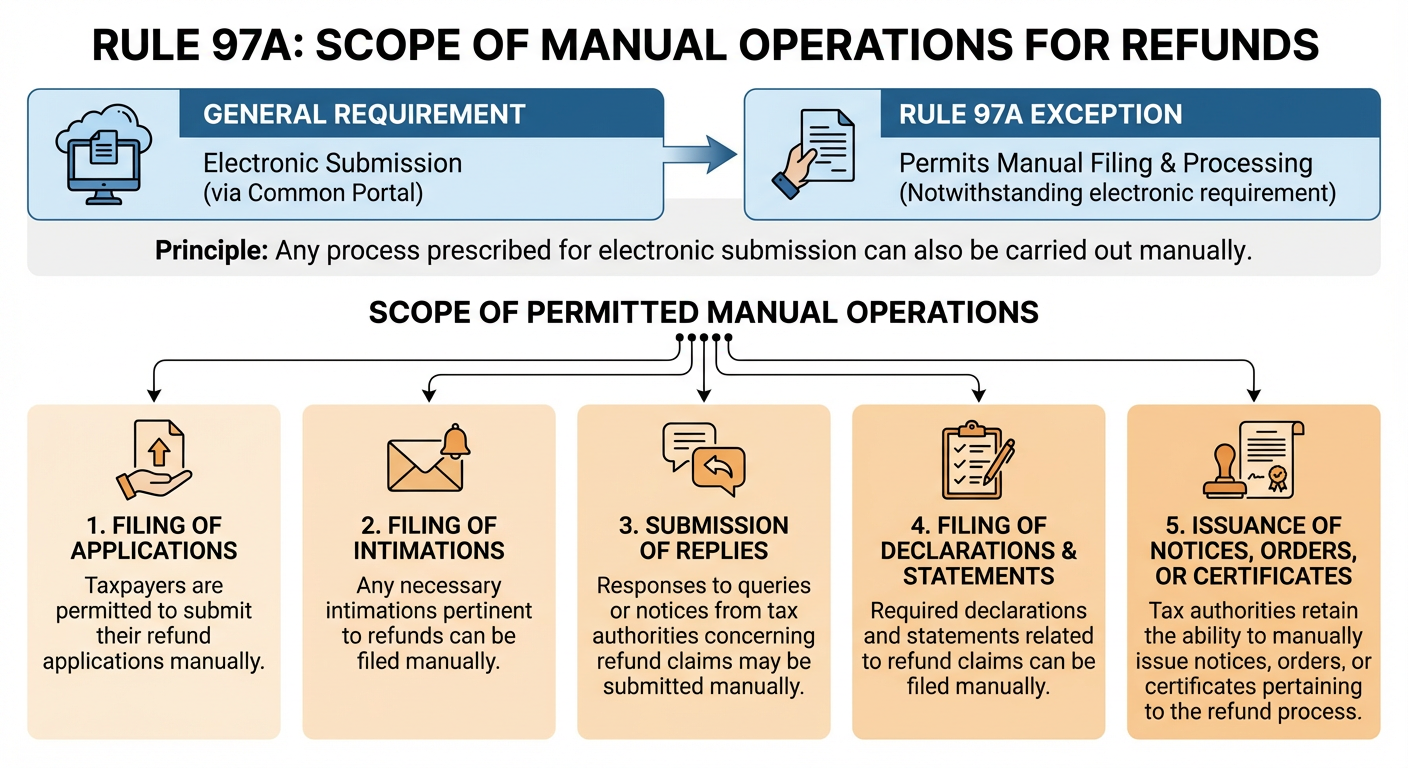
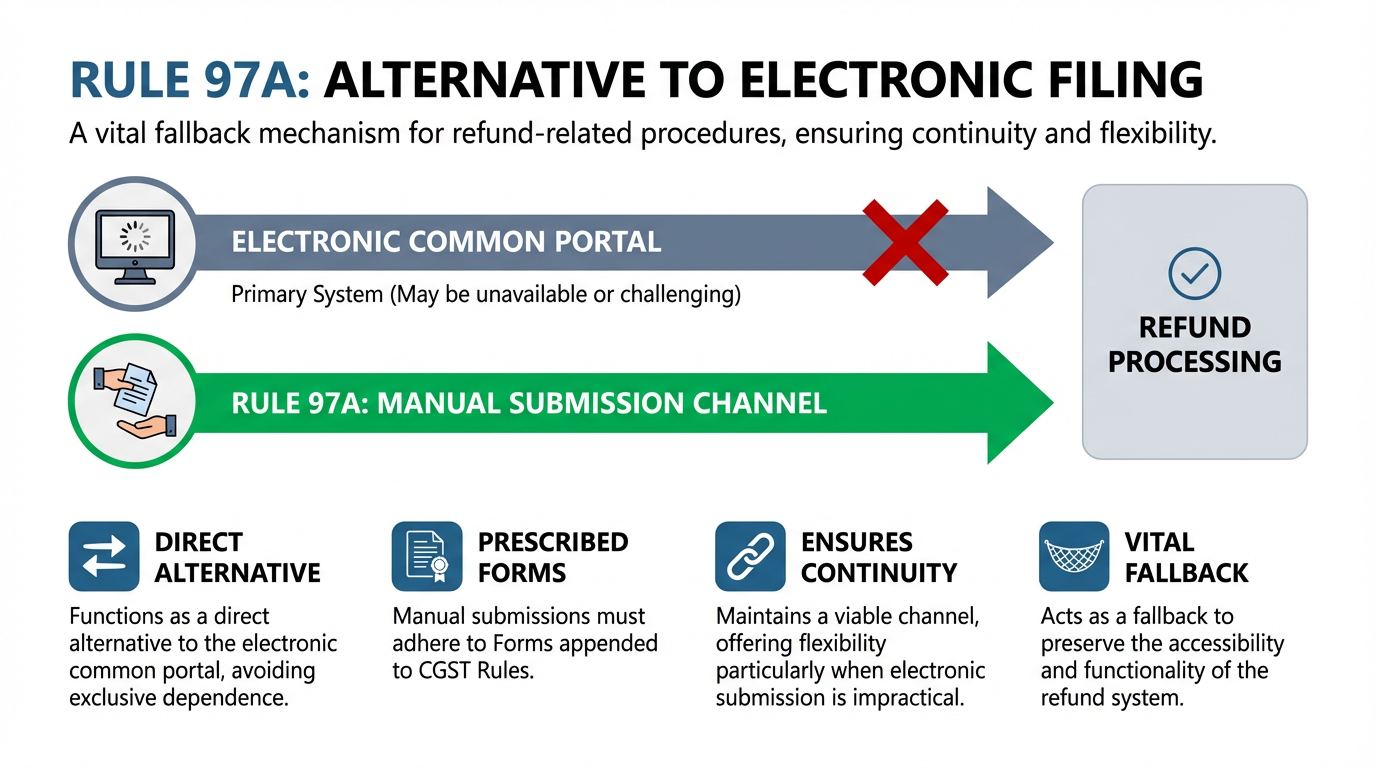
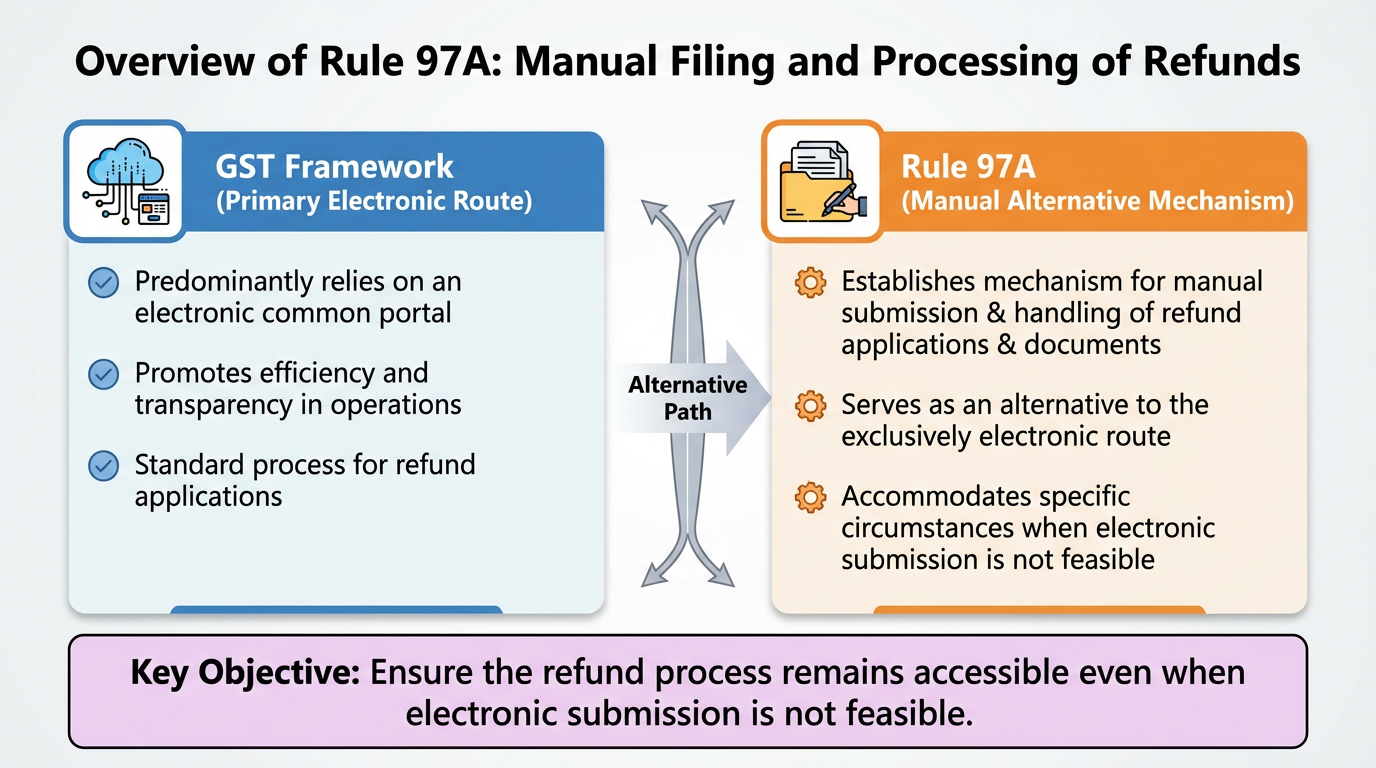
Beyond the primary categories of zero-rated supplies and inverted tax structures, the framework includes provisions for refunds on deemed exports and other general ITC refunds under Section 54. While the focus here is on the main categories and exceptions, a comprehensive understanding requires careful review of Section 54 and related rules, including Rule 97A for manual filing and processing, and any relevant notifications.

Procedural Aspects and Compliance Considerations

Procedural Aspects and Compliance Considerations

The process for claiming refunds involves specific procedural and compliance requirements:

Application Filing: Refund applications are typically filed electronically via the common portal, though manual filing may be permitted in certain circumstances (Rule 97A).

Interest on Delayed Refunds: If a refund is not disbursed within specified timeframes (e.g., 60 days from filing), interest may be payable to the applicant. For instance, interest might accrue at 6% per annum under certain conditions, or 9% per annum for refunds arising from appellate orders, as per Section 56 and related rules.

Timelines and Sanctioning: Final sanction and payment orders should be issued promptly to ensure disbursal within the 60-day target, as emphasized by administrative circulars.

Documentation and Records: Meticulous documentation is essential. This includes records related to ITC, zero-rated inputs, inverted tax structure calculations, production, inward/outward supplies, stock, ITC availed, and output tax payable/paid, as mandated by Section 35.

Audit and Verification: Refund claims are subject to scrutiny and audit under provisions like Section 61 (scrutiny of returns) and other audit mechanisms. Section 71 grants authorities access to books and premises to verify compliance.

Practical Guidance for Eligibility Analysis

Practical Guidance for Eligibility Analysis

To effectively analyse ITC refund eligibility, consider the following:

Scenario Key Considerations
Zero-rated supplies without tax payment Confirm zero-rated status and non-payment of tax. Trace eligible ITC on inputs used for these supplies under Section 54.
Inverted tax structure Verify if input ITC exceeds output tax, excluding nil-rated/exempt supplies and notified exclusions. Compute eligible unutilized ITC.
Exports with export duty Ascertain if exported goods are subject to export duty. If so, ITC refunds for those exports are disallowed.
General refund claims Utilize appropriate forms (electronic/manual) and ensure timely filing. Maintain comprehensive documentation for audit support.

Critical Considerations for ITC Refunds
Critical Considerations for ITC Refunds

Eligible Refund Categories:

Unutilized ITC due to zero-rated supplies made without tax payment.

Unutilized ITC in inverted tax structure scenarios (excluding nil-rated/exempt supplies and notified exclusions).

Refund on deemed exports.

Other refunds under Section 54(3) for unutilized ITC.

Important Exceptions:

No ITC refund for exports if goods are subject to export duty.

Nil-rated or exempt supplies generally do not qualify for inverted tax refunds.

Administrative Aspects:

Refund processing involves electronic/manual filing, with strict timelines for sanction and payment.

Interest on delayed refunds is governed by Section 56.

Thorough record-keeping is vital for scrutiny, audits, and assessments.

When evaluating ITC refunds, always categorize the claim under zero-rated supplies, inverted tax structure, or deemed exports as the primary paths, and verify any government-notified exclusions. Always check for applicable export duties, as they can negate ITC refunds for those exports. Maintaining thorough documentation and awareness of procedural requirements (filing, timelines, interest provisions) is crucial for smooth processing of ITC refunds.

Rate this chapter

0.00 / 5. Vote count: 0

Leave a comment