

Under GST, a subsidy provided by the Central or State Government is kept out of the taxable value, while a subsidy from anyone else that is directly linked to the price is added to it. The rule looks simple. In practice it raises three hard questions: who really provided the money, whether it is linked to the price of a specific supply, and what happens when the "price" on which the subsidy was computed already includes GST.
The Gujarat Authority for Advance Ruling faced all three in In re Greenbrilliance Renewable Energy LLP, Advance Ruling No. GUJ/GAAR/R/34/2021 dated 30-7-2021, reported at 2022 (61) G.S.T.L. 114 (A.A.R. - GST - Guj.). The ruling concerns rooftop solar systems under the Surya Gujarat scheme, but its reasoning reaches every supplier who sells under a government subsidy scheme with a GST-inclusive benchmark price: solar EPC players, agricultural equipment dealers, electric vehicle sellers and suppliers under welfare procurement schemes.
This article sets out the statutory framework, examines the ruling in detail, shows through the ruling's own figures that its outcome is revenue-neutral, and closes with practical guidance for suppliers.
How are subsidies valued under GST?
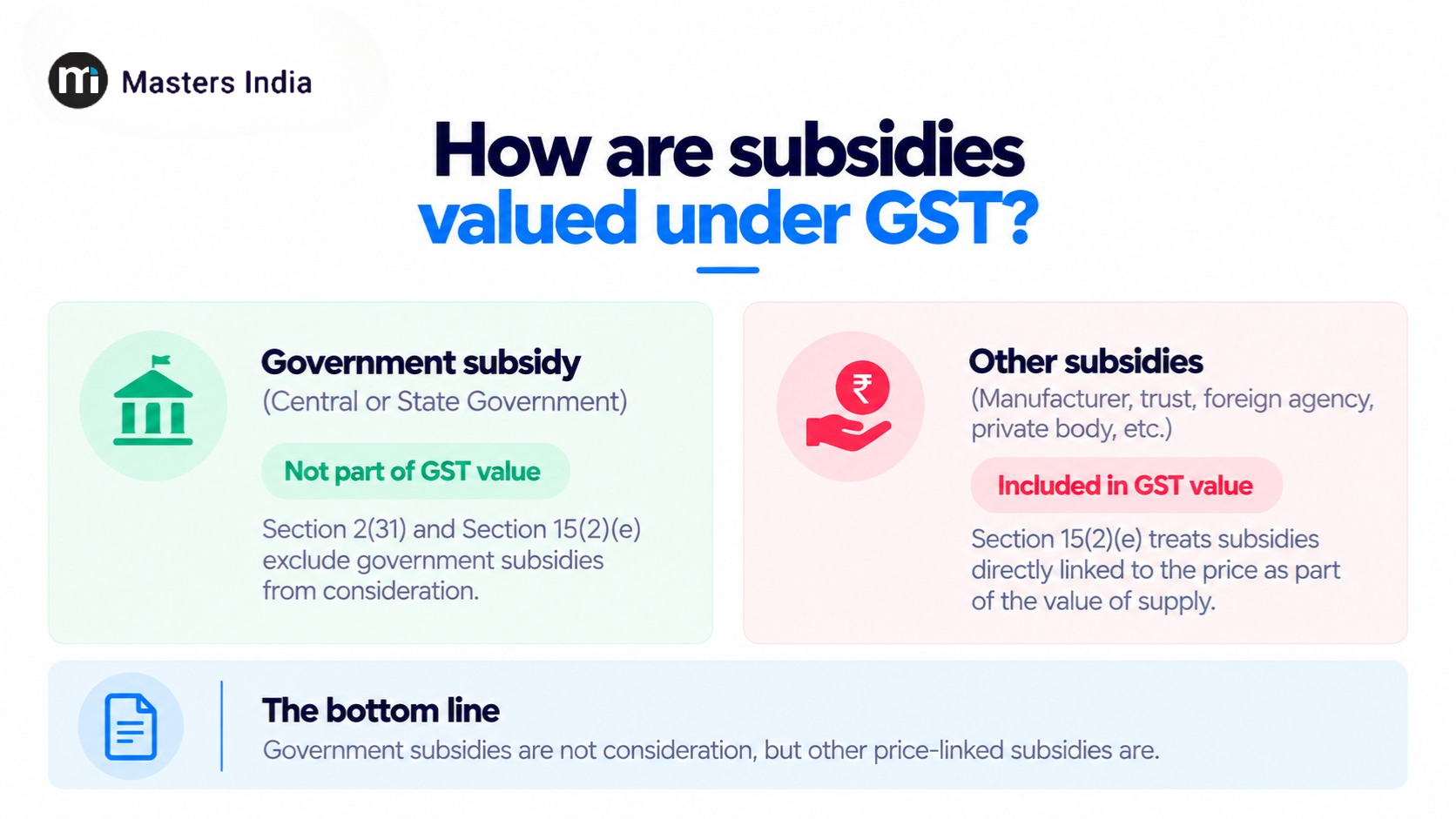 Two provisions of the CGST Act, 2017 work together, and they point the same way: government subsidies are not consideration, other price-linked subsidies are.
Section 2(31) - consideration. Consideration includes any payment made "by the recipient or by any other person" in respect of a supply, but expressly "shall not include any subsidy given by the Central Government or a State Government". A third-party payment is therefore ordinarily consideration; a government subsidy is carved out at the definition stage itself.
Section 15(1) - transaction value. Value is the price actually paid or payable, where supplier and recipient are unrelated and price is the sole consideration.
Section 15(2)(e) - inclusions. The value of supply shall include:
(e) subsidies directly linked to the price excluding subsidies provided by the Central Government and State Governments.
Explanation.- For the purposes of this clause, the amount of subsidy shall be included in the value of supply of the supplier who receives the subsidy.
The logic is policy-driven. If a government subsidy were taxed, the State would be paying tax to itself and the benefit meant for the consumer would shrink by the tax. Non-government subsidies enjoy no such carve-out: when a manufacturer, trust, foreign agency or private body pays part of the price, that amount is simply consideration from a third person.
The SGST Acts contain identical provisions, and Section 20 of the IGST Act adopts the CGST valuation provisions for inter-State supplies.
Three tests to determine GST treatment of a subsidy
Every subsidy should be run through three questions before the invoice is raised.
- Source: who ultimately bears the subsidy? The exclusion is for subsidies "provided by" the Central or State Government. Money routed through a DISCOM, PSU, nodal agency or bank retains its government character if the government is the real provider. The burden of proving this is on the supplier, as the Greenbrilliance ruling shows.
- Link: is it directly linked to the price? Only subsidies tied to the price of a particular supply enter Section 15(2)(e). A general grant, capital investment subsidy or interest subvention not tied to any individual sale is not consideration for a supply at all.
- Recipient: who receives it? The Explanation places a non-government subsidy in the value of supply of the supplier who receives it. Where the subsidy goes straight to the customer and the supplier charges full price, the supplier's value is unaffected.
| Situation |
Source |
Linked to price? | Effect on taxable value |
| State or Central scheme subsidy paid to the supplier per unit sold (directly or through a nodal agency) | Government | Yes | Excluded |
| Same subsidy, but paid by a DISCOM or PSU from its own funds | Not government | Yes | Included |
| Manufacturer or brand pays the dealer part of each unit's price under a scheme | Private | Yes | Included in the dealer's value |
| Trust, NGO or foreign agency pays part of the price per beneficiary | Private | Yes | Included |
| Government subsidy credited directly to the buyer's bank account; supplier charges full price | Government | Not to supplier | No effect; supplier taxes full price |
| Capital investment subsidy or interest subvention to the manufacturer | Government | No | Not part of any supply's value |
Greenbrilliance Renewable Energy: GST treatment of government subsidy
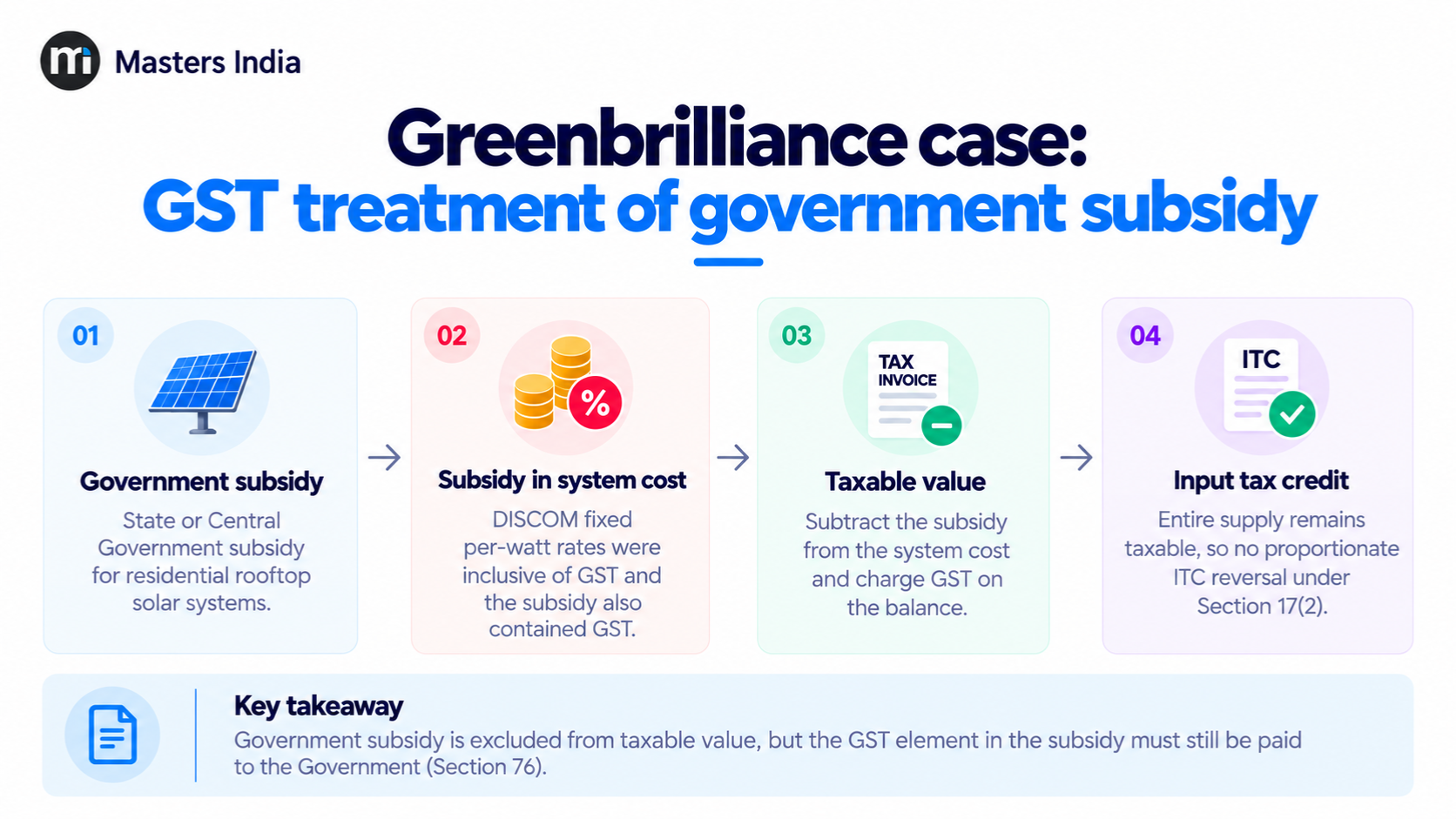 Citation: 2022 (61) G.S.T.L. 114 (A.A.R. - GST - Guj.); Advance Ruling No. GUJ/GAAR/R/34/2021 dated 30-7-2021. Bench: Shri Arun Richard, Member (Central) and Shri Sanjay Saxena, Member (State).
Facts of the Greenbrilliance case
The applicant supplies solar PV panels and solar EPC services. It was empanelled as a channel partner under the Surya Gujarat Yojana (2019-20 and 2020-21) through PGVCL's EOI dated 20-7-2019 for grid-connected residential rooftop systems.
- Residential consumers received a subsidy of 40% of system cost for capacity up to 3 kW and 20% for capacity from 3 kW to 10 kW. State and MNRE subsidies were alternatives, not cumulative.
- Per-watt rates were discovered through tender and fixed by the DISCOM. The EOI stated repeatedly that these rates were inclusive of GST and all other taxes.
- The consumer paid the channel partner the system cost minus the subsidy. After commissioning, the DISCOM released the subsidy directly to the channel partner.
- The applicant had been charging GST at the effective rate of 8.9% on the full system cost, including the subsidy portion.
Questions considered by the Gujarat AAR (AS REPHRASED AT HEARING)
The original questions on "ex-factory value", refund of excess tax, and directions to other suppliers were narrowed. Questions on refund and directions to others were held outside Section 97(2). The applicant then asked:
- Should the subsidy be reduced from the system price declared by the nodal agency to arrive at the taxable value?
- What is the implication of Section 17(2) if taxable value is derived after subtracting the subsidy?
Key findings of the Gujarat AAR
Evidence of government source. The applicant could not itself prove that the Government bore the subsidy. The Authority wrote to Gujarat Urja Vikas Nigam Ltd. (GUVNL), the nodal agency, which confirmed that the subsidy was given by the State or Central Government and that the DISCOM was only a facilitator (para 12).
Exclusion from value. On that basis, the subsidy was held excludible from the value of supply under Section 15(2)(e) (para 13).
GST element in the subsidy. The Authority then examined the EOI and the letter of intent dated 7-10-2020. Every rate was inclusive of GST, and the subsidy was calculated as a percentage of that GST-inclusive rate. The subsidy therefore itself contained a GST component (paras 14-15).
Section 76. Relying on Article 265 and Section 76(1), the Authority held that the applicant had collected the subsidy, inclusive of GST, from the Government. It must pay that GST element to the Government, notwithstanding that the subsidy is excluded from taxable value (para 16).
Section 17(2). Deducting the subsidy affects only valuation. The supply remains wholly taxable, not partly exempt. No proportionate reversal of input tax credit arises (para 17).
What did the Gujarat AAR rule in Greenbrilliance?
- The taxable value on the tax invoice to the customer shall be arrived at after deducting the subsidy from the "System Cost", and GST is payable on that value.
- Section 17(2) has no implication.
- Para 16 (the Section 76 finding) is to be read into the pronouncement.
The ruling is recorded as against the assessee.
Why the Greenbrilliance ruling is revenue-neutral
Run through the applicant's own 4.29 kW example, the ruling produces exactly the same total GST as taxing the full system cost: Rs. 16,036.02. The reduced invoice value lowers the tax shown to the customer, but paragraph 16 claws the difference back from the subsidy.
The example: 4,290 Wp of panels at Rs. 45.738 per Wp gives a GST-inclusive system cost of Rs. 1,96,216.02. The subsidy, computed on a 4.2 kW inverter, is Rs. 65,862.72 (40% on 3 kW plus 20% on 1.2 kW). The customer pays Rs. 1,30,353.30. Effective GST rate at the time: 8.9%.
| Amount (Rs.) | Method A: GST on full system cost | Method B: GST after deducting subsidy | AAR outcome: Method B + para 16 |
| GST-inclusive amount taxed on invoice | 1,96,216.02 | 1,30,353.30 | 1,30,353.30 |
| Taxable value on invoice | 1,80,180.00 | 1,19,700.00 | 1,19,700.00 |
| GST on customer invoice | 16,036.02 | 10,653.30 | 10,653.30 |
| GST element in subsidy payable under Section 76 | – | – | 5,382.72 |
| Total GST to Government | 16,036.02 | 10,653.30 | 16,036.02 |
The GST element in the subsidy is its tax fraction at the inclusive rate:
65{,}862.72 \times \frac{8.9}{108.9} = 5{,}382.72
The arithmetic is not a coincidence. Because the tender price and the subsidy are both GST-inclusive, the tax fraction of the whole always equals the tax fraction of its two parts. The practical gain from Ruling (1) is therefore nil: the customer's invoice shows less tax, but the supplier pays the balance out of the subsidy. The applicant's original method (Method A) produced the correct total liability all along.
Note: The ruling's summary of the applicant's example states the GST as "15036.02" in one place; the computation itself gives Rs. 16,036.02, which appears to be the intended figure.
Critical analysis of the Greenbrilliance subsidy ruling
The ruling is sound on valuation and input tax credit, but its use of Section 76 is debatable.
- Section 76 sits uneasily with Section 15(2)(e). Section 76(1) applies where a person has collected an amount "as representing the tax" and not paid it over. Having held that the subsidy is outside the value of supply, the Authority nonetheless treated part of it as tax collected. The Government did not pay any amount as tax; it paid a scheme benefit computed as a percentage of a benchmark rate that happened to be GST-inclusive. A contrary view is available that the benchmark is only a measure, and the subsidy is a single, tax-free amount. The Authority's answer, grounded in Article 265, is that a supplier should not retain a tax component it was paid on a tax-inclusive price. Suppliers should expect Revenue to press that view.
- The DISCOM voucher points both ways. The subsidy payment voucher placed on record showed release after deduction of TDS, GST, cess and performance security (para 9(g)). If the DISCOM deducted GST TDS under Section 51 on the subsidy, it treated the payment as consideration for a taxable supply. That supports the Revenue position that tax is embedded in the subsidy. It also underlines that the supplier's GST treatment must reconcile with the deductor's Form GSTR-7 credits.
- The Section 17(2) finding is correct. Section 17(2) apportions credit between taxable and exempt supplies. Excluding a government subsidy from value does not convert any part of a taxable supply into an exempt one. No proportionate reversal of credit on panels, inverters or services is required. This part of the ruling is of general application to all subsidised supplies.
- Evidence decides the source test. The applicant could not show that the Government bore the subsidy; the Authority had to obtain confirmation from GUVNL. Suppliers in other States, or under other schemes, cannot assume the same. A DISCOM or PSU that funds a "subsidy" from its own resources is not the Government, and the exclusion would fail.
- Binding effect. Under Section 103, an advance ruling binds only the applicant and the jurisdictional officers in respect of the applicant. For all other suppliers the ruling is persuasive, not binding. Its reasoning, however, will be influential wherever the scheme price is GST-inclusive.
- Refunds are unlikely to succeed. The refund question was held outside Section 97(2). On the ruling's own logic, a supplier who paid GST on the full system cost paid the correct total, so there is no excess to refund. Any claim would also face the unjust enrichment test in Section 54.
GST compliance checklist for suppliers receiving subsidies
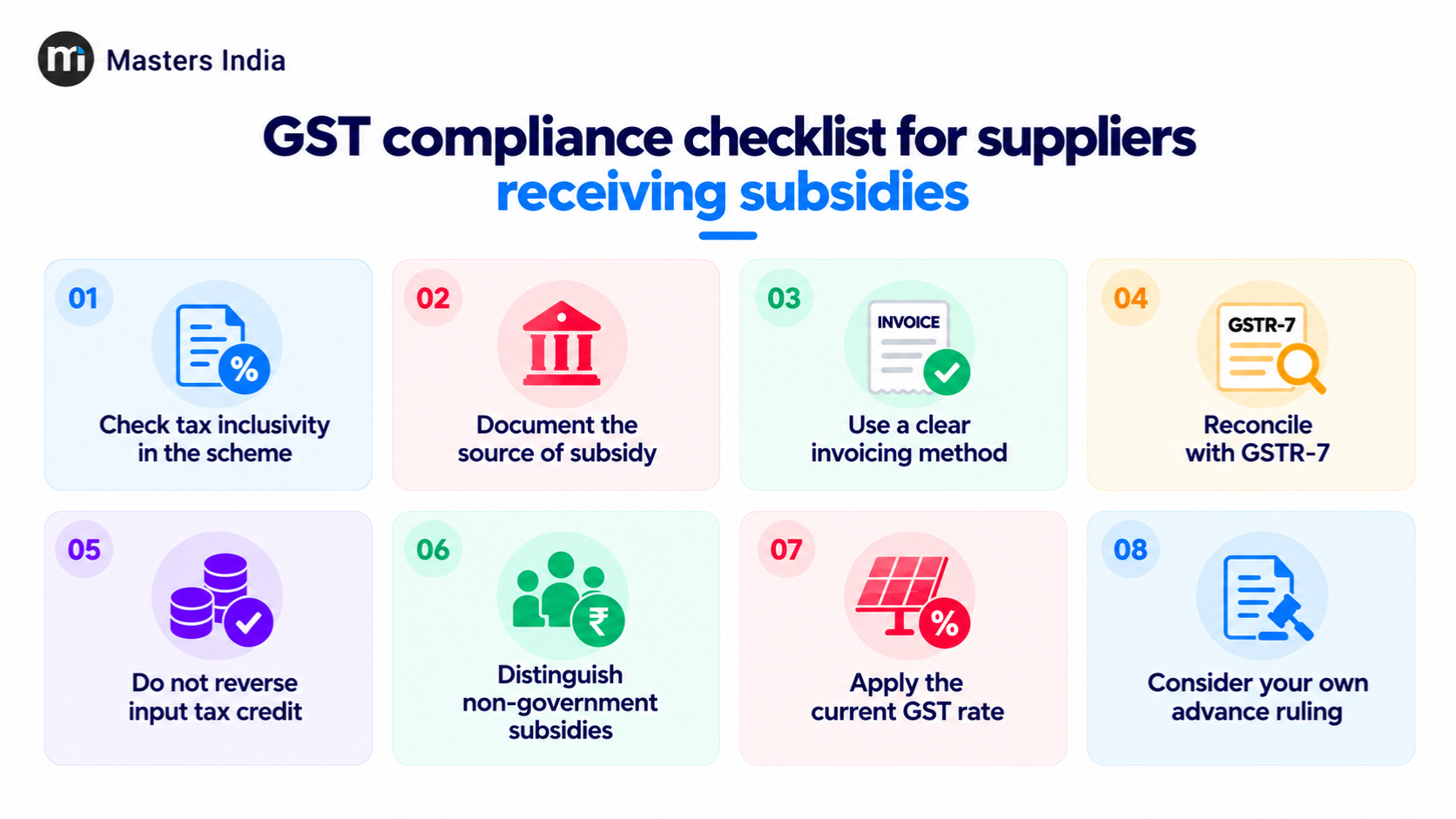
- Read the scheme document for tax inclusivity. If the benchmark or tender rate is "inclusive of GST" and the subsidy is a percentage of that rate, plan on the total GST equalling tax on the full system cost, whichever way the invoice is drawn.
- Document the source of the subsidy. Keep the scheme notification, the nodal agency's confirmation that funds come from the State or Central Government, and each release voucher. Without this, the Section 15(2)(e) exclusion is not available.
- Choose one invoicing method and apply it consistently. Show the gross system cost, the subsidy and the customer's share separately, and make the tax figure reconcile with the subsidy released. Suppliers following the ruling should account for the GST element in the subsidy in the same tax period in which the subsidy is received.
- Reconcile with GSTR-7. Where the DISCOM deducts GST TDS on the subsidy, match those credits with the output tax reported. Mismatches will generate notices.
- Do not reverse input tax credit. The exclusion of a government subsidy from value does not create an exempt supply. Section 17(2) and Rule 42 do not apply on that account.
- Distinguish non-government subsidies. A manufacturer's scheme payment to a dealer, or a trust's contribution per beneficiary, is included in value under Section 15(2)(e) and its Explanation. Tax it in the hands of the supplier who receives it.
- Check the current rate. The 8.9% effective rate in the ruling reflected the rates for solar power generating systems and the deemed 70:30 goods-services split applicable at the time. Rates for solar systems have since been revised; apply the rate notified for the date of supply.
- Consider your own advance ruling. Because the ruling binds only the applicant, a supplier with high subsidy volumes may seek its own ruling, particularly under a scheme whose price is stated exclusive of GST.
What should suppliers remember about GST valuation of subsidies?
Section 15(2)(e) keeps government subsidies outside the taxable value, and Greenbrilliance confirms that this can remain true even where the amount is routed through a DISCOM, provided the supplier can prove that the Central or State Government is the real source. However, where the scheme price itself is GST-inclusive, the ruling shows that excluding the subsidy from the customer invoice may not create any real tax saving because the GST element can still be recovered through Section 76.
The practical lesson is to document the subsidy source, check whether the scheme price is tax-inclusive, reconcile GSTR-7 credits, and avoid unnecessary ITC reversal where the underlying supply remains taxable. Masters India can support businesses with GST reconciliation, invoicing, and compliance workflows for subsidy-linked transactions.
About the Author

- ★★
- ★★
- ★★
- ★★
- ★★
Check out other Similar Posts

CFO Weekly Digest
A weekly newsletter delivering sharp insights, strategic analysis, and critical updates on business, finance, and compliance — designed exclusively for CFOs and Finance Leaders
Masters India is a GST Suvidha Provider (GSP) appointed by Goods and Services Tax Network (GSTN), a Government of India enterprise.
 Procapitus Business Park, 4th Floor, D 247/4A, Sector 63 Rd, Noida, Uttar Pradesh 201301
 info@mastersindia.co




Certified