
GST Summons to Firms: Who Must Appear & Authorized Representatives

Issuance of Summons to Firms/Companies
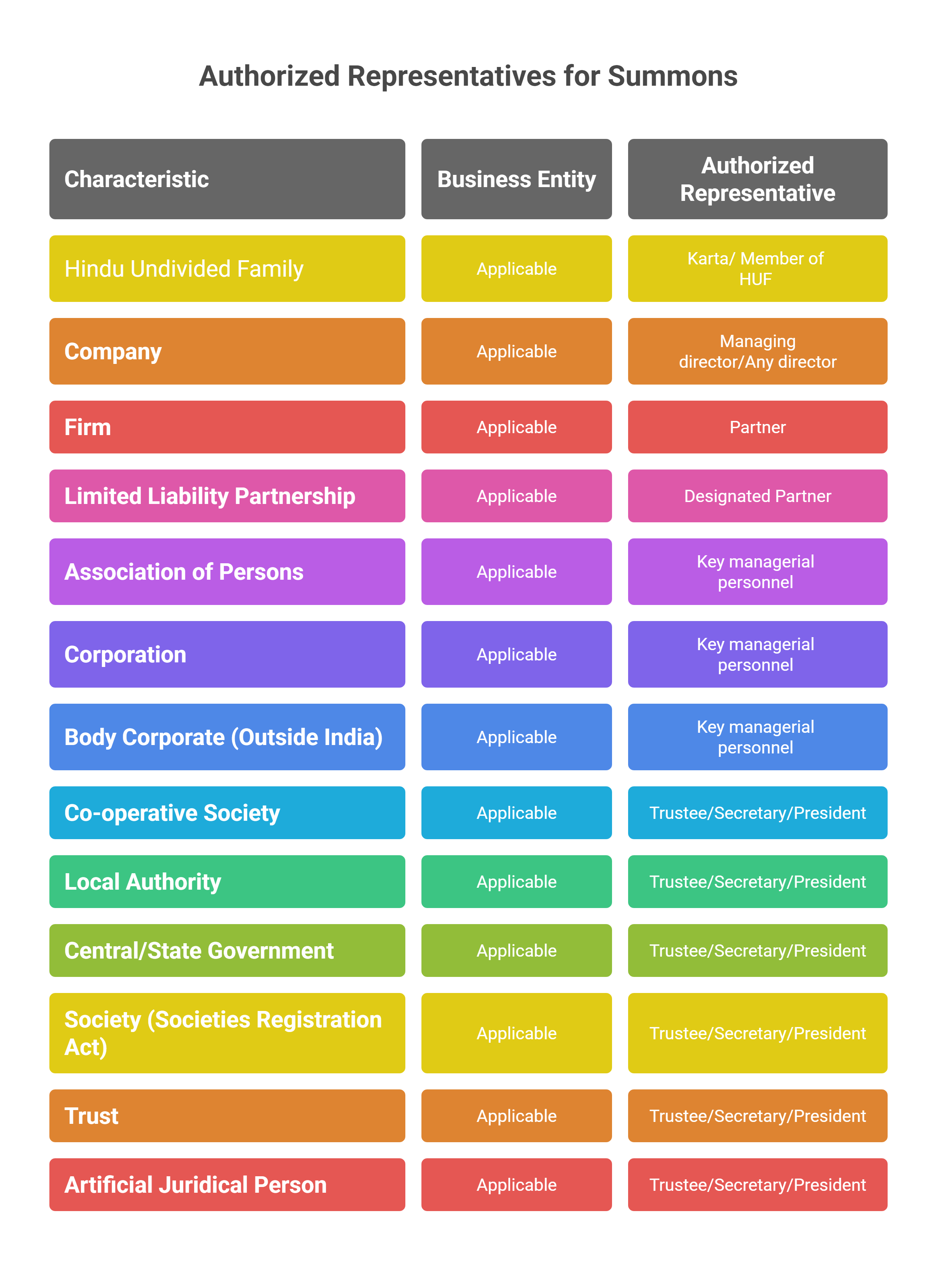
When dealing with business entities that are non-individuals, the taxable person can be any entity as defined in section 2(84) of the CGST Act, 2017. This includes:
- (a) A Hindu Undivided Family;
- (b) A company;
- (c) A firm;
- (d) A Limited Liability Partnership;
- (e) An association of persons or a body of individuals, whether incorporated or not, in
- India or outside India;
- (f) Any corporation established by or under any Central Act, State Act, or Provincial
Act, or a Government company as defined in clause (45) of section 2 of the Companies Act, 2013;
- (g) Any body corporate incorporated by or under the laws of a country outside India;
- (h) A co-operative society registered under any law relating to co-operative societies;
- (i) A local authority;
- (j) Central Government or a State Government;
- (k) A society as defined under the Societies Registration Act, 1860;
- (l) A trust; and
- (m) Every artificial juridical person, not falling within any of the above.
Since these entities are non-individuals and artificial/legal persons, they cannot be present in person. Therefore, they must be represented by an authorized representative, who could be one of the following:
- (a) Managing director/whole time director/executive director
- (b) Any director
- (c) Partner
- (d) Designated partner
- (e) Key managerial personnel - CEO/CFO/company secretary, etc.
- (f) Trustee/Secretary/President, etc., in the case of other enterprises.
About the Author

- ★★
- ★★
- ★★
- ★★
- ★★

Check out other Similar Posts

CFO Weekly Digest
A weekly newsletter delivering sharp insights, strategic analysis, and critical updates on business, finance, and compliance — designed exclusively for CFOs and Finance Leaders
Masters India is a GST Suvidha Provider (GSP) appointed by Goods and Services Tax Network (GSTN), a Government of India enterprise.
 Procapitus Business Park, 4th Floor, D 247/4A, Sector 63 Rd, Noida, Uttar Pradesh 201301
 info@mastersindia.co



Certified