

While most corporate finance leaders and tax heads focus their governance efforts on rate slates, monthly filing deadlines, and standard vendor reconciliations, subtle classification nuances, inter-state stock movement mechanics, and e-way bill validity rules quietly generate severe working capital drag. Corporate tax compliance is rarely limited to administrative routine; it demands strategic legal positioning where standard commercial logic often collides with strict GST statutory interpretations.
Misinterpreting inter-state transfers of capital assets, falling into retail packaging tax traps, or failing to optimise supply chain warehousing can lock up millions in unrecoverable tax payments or invite aggressive penalty proceedings.
This executive briefing provides a curated analysis of five counter-intuitive GST rules and advance rulings. By mastering these statutory mechanics, CFOs and Tax Heads can proactively eliminate unforced penalty exposures, defer tax liabilities legally, and unlock trapped cash flow across corporate supply chains.
Can declaring a transporter godown reduce e-way bill expiry issues?
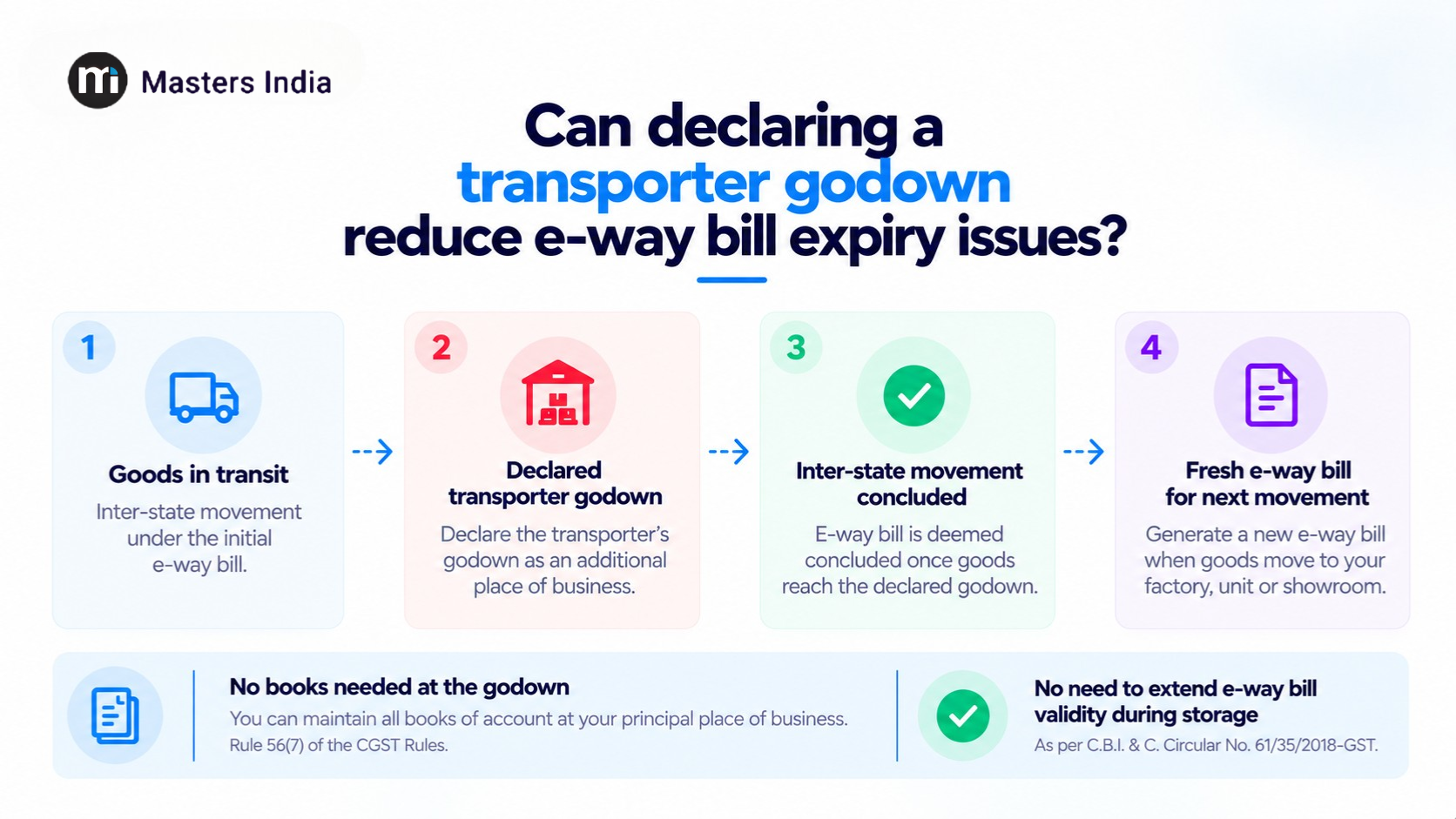 When moving goods across long distances, inventory frequently sits in third-party logistics (3PL) transit hubs or transporter godowns awaiting final delivery instructions. Under routine logistics management, monitoring e-way bill expiry dates and filing manual extensions during storage creates a heavy operational burden, and any oversight risks inventory detention and hefty penalties under Section 129 of the CGST Act.
C.B.I. & C. Circular No. 61/35/2018-GST offers an elegant, counter-intuitive solution. A recipient taxpayer storing goods at a transporter’s godown can formally declare that godown as an additional place of business. This legal procedure requires only a simple online declaration on the GST portal accompanied by written concurrence from the transporter.
Once declared, the inter-state transportation under the initial e-way bill is legally deemed to be concluded the moment the consignment reaches the transporter’s godown. Consequently, the recipient is freed from the obligation to extend the original e-way bill validity during storage. When goods are subsequently moved from the transporter’s godown to any factory, unit, or showroom of the recipient, a fresh e-way bill is generated under applicable State-specific rules.
To address compliance concerns regarding books of account, Rule 56(7) of the CGST Rules explicitly clarifies that taxpayers need not keep accounting records at the transporter's godown;
all books of account relating to goods stored at such declared premises can be legally maintained at the taxpayer's principal place of business.
"Where the transporter's godown has been declared as the additional place of business by the recipient taxpayer, the transportation under the e-way bill shall be deemed to be concluded once the goods have reached the transporter's godown... Hence, e-way bill validity in such cases will not be required to be extended." - C.B.I. & C. Circular No. 61/35/2018-GST
CFO Strategy Check
- Logistics Governance Audit: Identify top 3PL transit hubs where inventory sits beyond initial e-way bill validity windows and execute additional place of business declarations with transporter concurrence.
- Compliance Process Automation: Ensure standard operating procedures (SOPs) trigger a fresh e-way bill only upon final movement from the transporter's godown to internal plants, halting unnecessary e-way bill extension workflows.
When is inter-state movement of machinery not subject to IGST?
Companies operating in capital-intensive sectors-such as infrastructure, oil and gas, construction, and engineering-frequently move high-value capital assets across state lines to execute project work. Finance teams often treat these relocations as taxable stock transfers between "distinct persons" under Section 25(4) of the CGST Act, paying upfront Integrated GST (IGST) and locking up critical liquidity in input tax credit (ITC) accumulation.
Synthesizing C.B.I. & C. Circular Nos. 1/1/2017-GST, 21/21/2017-GST, and 80/54/2018-GST reveals a critical legal distinction that exempts these asset movements from IGST levy:
- Wheeled Conveyances & Cranes (Circular No. 1/1/2017-GST): The inter-state movement of conveyances, rigs, tools, spares, and goods on wheels (such as mobile tower cranes) between distinct entities under Section 25(4) for carrying goods/passengers or for repairs and maintenance is statutory treated as "neither a supply of goods nor a supply of service," provided the movement is not for further supply of the equipment. Thus, no IGST applies.
- Non-Wheeled Heavy Machinery (Circular No. 80/54/2018-GST): For heavy machinery used in infrastructure projects that is not mounted on wheels-such as tower cranes, drilling rigs, batching plants, concrete pumps, and industrial mixers-movement across state lines for provision of services on own account does not constitute a supply, provided no transfer of title or stock transfer to a distinct person occurs.
Tax heads must carefully separate capital asset movements from repair and maintenance services performed on such machinery; actual repair services supplied on conveyances or equipment remain taxable under applicable CGST/SGST/IGST rates.
"...such inter-state movement shall be treated 'neither as a supply of goods nor supply of service,' and consequently no IGST would be applicable on such movements." - C.B.I. & C. Circular No. 1/1/2017-GST
CFO Strategy Check
- Capital Transfer Audit: Review past inter-state movements of heavy machinery, rigs, and cranes to verify whether IGST was erroneously remitted on non-supply transfers under Section 25(4).
- Asset Tracking SOPs: Establish clear operational documentation (delivery challans denoting "movement for provision of service on own account") to establish that title and ownership remain unchanged during inter-state site deployments.
Does product branding or end-use change GST classification?
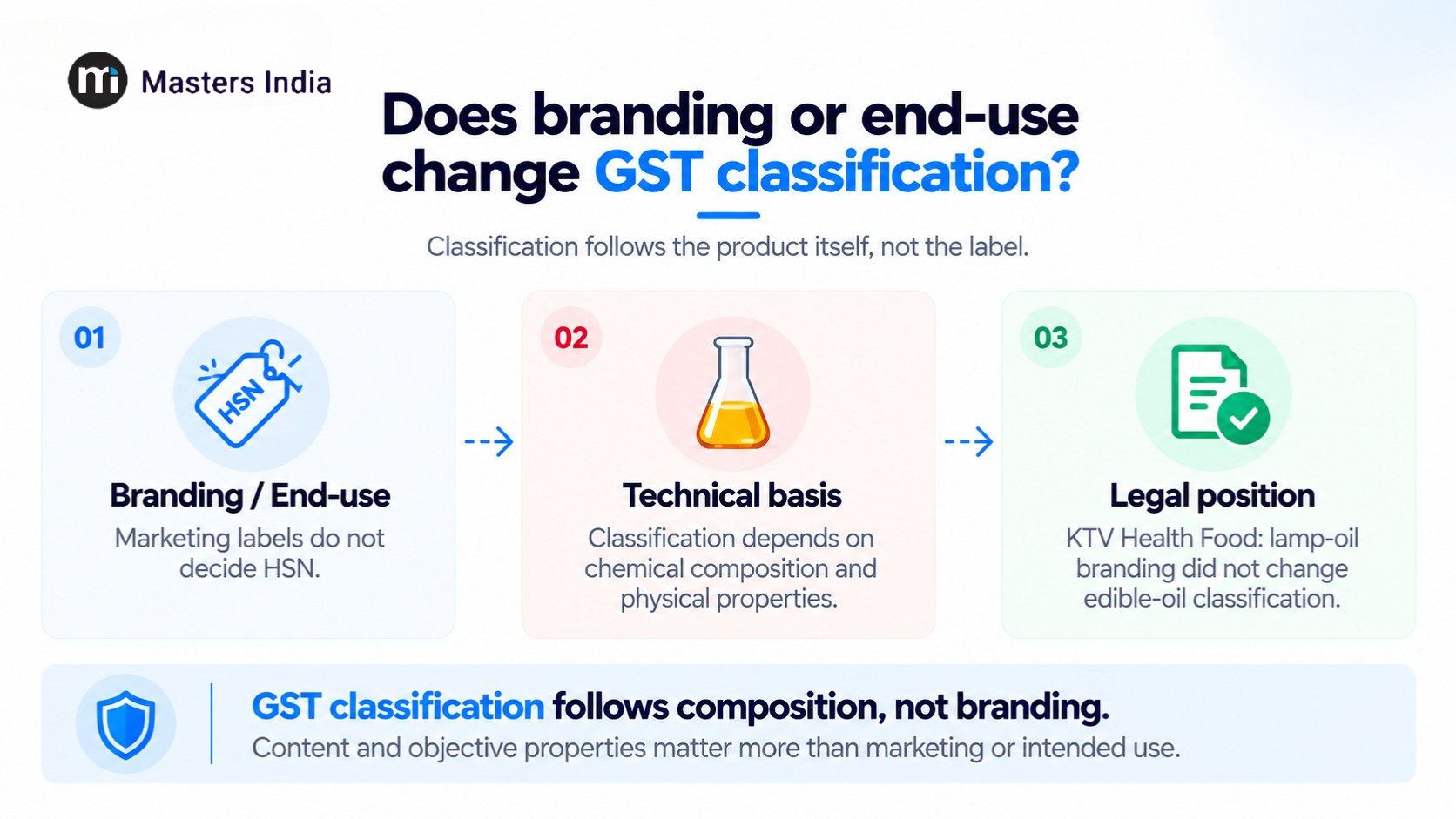 A frequent trap for corporate tax heads is classifying finished products or raw materials based on marketing labels, customer usage, or commercial positioning rather than intrinsic technical and chemical parameters.
In KTV Health Food (P.) Ltd., the applicant repacked and marketed refined vegetable oils (refined rice bran oil and RBD palmolein oil) as "lamp oil" for religious lighting. The product held an FSSAI license and met standard edible oil specifications. The Authority for Advance Ruling (AAR) held that marketing an edible-grade product for non-edible commercial uses like lamp lighting does not alter its fundamental classification under HSN Heading 1511/1515. Classification under GST tariff schedules is governed strictly by objective chemical composition and physical properties, not by commercial branding or intended end-use.
This principle operates symmetrically across tariff chapters. In Commissioner v. Jocil Ltd., the Supreme Court established that non-edible industrial grade oils fall completely outside Chapter 15's edible oil categories because the essential element of edibility is absent from the product's objective technical specifications.
Relying on marketing copy or customer declarations rather than certified laboratory test reports creates severe exposure to tax demands, retroactive interest, and misclassification penalties during GST audits.
"...classification depended on content and not intended end use, so product was classifiable under Heading 1515 90 40 irrespective of its marketing as lamp oil." - In re KTV Health Food (P.) Ltd. [2025] 179 taxmann.com 535 (AAR - Tamil Nadu)
CFO Strategy Check
- Technical HSN Review: Audit product catalogs to ensure HSN classifications align strictly with certified chemical compositions, FSSAI licenses, and laboratory test parameters rather than marketing or sales pitch decks.
- Vendor Contract Defense: Ensure procurement contracts for raw materials require suppliers to provide technical specifications and lab analysis certificates to defend input tax credit classifications against audit queries.
When is GST payable on goods sent for display or approval?
Moving high-value commercial inventory, industrial capital samples, or specialised products across state borders for display, customer approval, or consignment exhibitions often leads finance teams to trigger pre-sale IGST liabilities prematurely.
Under C.B.I. & C. Circular No. 22/22/2017-GST (governing art gallery displays) and Circular No. 10/10/2017-GST (governing movements on an approval basis), moving goods across state boundaries without initial consideration does not constitute a taxable supply at the point of removal. Such movements are executed cleanly under cover of a delivery challan along with a valid e-way bill.
Because no monetary consideration flows when goods are dispatched for display or approval, tax liability is legally deferred. The actual inter-state supply fructifies-and IGST liability is triggered-only when the ultimate buyer selects the item, the sale is confirmed, and a tax invoice is issued.
To maintain strict operational compliance during approval sales, sales personnel or representatives carrying inventory across state lines must carry physical or digital invoice books. This enables immediate generation of a tax invoice at the exact moment the customer selects the goods and the transaction fructifies.
"In case of supply by artists through galleries, there is no consideration flowing from the gallery to the artist when the art works are sent to the gallery for exhibition and therefore, the same is not a supply. It is only when the buyer selects a particular art work... that the actual supply takes place..." - C.B.I. & C. Circular No. 22/22/2017-GST
CFO Strategy Check
- Consignment & Sample Audit: Review inter-state dispatch protocols for trade shows, gallery exhibitions, and customer trials to ensure tax liabilities are deferred until sale fructification.
- Field Sales Compliance: Mandate that field personnel or account managers handling approval movements carry valid invoice books and delivery challans to ensure instantaneous invoice generation upon sale confirmation.
When does the 25 kg/25 L bulk packaging exemption apply?
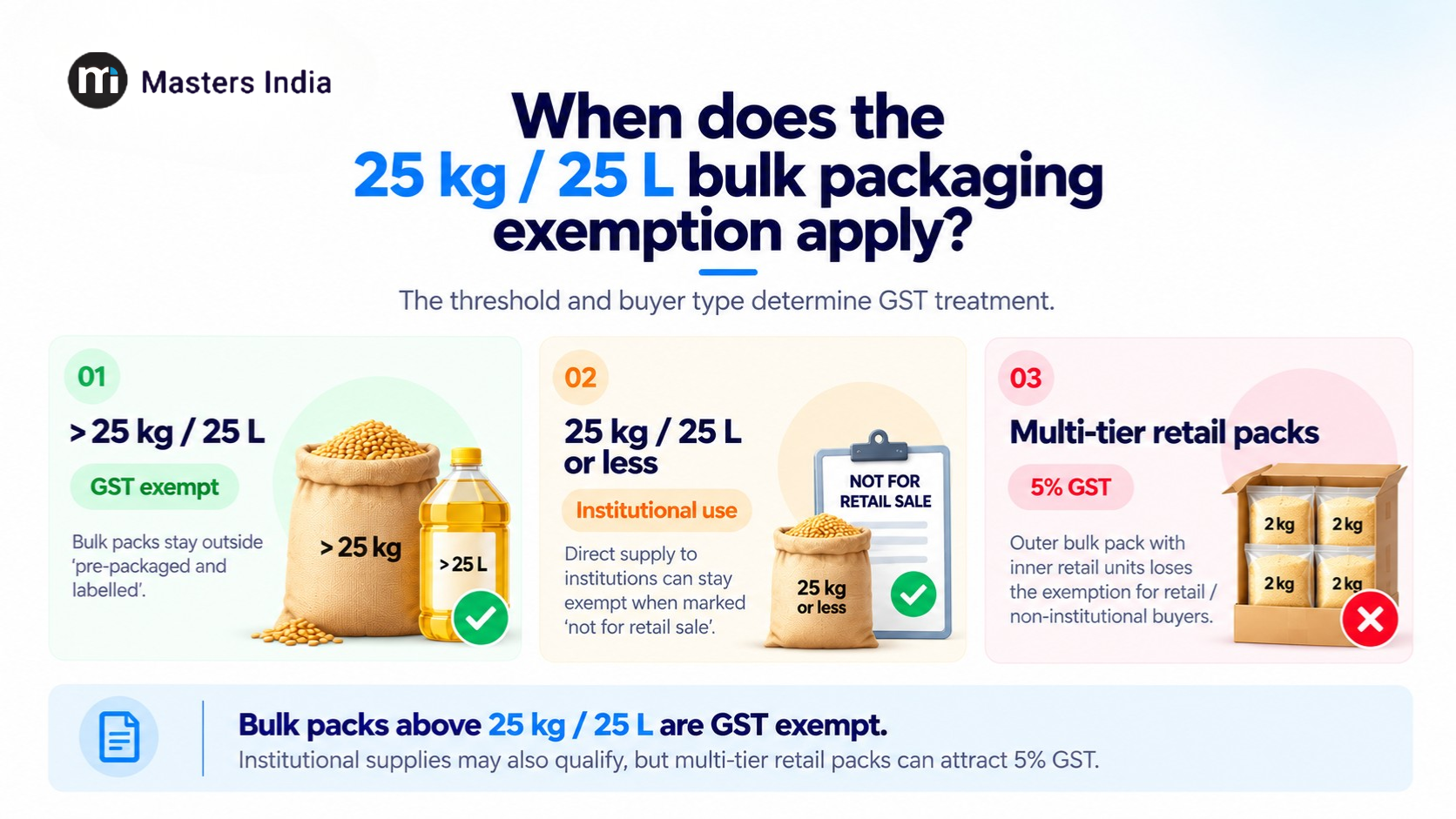 Navigating the tax line between 5% GST on "pre-packaged and labelled" retail commodities and 0% GST on bulk agricultural/food products requires strict adherence to unit thresholds and distribution channels.
Under Circular No. 229/23/2024-GST (amending Notifications No. 1/2017-CT(R) and 2/2017-CT(R) via Notifications 2/2024-CT(R) and 3/2024-CT(R)), packages containing agricultural or food commodities exceeding 25 kilograms or 25 liters in a single container are explicitly excluded from the definition of "pre-packaged and labelled." Consequently, bulk supplies exceeding 25 kg/25 L do not attract the 5% GST levy.
For packages containing 25 kg/25 L or less, corporate procurement and sales teams can leverage the Institutional Consumer Exemption Shield:
- Institutional Exemption (Abhithanjali Traders & Ramdharsan Thanikachalam): Wholesale packages of food commodities (e.g., frozen poultry meat or grains) supplied directly or through certified distribution channels exclusively to institutional consumers (such as the Indian Army, educational institutions, or registered hotels and hospitals) for their own consumption are exempt from 5% GST under Notification No. 2/2017-Central Tax (Rate), provided they are marked "not for retail sale" and meet Legal Metrology declarations.
- The Multi-Tier Packaging Trap (Ramdharsan Thanikachalam): A critical nuance arises when wholesale packs (e.g., a 30 kg outer bag) contain smaller inner retail units (e.g., fifteen 2 kg packs). If such multi-tier packages are supplied to non-institutional or retail buyers, the exemption is completely disallowed, and 5% GST applies across the entire consignment.
Leveraging institutional exemptions properly prevents unrecoverable tax leakage on major procurement contracts while protecting supply chains against pre-packaging tax assessments.
"...exclude the supply of agricultural farm produce in package(s) of commodities containing quantity of more than 25 kilograms or 25 litres from the scope of 'pre-packaged and labelled'. Consequently, supply of agricultural farm produce in package(s) containing quantity of more than 25 kilogram or 25 litre will not attract GST levy of 5%." - C.B.I. & C. Circular No. 229/23/2024-GST
CFO Strategy Check
- Procurement Package Redesign: Audit bulk food and raw material purchases to ensure container sizes exceed 25 kg / 25 L or are structured under compliant institutional consumer contracts to eliminate unnecessary 5% tax friction.
- End-Use Audit Trails: Establish mandatory end-user certificates and Legal Metrology compliance labelling ("not for retail sale") on all institutional supply channels to withstand audit scrutiny.
How can CFOs turn GST compliance into working-capital protection?
Optimising corporate GST management requires finance leaders to look beyond routine filing calendars and examine the statutory mechanics that affect cash flow. Transporter godown declarations, inter-state machinery movements, HSN classification, approval-based dispatches and packaging thresholds can all create avoidable tax costs when they are handled without a clear legal and operational framework.
Tax heads should therefore build a board-level GST risk matrix covering high-exposure classification risks, packaging structures, transporter godown declarations, delivery challan controls and field invoicing processes. The goal is not simply to remain compliant, but to prevent unnecessary tax payments and working-capital blockage before they arise. Masters India can support this through GST software, APIs and compliance workflows that help finance teams strengthen controls across these areas.
About the Author

- ★★
- ★★
- ★★
- ★★
- ★★
Check out other Similar Posts

CFO Weekly Digest
A weekly newsletter delivering sharp insights, strategic analysis, and critical updates on business, finance, and compliance — designed exclusively for CFOs and Finance Leaders
Masters India is a GST Suvidha Provider (GSP) appointed by Goods and Services Tax Network (GSTN), a Government of India enterprise.
 Procapitus Business Park, 4th Floor, D 247/4A, Sector 63 Rd, Noida, Uttar Pradesh 201301
 info@mastersindia.co




Certified