
GST Refunds on Export Inputs: A CFO’s 2025 Compliance Playbook 📊✈️

GST Refunds on Export Inputs 2025 CFO
Exports remain zero-rated under India’s GST, yet the cash locked in input tax credit (ITC) can strain working capital if the refund process is inefficient. Below is a walkthrough—precise on law, practical for finance leaders—to ensure every rupee spent on export inputs makes its way back to your bank account.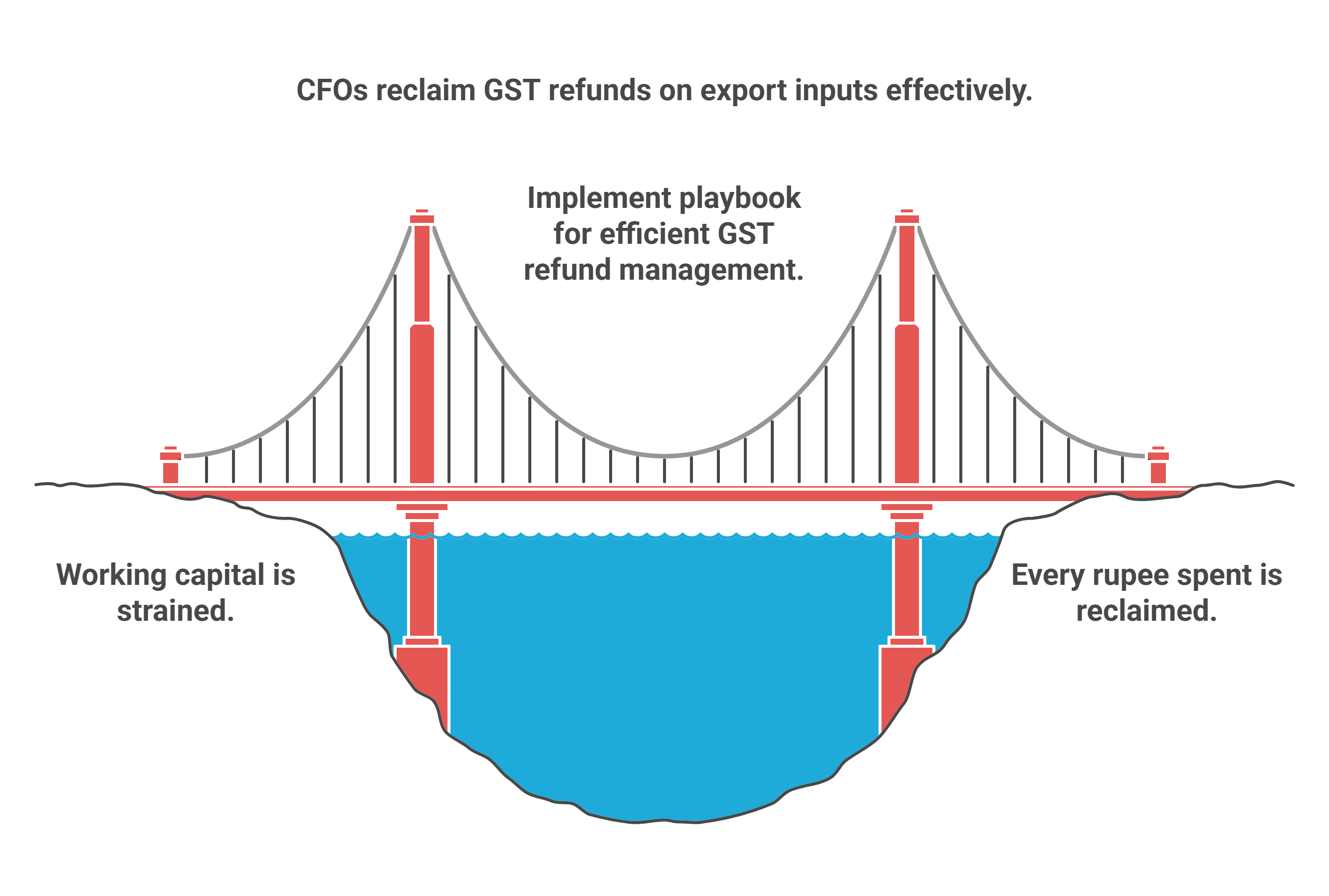
1. Legal Backbone (What the Law & Procedure is)
|
Provision |
Why it matters |
|
Sec. 54 CGST Act |
Governs all GST refunds, including the two-year filing clock. |
|
Sec.16 IGST Act |
Declares exports zero-rated, unlocking ITC refunds or IGST rebates. |
|
Rule 89 CGST Rules |
Lays down the forms, formulae and documentation (Statements 3, 3A, 9A, 9B). |
|
Rule 89(1B) |
Allows for a refund of the additional IGST paid later, as the export price increased. Inserted via Notification 12/2024-CT, 10 Jul 2024. |
|
Rule 96A (amended) |
Extends the time to realise export proceeds to FEMA timelines (no longer a 1-year limit). |
|
Circular 226/20/2024-GST |
Prescribes the documentary pack for refunds of additional Integrated Goods and Services Tax (IGST). |
|
GSTN Advisory 14 Jul 2024 |
Temporary portal workaround—file under “Any other” until a dedicated category appears. |
2. Two Pathways to Liquidate Your Tax Credit
|
Route |
Cash-flow impact |
What you actually claim |
|
A. LUT / Bond (No IGST at port) |
Neutral—no IGST blocked |
Refund of unutilised ITC on inputs & input services via RFD-01 |
|
B. Pay IGST at Customs |
Negative initially; refund automatically |
Customs auto-credits basic IGST refund under Rule 96(3). Additional IGST due to later price hikes is reclaimed separately via RFD-01 (Rule 89(1B)). |
3. Step-by-Step Road-Map (Route A: Unutilised ITC)
-
House-keeping
-
File GSTR-1 & 3B for the period; reconcile with books and ICEGATE shipping data.
-
-
LUT in place
-
Furnish/renew Letter of Undertaking (Form GST RFD-11) before export.
-
-
Prepare RFD-01
-
Fill Statement 3A (turnover & ITC), auto-populate invoices from GSTR-1.
-
-
Attach evidence
-
Shipping bills, export invoices, BRC/FIRC (services) or proof of export (goods), inward supply invoices, self-certified reconciliation of ITC.
-
-
Debit ITC ledger equal to the claim.
-
Track Deficiency Memo (RFD-03) and respond within 15 days to avoid fresh filing.
-
Refund Order (RFD-06) & payment advice (RFD-05)—funds hit the bank via PFMS.
Time-limit – File within 2 years from the “relevant date”. Delay = forfeiture, unless the Commissioner condones under specific circulars.
4. Step-by-Step Road-Map (Route B: Additional IGST After Price Revision)
-
Pay supplementary IGST
-
Issue debit note/supplementary invoice; discharge tax via GSTR-3B.
-
-
File RFD-01 under “Any other” (until GSTN launches the new category).
-
Upload Statements 9A & 9B with:
-
Original & supplementary invoice numbers
-
Shipping-bill details
-
Proof of extra remittance (FIRC/BRC)
-
Proof of additional IGST payment & CA/CMA certificate (Rule 89 (2)(bb),(bc)).
-
-
The two-year clock runs from the date of the supplementary shipping bill/invoice, with a one-time grace period for older exports (Rule 89(1B) proviso).
-
Processing by a jurisdictional GST officer (not Customs) as per Circular 226/20/2024.
5. “Relevant Date” Decoder (for the two-year rule)
-
Sea/Air – Date vessel/aircraft leaves India.
-
Land – Date goods cross the frontier.
-
Post – Date of dispatch by post office.
-
Services (payment pre-export) – Invoice date.
-
Services (payment post-export) – Receipt date.
-
Deemed exports – Return filing date reporting the supply.
-
Price-revision IGST – Shipping-bill date of the supplementary invoice (Rule 89(1B)).
6. Exceptions & Extensions CFOs Should Exploit
|
Scenario |
Relief |
|
Payment for services not realised in 1 year |
Commissioner may grant further time aligned to FEMA extensions. |
|
Delayed exports (beyond LUT’s 3-month window) |
Post-facto extension possible by Commissioner; notify via DRC-20. |
|
Portal category missing |
Use “Any other” with proper remarks until GSTN releases the new refund tile. |
|
Amount < ₹1,000 |
Statutory de-minimis—no refund processed (s 54(14)). |
7. Governance Checklist for Finance Leaders ✅
-
One-click ITC tracker – Automate ledgers to flag ineligible or blocked credits (Rules 38, 42, 43).
-
Shipping-bill ↔ Invoice mapping – Ensure ICEGATE & GSTR-1 data match; customs suspends refund for mismatches.
-
Contract clauses – Capture price-revision terms upfront. Easier to justify additional IGST refunds.
-
Document vault – Digitally store invoices, FIRCs, CA certificates; retention = 72 months (Sec. 36 CGST Act).
-
Quarterly mock audit – Simulate refund scrutiny; identify gaps before GST authorities do.
-
ERP patches – Enable LUT renewal alerts, Rule 89 Excel output, and auto-generation of Statements 9A/9B.
-
Litigation watch – Track High-Court rulings on inverted duty refunds and export duty denial to strategise claims.
8. Common Pitfalls Triggering Refund Rejections 🚩
-
Availing drawback + ITC refund on the same goods.
-
Exporting goods that attract export duty (no ITC refund).
-
Failing to debit the electronic credit ledger when filing RFD-01.
-
Using ineligible credits (motor vehicles, personal consumption) in the refund formula.
-
Mismatched port codes or invoice values between GSTR-1 & shipping bill.
-
BRC/FIRC not reflecting full consideration for service exports.
9. Strategic Take-aways for CFOs
-
Cash-flow Predictability – Treat refund lead-time as a KPI; escalate if RFD-06 exceeds 60 days.
-
Policy Awareness – Notification 12/2024-CT now lets you claw back extra IGST—use it.
-
Documentation Culture – The strongest defence in a refund audit is contemporaneous paperwork.
-
Tech Integration – Invest in GST-ERP connectors that auto-populate RFD-01 and reconcile ICEGATE data.
-
Continuous Learning – Refund rules shift fast; schedule quarterly trainings for your tax team.
Final Word
Export refunds are no longer a clerical task—they’re a strategic liquidity lever. Deploy the controls above, stay alert to 2024-25 rule changes, and you’ll maintain a healthy working capital position and keep regulators satisfied.
Do you have a specific scenario or sector-specific nuance? Drop a note, and I’ll break it down with case law and practical structuring tips.
About the Author

- ★★
- ★★
- ★★
- ★★
- ★★

Check out other Similar Posts

CFO Weekly Digest
A weekly newsletter delivering sharp insights, strategic analysis, and critical updates on business, finance, and compliance — designed exclusively for CFOs and Finance Leaders
Masters India is a GST Suvidha Provider (GSP) appointed by Goods and Services Tax Network (GSTN), a Government of India enterprise.
 Procapitus Business Park, 4th Floor, D 247/4A, Sector 63 Rd, Noida, Uttar Pradesh 201301
 info@mastersindia.co




Certified