
GST Refund on Electricity Exports: Rules, ITC, and Key Judgments

Are electricity exports eligible for GST refunds? Under Section 16 of the IGST Act, 2017, the export of electrical energy to a neighbouring country is treated as a "zero-rated supply," entitling the generating company to claim a refund of unutilized Input Tax Credit (ITC). However, because electricity is an intangible commodity transmitted via cross-border power grids rather than physical ports, exporters faced significant hurdles when attempting to claim their statutory refunds.
The procedural hurdle: The impossibility of shipping bills
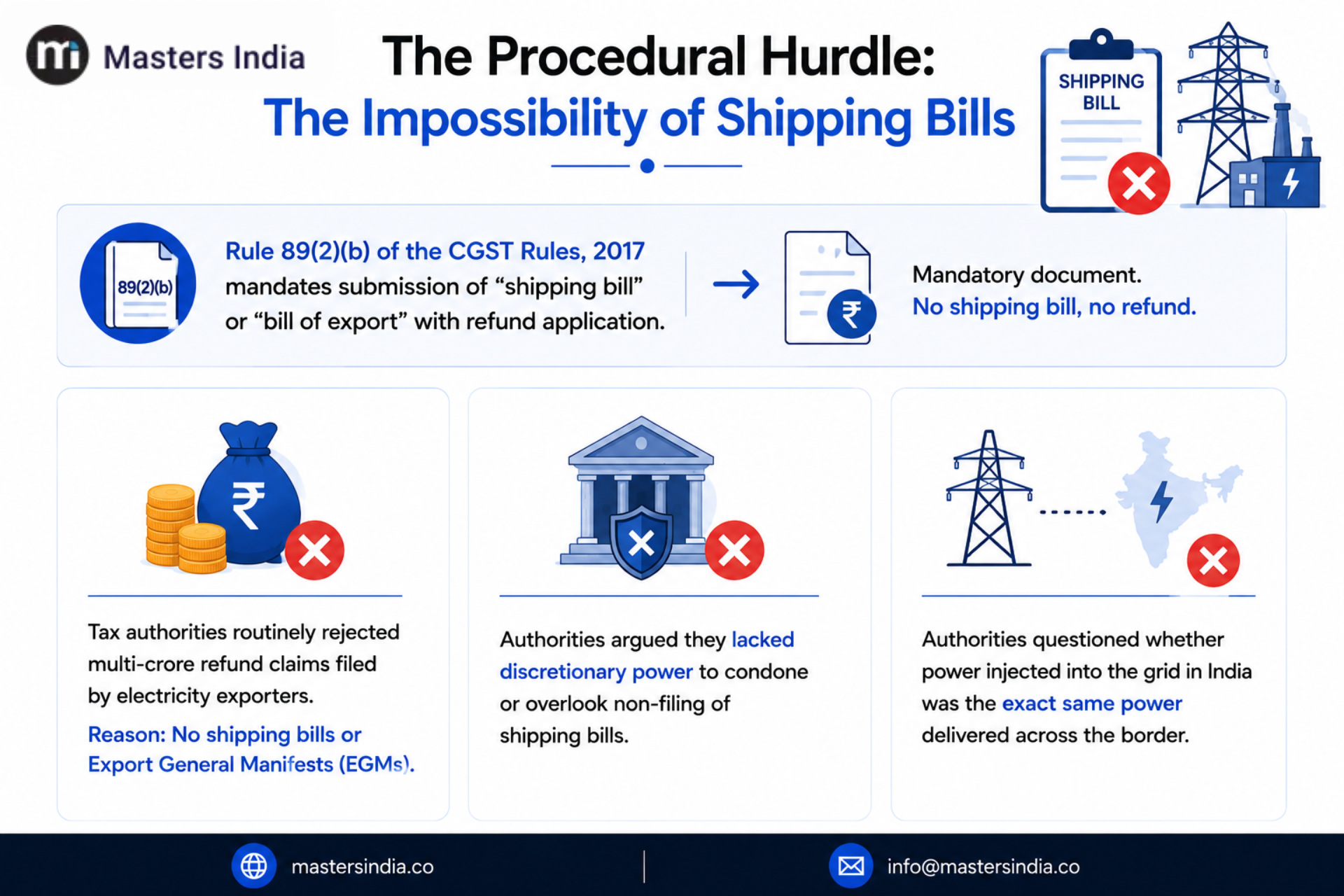 The primary obstacle for power generating units was Rule 89(2)(b) of the CGST Rules, 2017, which strictly mandated the submission of a "shipping bill" or "bill of export" along with the refund application.
- Tax authorities routinely rejected multi-crore refund claims filed by electricity exporters on the grounds that no shipping bills or Export General Manifests (EGMs) were produced.
- Authorities further argued that they lacked discretionary power to condone or overlook the non-filing of shipping bills, and questioned whether the power injected into the grid in India was the exact same power delivered across the border.
Judicial intervention and the doctrine of impossibility
In the landmark case of Sembcorp Energy India Limited v. State of Andhra Pradesh (2022) 65 GSTL 263 (AP), the High Court strongly rebuked the mechanical rejection of these refund claims.
- The Court observed that a shipping bill is exclusively a customs document meant for physical goods transported by rail, road, or water. Generating a shipping bill for the transmission of electricity is practically and legally impossible.
- Applying the established legal maxim "lex non cogit ad impossibilia" (the law does not compel a man to do things which he cannot possibly perform), the Court held that the substantive right to claim an ITC refund cannot be defeated by a procedural impossibility.
Regulatory resolution
Circular No. 175/07/2022-GST & Rule 89(2)(ba) acknowledging the anomaly, the Ministry of Finance intervened to cure the defect by inserting Clause (ba) into Rule 89(2) of the CGST Rules. Under the amended framework, an exporter of electricity is no longer required to produce a shipping bill. Instead, to establish proof of export and claim the refund, the exporter must provide:
- A statement containing the number and date of export invoices.
- The details of energy exported and the tariff per unit as per the agreement.
- Crucially, a copy of the statement of scheduled energy for exported electricity issued by the Regional Power Committee (RPC) secretariat as a part of the Regional Energy Account (REA).
Retrospective application of beneficial legislation
A critical issue in the litigation was whether this new procedural relaxation could be applied to past exports. The Revenue argued that the amendment was prospective. However, the High Court ruled that the amendment was clarificatory and curative in nature, designed to cure an inherent defect in the law that failed to visualise the intangible nature of electricity. Therefore, following the doctrine of fairness, the Court directed that this beneficial legislation must be given retrospective effect, allowing exporters to successfully claim their held-up refunds for past periods.
The larger context of refunds & interest
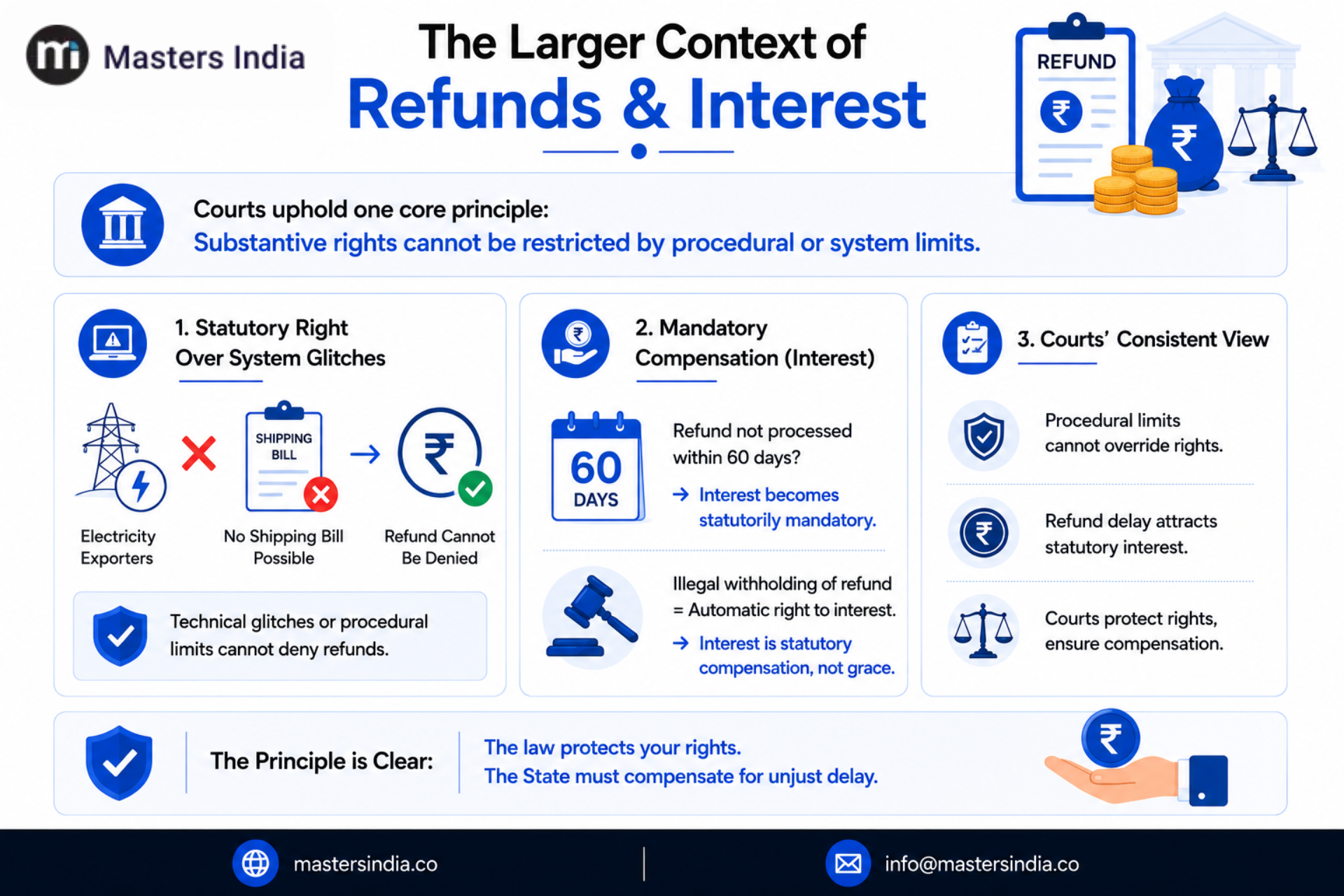 The jurisprudence surrounding the export of electricity aligns perfectly with a broader, fundamental principle established by the courts regarding GST refunds and interest: Substantive rights cannot be handcuffed by procedural or systemic limitations.
Statutory right over system glitches
Just as electricity exporters could not be denied refunds due to the impossibility of generating shipping bills, courts have consistently held that technical glitches on the GST portal or procedural limitations cannot deprive an assessee of their legitimate refund.
Mandatory compensation (interest)
When authorities illegally withhold or unlawfully reject a valid refund claim (such as insisting on a shipping bill for electricity), they inevitably delay the disbursement of funds. Under Section 56 of the CGST Act, if a refund is not processed within 60 days of the receipt of a complete application, the payment of interest becomes an absolute statutory mandate.
As established in cases like Bansal International vs Commissioner of DGST [(2023) 13 CENTAX 210 (Del.) :: (2024) 83 GSTL 190 (Del.)], the obligation to refund money received and retained without right implies and carries with it the automatic right to interest. The courts emphasise that this interest is not a matter of equity or grace, but a strict statutory compensation to ensure the State makes the party good for the undue retention of their lawful monies.
What should electricity exporters know about GST refund claims?
Electricity exports qualify as zero-rated supplies under Section 16 of the IGST Act, giving exporters the statutory right to claim refunds of unutilized Input Tax Credit. As the Sembcorp judgment reaffirmed, this substantive right cannot be defeated merely because the law originally required a shipping bill—a procedural requirement that was impossible to satisfy for electricity transmitted through power grids. The subsequent amendment to Rule 89(2) and the introduction of alternative documentary requirements further reinforced this position by extending relief to both current and past refund claims.
The broader principle remains equally significant: procedural or systemic limitations should not override legitimate GST refund rights. Where valid refunds are unlawfully withheld or delayed, Section 56 also safeguards taxpayers by providing for statutory interest as compensation.
By understanding these evolving legal principles and maintaining the prescribed documentation, electricity exporters can strengthen their refund claims and minimize disputes. Masters India helps businesses simplify GST compliance, refund management, and tax technology through expert guidance and automated GST solutions.
About the Author

- ★★
- ★★
- ★★
- ★★
- ★★

Check out other Similar Posts

CFO Weekly Digest
A weekly newsletter delivering sharp insights, strategic analysis, and critical updates on business, finance, and compliance — designed exclusively for CFOs and Finance Leaders
Masters India is a GST Suvidha Provider (GSP) appointed by Goods and Services Tax Network (GSTN), a Government of India enterprise.
 Procapitus Business Park, 4th Floor, D 247/4A, Sector 63 Rd, Noida, Uttar Pradesh 201301
 info@mastersindia.co




Certified