
GST Liability in Business Transfers, Mergers and Corporate Changes

Under the Goods and Services Tax (GST) framework, tax liability generally rests upon the supplier under the forward charge mechanism, or upon the recipient under the reverse charge mechanism. However, Chapter XVI of the CGST Act (consisting of Sections 85 to 94) extends this liability beyond the immediate parties to the transaction. It establishes a comprehensive legal framework for the recovery of tax, interest, and penalties during business transitions, corporate restructurings, insolvencies, partnerships, and fiduciary operations.
By creating joint and several liabilities, shifting obligations to legal representatives, and piercing the corporate veil of private companies, Chapter XVI serves as an "extended recovery net" to safeguard the interest of revenue. This article provides a technical, section-by-section analysis of these provisions.
Liability in case of transfer of business (Section 85)
Section 85 of the CGST Act governs tax liability when a business is transferred, either in whole or in part.
Pre-transfer liabilities
When a taxable person transfers their business by sale, gift, lease, leave and license, hire, or any other manner, the transferor and transferee are jointly and severally liable to pay any tax, interest, or penalty due up to the time of such transfer, in line with the GST liability rules for business transfers and corporate changes. This liability applies whether the dues were determined prior to the transfer but remained unpaid, or are determined subsequent to the transfer.
Post-transfer liabilities
The transferee is solely liable to pay tax on the outward supplies of goods or services effected by them from the date of such transfer. If the transferee carries on the business under their own name or another name, they must apply for registration or seek amendments to their existing certificate of registration within the prescribed time.
Manner of ITC transfer
Under Section 18(3) and Rule 41 of the CGST Rules, the transferor is allowed to transfer unutilized Input Tax Credit (ITC) lying in their electronic credit ledger to the transferee by filing Form GST ITC-02 electronically on the common portal. To validate this transfer, a practicing Chartered Accountant or Cost Accountant must issue a certificate certifying that the business transfer was executed with a specific provision for the transfer of liabilities.
"Transfer of business" vs. "sale of assets"
Section 85 strictly applies only to the transfer of a business as a going concern. If a transaction is structured as a mere "itemized sale of assets" (where the business itself is not transferred, but assets are sold on payment of applicable GST), the transferee carries no historical liability under the GST law; all historical dues remain solely with the transferor.
Liability of agent and principal (Section 86)
 Section 86 casts joint and several liability on both the principal and the agent when goods are handled through agency channels.
Joint and several liability
Where an agent supplies or receives any taxable goods on behalf of their principal, both the agent and the principal are jointly and severally liable to pay the tax payable on such goods. This provision gives the Government direct recourse to recover tax dues from either party without having to first exhaust its remedies against the principal obligor. If the agent discharges the liability, they hold the right of subrogation to recover the dues from the principal through civil remedies.
Restricted to goods
A critical technical nuance is that Section 86 is strictly restricted to the supply of taxable goods. It does not apply to agents who facilitate the supply of services on behalf of a principal.
Schedule I & invoice-issuing authority
Under Paragraph 3 of Schedule I, the transfer of goods between a principal and their agent without consideration is treated as a "deemed supply" only if the agent undertakes to supply or receive those goods on behalf of the principal. As clarified by Circular No. 57/31/2018-GST, the key test to determine if an agent is acting in a representative capacity under Schedule I is whether the invoice to the customer is issued by the agent in their own name.
Agent simplicitor
If the invoice is issued by the agent to the customer in the name of the principal, the agent is not covered under Schedule I Para 3.
Reseller-agent
If the invoice is issued by the agent in their own name, it constitutes a supply inter se. The agent must report the total turnover as an outward supply and is eligible for ITC on the invoice issued by the principal.
Liability in case of amalgamation or merger of companies (Section 87)
Section 87 addresses the tax implications of transactions carried out during the transition period of corporate mergers and amalgamations.
The interim period dilemma
When two or more companies are merged or amalgamated pursuant to an order of a Court, Tribunal (such as the NCLT), or otherwise, the order often takes effect retrospectively from an appointed/transfer date earlier than the date of the actual order, creating specific GST liability implications during mergers and amalgamations.
Treatment as distinct companies
Under Section 87(1), any supply or receipt of goods or services inter se between the amalgamating companies during the commencing period (from the appointed date to the date of the merger order) must be included in their respective taxable turnovers, and GST must be discharged accordingly.
The legal fiction
Notwithstanding the retrospective nature of the merger order under corporate law, Section 87(2) mandates that for the purposes of GST, the merging companies shall be treated as distinct companies up to the date of the order. Their respective registration certificates are cancelled only with effect from the date of the merger order.
Registration obligations
Under Section 22(4) of the CGST Act, the transferee company must obtain GST registration effective from the date on which the Registrar of Companies (ROC) issues the certificate of incorporation giving effect to the merger order.
Liability in case of company in liquidation (Section 88)
Section 88 regulates tax recovery when a corporate entity undergoes winding up or liquidation.
Obligations of the liquidator
Within 30 days of their appointment, every receiver or liquidator of a company’s assets must intimate their appointment in writing to the jurisdictional Commissioner.
Commissioner's notification
Within 3 months of receiving this intimation, the Commissioner must notify the liquidator of the estimated amount of tax, interest, or penalty that is currently payable or likely to become payable by the company.
Statutory form
Under Rule 160 of the CGST Rules, the Commissioner notifies this recovery demand to the liquidator electronically on the common portal in FORM GST DRC-24.
Priority of dues
In practice, directing a liquidator to unconditionally set aside tax dues before winding up can conflict with corporate insolvency laws. While Section 82 of the CGST Act provides that GST dues shall be a "first charge on the property" of a taxable person, this is explicitly subject to the provisions of the Insolvency and Bankruptcy Code (IBC), 2016. Under the Section 53 waterfall of the IBC, Government dues stand fifth in priority of distribution, behind insolvency resolution costs, secured creditors, and employee wages.
Liability of directors of private company (Section 89)
Section 89 pierces the corporate veil by holding directors personally liable for unrecovered corporate tax liabilities.
Vicarious liability
Where any tax, interest, or penalty due from a private company in respect of any supply of goods or services for any period cannot be recovered, every person who was a director of the company during that period is jointly and severally liable for the payment, subject to the applicable GST liability provisions during liquidation and dissolution. This provision overrides the Companies Act, 2013, creating personal liability despite the company's separate legal entity status.
The escape clause (no-negligence)
A director can escape this personal liability if they prove to the satisfaction of the Commissioner that the non-recovery of the tax dues cannot be attributed to any gross neglect, misfeasance, or breach of duty on their part in relation to the affairs of the company.
Effect of conversion to public company
Under Section 89(2), if a private company is converted into a public company, the vicarious liability under Section 89(1) does not apply to any person who was a director of the private company for any unrecovered dues of the pre-conversion period. However, this exemption does not apply to any personal penalty previously imposed on such a director.
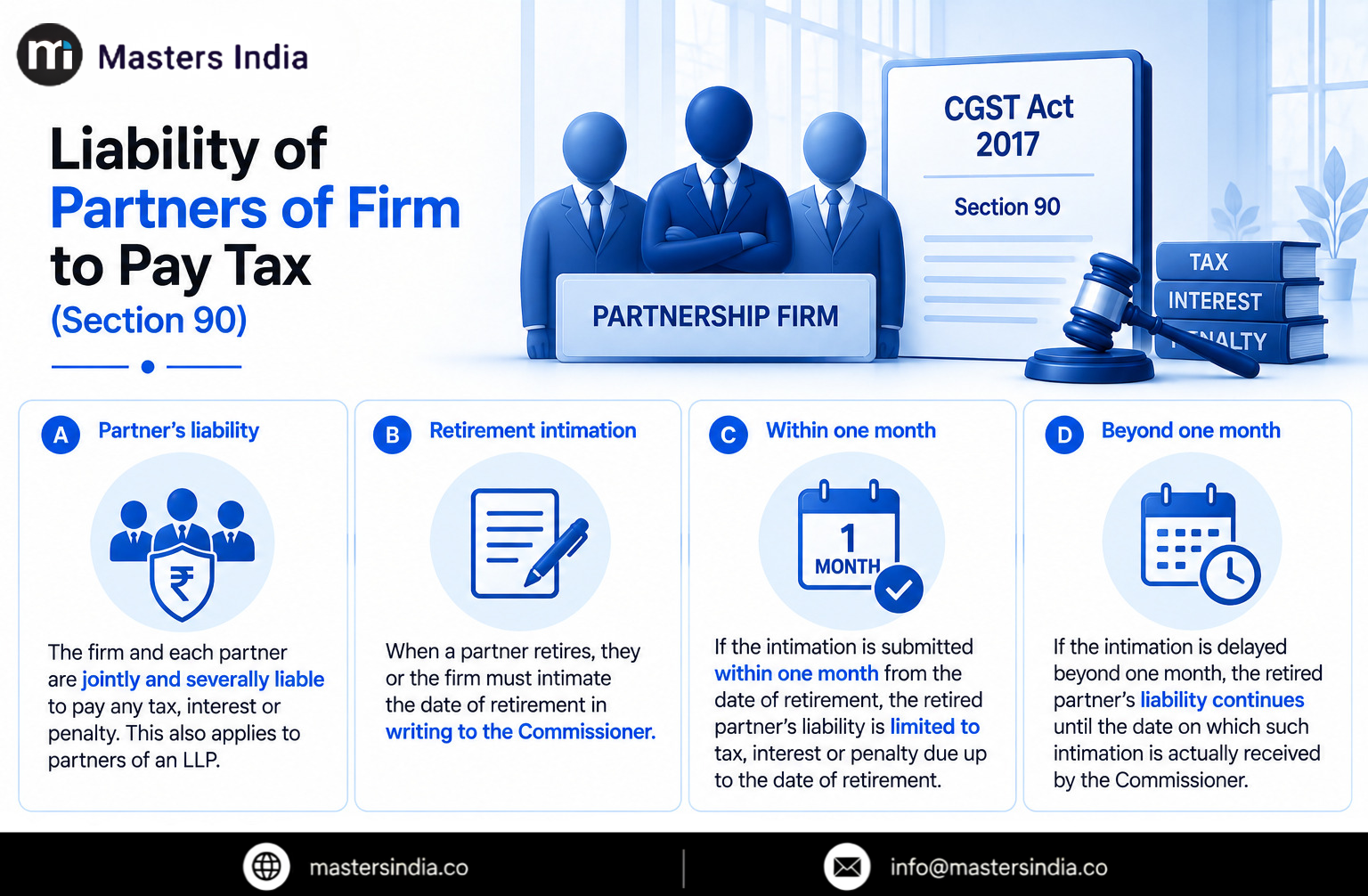
Liability of partners of firm to pay tax (Section 90)
Section 90 fastens joint and several liability on the partners of partnership firms.
Partner's liability
Notwithstanding any contract to the contrary or any other law, when a partnership firm is liable to pay any tax, interest, or penalty, the firm and each of the partners are jointly and severally liable. This liability is also fully applicable to partners of a Limited Liability Partnership (LLP).
Retirement intimation
When a partner retires, they or the firm must intimate the date of retirement in writing to the Commissioner.
The one-month rule
If this written intimation is submitted within one month from the date of retirement, the retiring partner's liability is strictly limited to tax, interest, or penalty due up to the date of retirement (whether determined on that date or thereafter).
If the intimation is delayed beyond one month, the retired partner's liability continues until the date on which such intimation is actually received by the Commissioner.
Liability of guardians, trustees, etc. (Section 91)
Section 91 governs businesses carried on by representative or fiduciary capacities on behalf of minors or incapacitated persons.
Fiduciary recovery
Where a business is carried on by a guardian, trustee, or agent on behalf of and for the benefit of a minor or an incapacitated person, any tax, interest, or penalty payable in respect of the business is levied upon and recoverable from such guardian, trustee, or agent.
Extent of liability
The recovery is made in the same manner and to the same extent as it would have been determined and recovered from the minor or incapacitated person if they were a major or capacitated person conducting the business themselves.
Liability of Court of Wards, etc. (Section 92)
Section 92 applies to businesses managed by officers of the Court or judicially appointed administrators.
Representative liability
Where the estate of a taxable person is under the control of the Court of Wards, the Administrator General, the Official Trustee, or a receiver or manager appointed by a court order, any tax, interest, or penalty payable by the business is recoverable from them.
Statutory application
Dues are recoverable in like manner and to the same extent as they would be determined and recovered from the taxable person as if they were conducting the business themselves.
Special provisions regarding death, HUF partition, and dissolution (Section 93)
Section 93 outlines the liability to pay tax in special personal and structural changes, subject to the provisions of the IBC, 2016.
| Situation | Who is Liable? | Extent of Liability |
| Death of Individual (Business Continued) | Legal Representative or the person continuing the business. | Unlimited liability for pre-death dues |
| Death of the Individual (Business Discontinued) | Legal Representative | Limited to the value of the estate received rom the deceased. |
| Partition of HUF or AOP | Each member or group of members. | Joint and several liablity for dues up to the date of partition (whether determined before or after). |
| Dissolution of a Partnership Firm | Every person who was a partner up to dissolution. | Joint and several liablity for dues up to the date of dissolution. |
| Termination of Guardianshio or Trust | The ward or the benefiary, | Liable for dues up the date of termination (whether determined before or after). |
Liability in other cases (Section 94)
Section 94 acts as a residual clause governing discontinued, dissolved, or reconstituted firms and associations.
Discontinuance of HUF, firm, or AOP
Under Section 94(1), if a firm, HUF, or AOP discontinues its business, the tax, interest, or penalty payable up to the date of discontinuance may be determined as if no such discontinuance had taken place. Partners or members remain jointly and severally liable for dues determined either prior to or after the date of discontinuance.
Reconstitution of firm or AOP
Under Section 94(2), where a change occurs in the constitution of a firm or an association of persons, the partners/members who existed both before and after the reconstitution are jointly and severally liable to pay tax, interest, or penalty due for any period prior to reconstitution.
Interaction with Section 90
This pre-reconstitution liability under Section 94(2) applies without prejudice to Section 90. Thus, even if a partner retires and intimates their retirement under Section 90, the provisions of Section 94(2) can still fasten joint and several liability on them for any unresolved dues relating to the period prior to their retirement.
What businesses should know about GST liability during structural changes
Chapter XVI of the CGST Act provides a robust recovery framework. Understanding these provisions is vital during corporate restructuring, insolvency planning, business transfers and partnership retirements. Ensuring that appropriate notifications are sent to the Commissioner, liability clauses are explicitly included in business transfer agreements, and proper certifications are submitted can help prevent severe personal financial exposure for partners, directors and legal heirs.
For businesses dealing with restructuring or changes in ownership, careful GST planning can help identify these liabilities before they become disputes. Masters India can support businesses in managing GST compliance and related tax requirements during such transitions.
About the Author

- ★★
- ★★
- ★★
- ★★
- ★★

Check out other Similar Posts

CFO Weekly Digest
A weekly newsletter delivering sharp insights, strategic analysis, and critical updates on business, finance, and compliance — designed exclusively for CFOs and Finance Leaders
Masters India is a GST Suvidha Provider (GSP) appointed by Goods and Services Tax Network (GSTN), a Government of India enterprise.
 Procapitus Business Park, 4th Floor, D 247/4A, Sector 63 Rd, Noida, Uttar Pradesh 201301
 info@mastersindia.co




Certified