
GST Cross-Charge and Valuation Rules: Complete Guide for Businesses

For businesses operating across multiple GST registrations, determining the correct value of internal transactions is one of the most challenging aspects of GST compliance. Cross-charge arrangements between head offices and branches often raise questions around valuation methods, Input Service Distributor (ISD) applicability, and Input Tax Credit (ITC) implications.
This article explains the valuation framework under Section 15 and Rules 27–31, examines key judicial developments, and highlights practical compliance strategies for managing GST cross-charge effectively.
1. Conceptual background - Why valuation & cross-charge matter
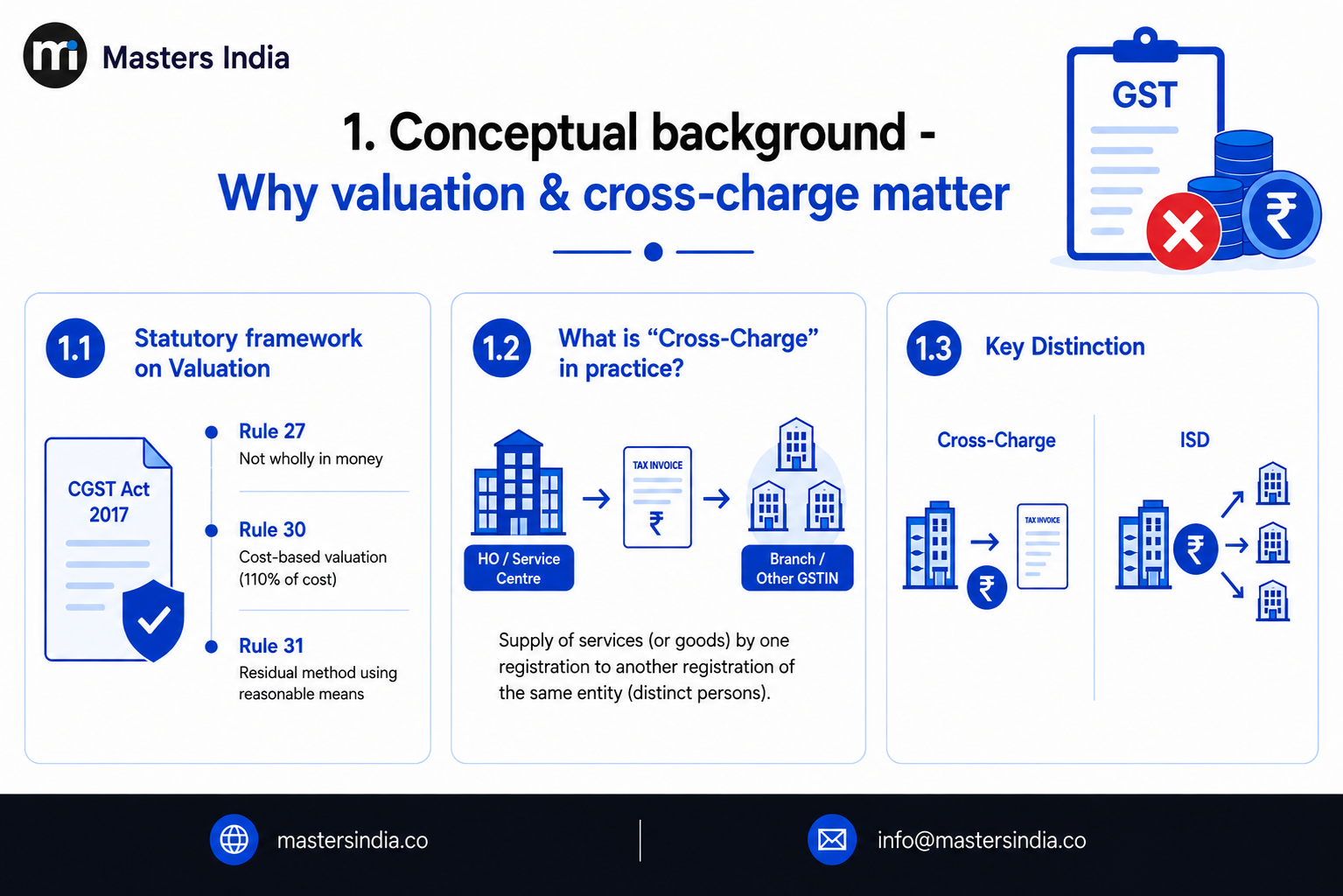 1.1 Statutory framework on Valuation
The starting point for valuation is Section 15 of the Central Goods and Services Tax Act, 2017 (not reproduced here) read with the valuation rules in the Central Goods and Services Tax Rules, 2017:
- Rule 27 – value where consideration is not wholly in money
- Rule 30 – cost-based valuation (110% of cost) where earlier rules don’t work
- Rule 31 – residual method using reasonable means consistent with Section 15
These rules are frequently invoked in cross-charge situations because:
- Many intra-group / intra-GSTIN allocations are not at arm’s length or even not priced at all.
- Consideration may be partly in money and partly in kind, or purely notional.
- The department often alleges undervaluation or non-disclosure of supplies between distinct persons.
1.2 What is "Cross-Charge" in practice?
“Cross-charge” is not a defined term in the Act, but in practice it refers to:
- Supply of services (or goods) by one registration of a legal entity to another registration of the same entity (distinct persons under Section 25(4)/(5) of the CGST Act), e.g.:
- Head Office (HO) providing management, HR, IT, legal, branding, treasury, etc. to branches.
- Shared service centres providing back-office support to multiple GSTINs.
- The HO / service centre raises a tax invoice on the recipient registration and charges GST on the value determined under Section 15 read with Rules 27–31.
This is distinct from the Input Service Distributor (ISD) mechanism, where credit is distributed without treating it as a separate outward supply. Much of the controversy is about when cross-charge is mandatory vs when ISD is sufficient/preferable, and how to value such cross-charges.
2. Valuation rules most relevant to cross-charge
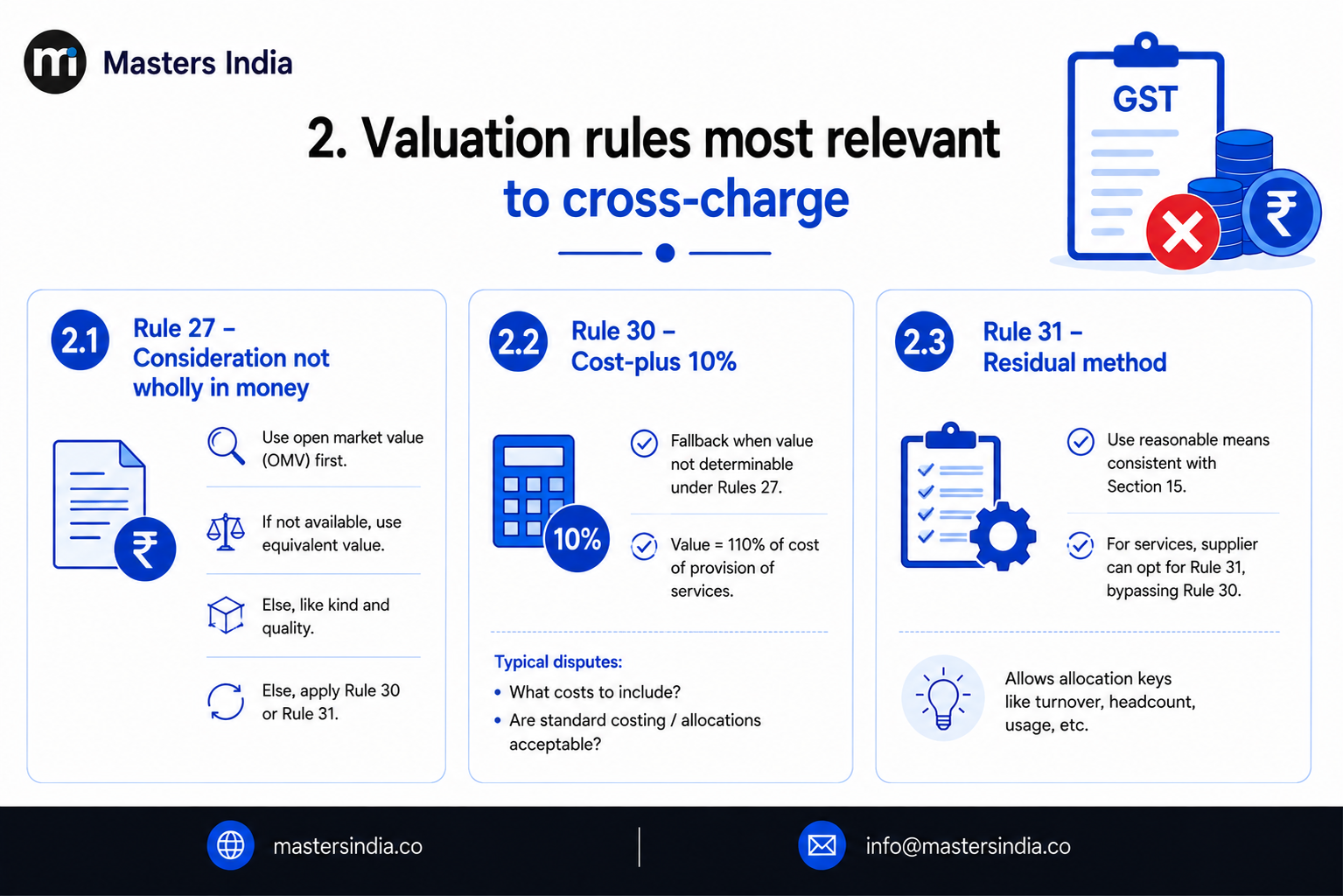 2.1 Rule 27 - Consideration not wholly in money
Where consideration is not wholly in money, Rule 27 prescribes a hierarchy:
“Where the supply of goods or services is for a consideration not wholly in money, the value of the supply shall, –
(a) be the open market value of such supply;
(b) if the open market value is not available under clause (a), be the sum total of consideration in money and any such further amount in money as is equivalent to the consideration not in money, if such amount is known at the time of supply;
(c) if the value of supply is not determinable under clause (a) or clause (b), be the value of supply of goods or services or both of like kind and quality;
(d) if the value is not determinable under clause (a) or clause (b) or clause (c), be the sum total of consideration in money and such further amount in money that is equivalent to consideration not in money as determined by the application of rule 30 or rule 31 in that order.”
Illustrations in the Rules show how open market value (OMV) applies when part of the consideration is in kind (e.g., the exchange of an old phone or the barter of a printer).
In cross-charge, this becomes relevant where:
- The HO recovers only part of the cost from branches (e.g. only salary, not overheads), or
- There is no explicit recovery, but the department alleges that the branch is still receiving a taxable service.
In such cases, the department may argue that OMV or like-kind and quality should be used, or failing that, Rule 30 / Rule 31.
2.2 Rule 30 - Cost-plus 10%
“Where the value of a supply of goods or services or both is not determinable by any of the preceding rules of this Chapter, the value shall be one hundred and ten percent of the cost of production or manufacture or the cost of acquisition of such goods or the cost of provision of such services.”
For cross-charge, this is the default departmental fallback when:
- There is no comparable OMV, and
- The entity has internal cost records for the shared services.
Typical disputes:
What constitutes “cost of provision of services” – only direct salary or also overheads, corporate allocations, depreciation, etc.
Whether standard costing or management accounting allocations are acceptable.
2.3 Rule 31 - Residual method
“Where the value of supply of goods or services or both cannot be determined under rules 27 to 30, the same shall be determined using reasonable means consistent with the principles and the general provisions of section 15 and the provisions of this Chapter:
Provided that in the case of supply of services, the supplier may opt for this rule, ignoring Rule 30.”
This proviso is important for cross-charge:
- For services, the supplier (e.g. HO) can directly adopt Rule 31, bypassing cost-plus 10%.
- This opens room for reasonable allocation keys (turnover, headcount, usage metrics) instead of strict cost-plus.
However, “reasonable means” is inherently subjective, leading to valuation disputes.
3. Key controversies around cross-charge
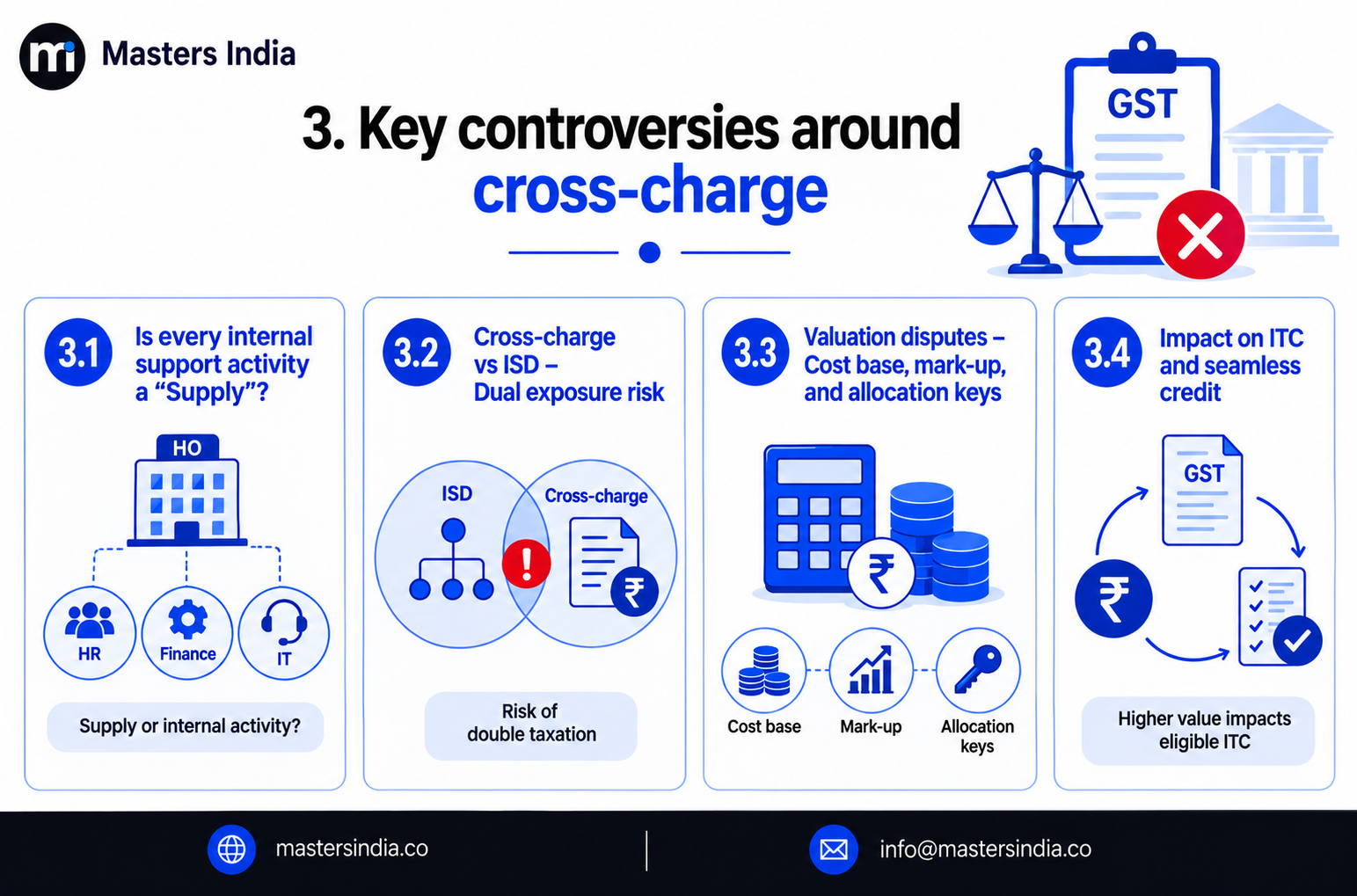 3.1 Is every internal support activity a "Supply"?
Core controversy: whether every internal support function (HR, finance, IT, management) performed by HO for branches is a taxable supply between distinct persons, even if no separate consideration is charged.
Department’s stance (broadly):
- Distinct persons are treated as separate taxable persons.
- Any service by one registration to another is a supply, even if without consideration, by virtue of Schedule I (supplies between related/distinct persons in the course or furtherance of business).
- Therefore, cross-charge is mandatory for such services, and valuation must follow Rules 27–31.
Taxpayer arguments
- Some activities are purely internal / stewardship and do not amount to a “service” in the first place.
- Certain costs are already embedded in the price of outward supplies of the branch; separate cross-charge may lead to double taxation.
- Where ISD mechanism is used to distribute common credits, separate cross-charge may not be warranted.
This debate is still evolving through departmental instructions and litigation.
3.2 Cross-charge vs ISD - Dual exposure risk
Another controversy is the overlap between cross-charge and ISD:
- If HO procures common input services (e.g. audit, software, consultancy) and uses them for multiple registrations, it can:
- Distribute ITC via ISD, or
- Cross-charge the service to branches (treating it as an outward supply) and let branches take ITC.
Issues:
- Some authorities insist that ISD is mandatory for distribution of common input services; others accept cross-charge.
- There is a risk of double taxation if both ISD and cross-charge are applied incorrectly.
- Valuation under cross-charge (especially cost-plus) can inflate the tax base compared to simple ITC distribution.
3.3 Valuation disputes - Cost base, mark-up, and allocation keys
Where cross-charge is accepted, the next layer of controversy is how much to charge:
- Cost base: whether to include only direct costs (salary of shared staff) or also indirect overheads (rent, utilities, corporate charges).
- Mark-up: whether 10% mark-up under Rule 30 is mandatory, or whether Rule 31 can be used to avoid mark-up where there is no profit element.
- Allocation keys: turnover, headcount, usage, time spent, or a combination – and whether the chosen key is “reasonable” under Rule 31.
The lack of detailed statutory guidance leads to subjective assessments and show-cause notices alleging undervaluation.
3.4 Impact on ITC and seamless credit
Cross-charge valuation directly affects Input Tax Credit (ITC):
- Higher cross-charge value → higher GST → higher ITC for recipient registration.
- However, if the recipient is engaged in exempt supplies or non-business activities, ITC may be partially blocked, making cross-charge a real cost.
4. Selected judicial developments touching valuation / cross-charge themes
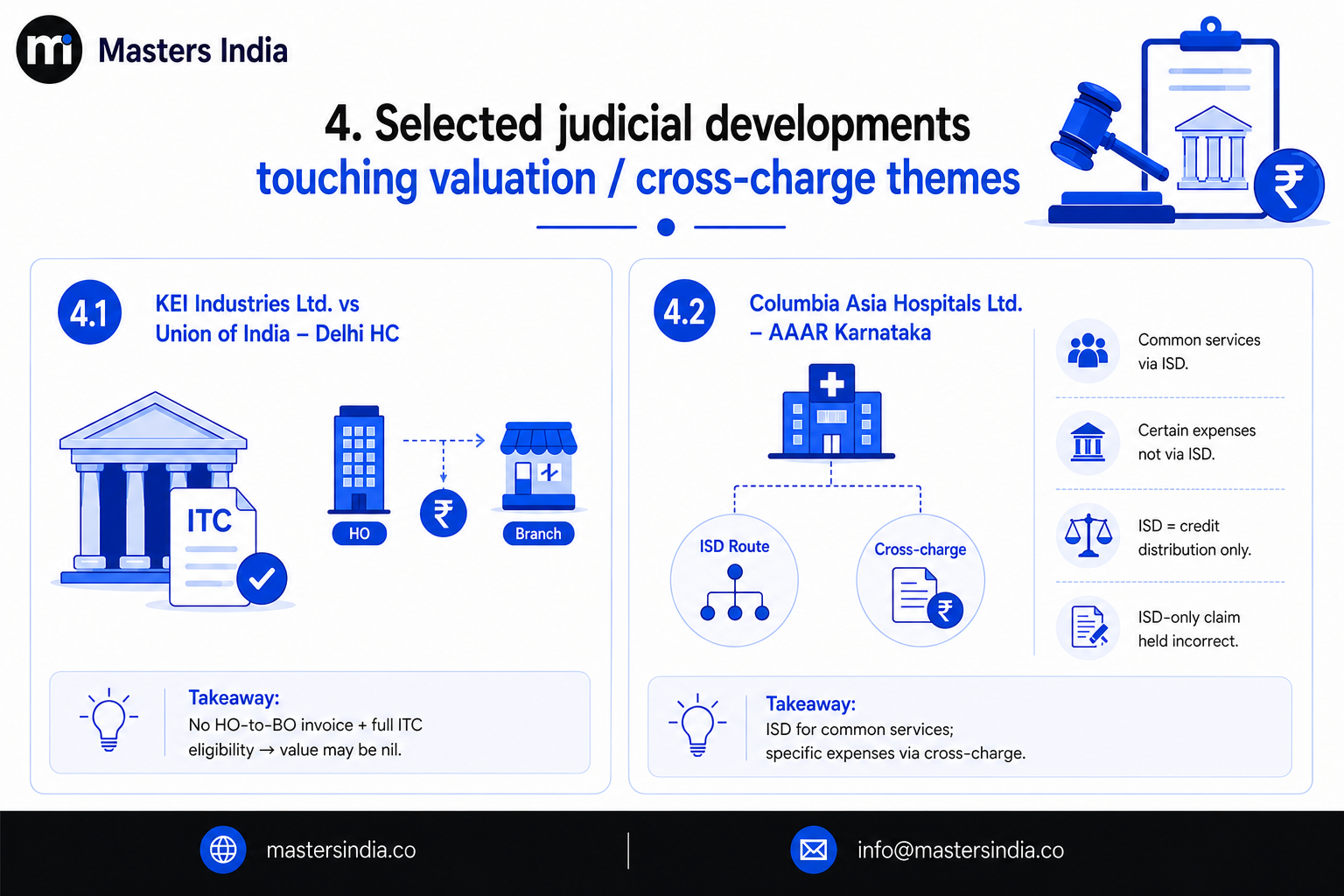 4.1 M/s KEI Industries Ltd. vs Union of India – Delhi high court
(W.P.(C) No. 6919 of 2025 and C.M. Appl. No. 31310 of 2025, 22-May-2025 :: (2025) 30 CENTAX 499)
Where petitioner-assessee had challenged a demand order passed by respondent-department for payment of IGST on internally incurred expenses, on ground that no cross-charges were made and full ITC was available to Branch Offices of petitioner-assessee, and further, CBIC Circular No. 199/11/2023-GST dated 17.07.2023 and decision in Metal One Corporation India Pvt. Ltd. v. Union of India clarified that where no invoice was issued and full ITC was available, then, value could be deemed Nil, therefore, in light of above facts, impugned order was liable to be set aside and matter was to be remanded back to respondent-department.
Takeaway: the Delhi High Court held that where no HO-to-BO cross-charge invoice is issued and the branch is eligible for full ITC, the value of internally generated services may be deemed nil under CBIC Circular No. 199/11/2023-GST, so the IGST demand was set aside and remanded for reconsideration.
4.2 Columbia Asia Hospitals Ltd. – AAAR Karnataka
[Order No. KAR/AAAR/05/2018-19, 12-Dec-2018 | (2019) 20 GSTL 763 (AAAR-GST)]
Valuation (GST) – Input Tax Credit (ITC) – Supply by a corporate office to branch offices – Expenses incurred by the corporate office for services availed from third-party service providers – Cross-charge mechanism vis-à-vis the Input Service Distributor (ISD) route – ITC of GST paid on the receipt of services or goods from third parties by the corporate office can be availed by it.
In respect of services commonly used by all distinct persons, the ITC is to be distributed to all units through the ISD route. In a cross-charge, there is an element of service rendered by the person who cross-charges its other units, even though they belong to the same legal entity. In the ISD mechanism, there is no element of service at all, but merely a distribution of credit. Certain expenses, such as rent paid for immovable property, housekeeping services, etc., incurred in maintaining and operating the corporate office, will not be distributable through the ISD route.
Rather, they are required to be allocated to the other units only by way of cross-charge. The contention of the assessee that the ISD mechanism was squarely applicable to it and that the cross-charge method was not applicable was held to be legally incorrect under Sections 16 and 20 of the Central Goods and Services Tax Act, 2017.
Takeaway: Input Tax Credit (ITC) of GST paid by a corporate office on services or goods received from third parties can be availed by it, with common services distributed to branch offices through the Input Service Distributor (ISD) route. However, expenses such as rent and housekeeping must be allocated through cross-charges, as the ISD mechanism involves only the distribution of credit and not the provision of services.
Accordingly, the assessee's claim that only the ISD mechanism applied and not the cross-charge method was held to be legally incorrect under Sections 16 and 20 of the Central Goods and Services Tax Act, 2017.
5. Practical trends & departmental approach
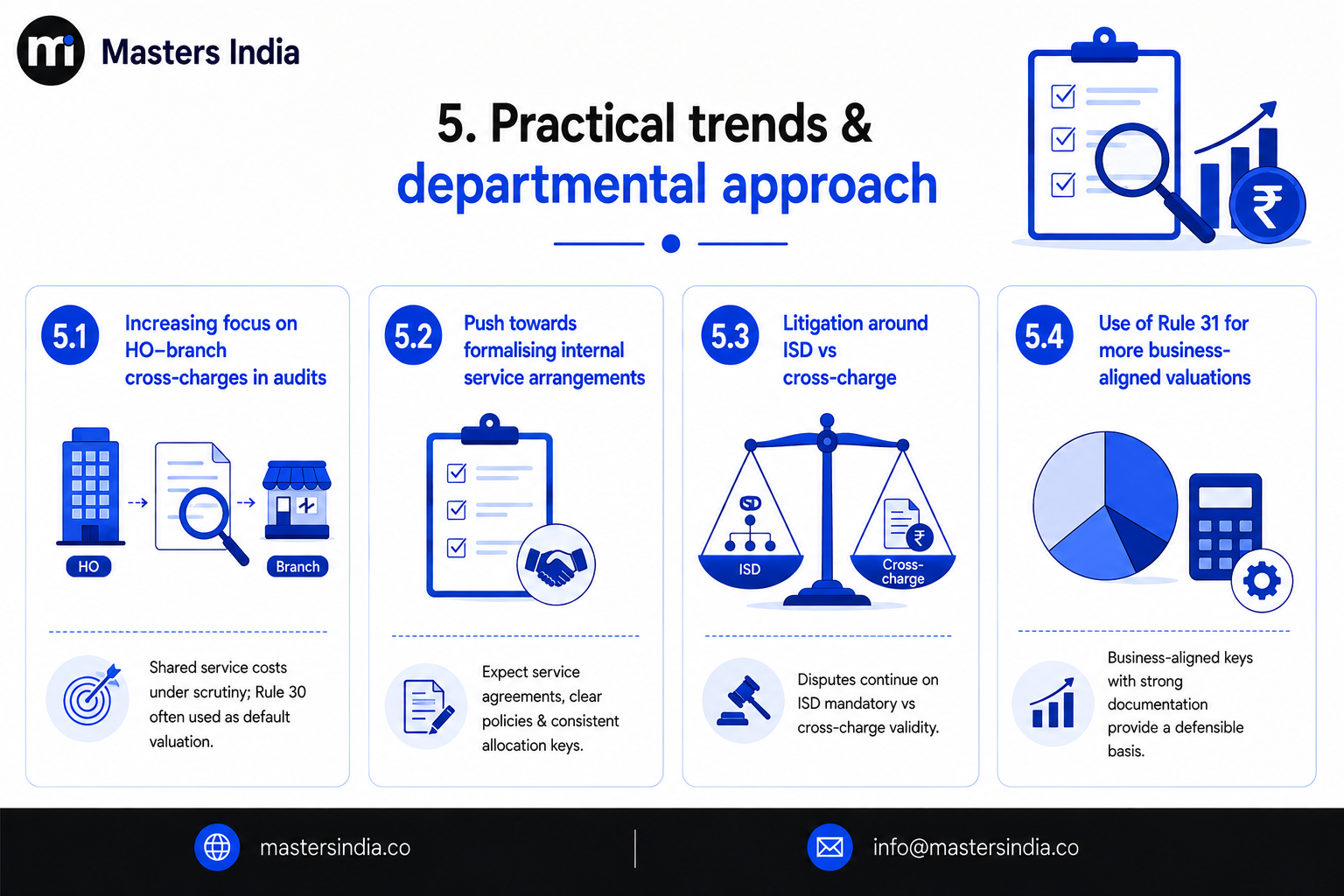 5.1 Increasing focus on HO–branch cross-charges in audits
Recent audit and investigation trends show:
- Scrutiny of trial balance/cost centers to identify shared service costs (HR, IT, management fees, corporate overheads) not cross-charged.
- Show cause notices alleging:
- Non-disclosure of taxable supplies between distinct persons (Schedule I).
- Undervaluation where cross-charge exists but is limited to partial cost.
- Use of Rule 30 (cost + 10%) as a default valuation method, sometimes ignoring the Rule 31 proviso that allows a more flexible approach for services.
5.2 Push towards formalising internal service arrangements
Tax officers increasingly expect:
- Documented service agreements between HO and branches/group entities.
- Defined pricing/allocation policies (e.g. cost-plus, headcount-based, turnover-based) that can be tested under Section 15 and Rules 27–31.
- Consistent application of allocation keys across periods.
Taxpayers who lack such documentation are more vulnerable to ad-hoc valuations imposed by the department.
5.3 Litigation around ISD vs cross-charge
- There is a growing body of disputes where:
- The department alleges that ISD registration is mandatory for distributing common input services, and that cross-charge is not a substitute.
- Taxpayers argue that cross-charge is a valid alternative, especially where HO is itself providing a composite service to branches.
Until there is clear Supreme Court guidance or explicit legislative clarification, this remains a grey area, and positions should be taken carefully and consistently.
5.4 Use of rule 31 for more business-aligned valuations
Some taxpayers are proactively:
- Invoking the Rule 31 proviso for services to adopt business-aligned allocation keys (e.g. usage metrics, time sheets, transaction volumes) instead of strict cost-plus.
- Documenting the reasonableness of their method with:
- Internal policies
- Board approvals
- Working papers showing how allocations are computed.
This can provide a defensible basis in audits, though it does not eliminate litigation risk.
6. Risk management & best practices for professionals
 6.1 Design a clear cross-charge policy
- Map all intra-GSTIN flows of services (HR, IT, finance, legal, branding, management, logistics coordination, etc.).
- Decide, for each category, whether to use ISD or cross-charge, and document the rationale.
- Where cross-charge is adopted, choose a valuation method consistent with Section 15 and Rules 27–31:
- OMV / comparable pricing where available.
- Cost-plus (Rule 30) where cost data is robust.
- Residual method (Rule 31) with clear allocation keys for services.
6.2 Maintain robust documentation
- Inter-unit service agreements specifying:
- Nature of services
- Basis of valuation (cost-plus, allocation key, etc.)
- Frequency of invoicing
- Working papers showing:
- Cost build-up (direct + indirect costs)
- Allocation keys and their rationale
- Reconciliations with financial statements.
6.3 Build a strong litigation strategy
In case of notices:
- Argue valuation in line with:
- Section 15 principles (transaction value, related party, distinct persons).
- Rule 27–31 hierarchy, emphasising the Rule 31 proviso for services where appropriate.
- Where a notification or instruction is relied upon by the department, consider whether there is any jurisdictional defect in its issuance.
What should businesses know about GST cross-charge and valuation?
Cross-charge is likely to remain a major area of scrutiny during GST audits, particularly for businesses operating across multiple states. While Rules 27, 30, and 31 provide the statutory framework for valuation, they also leave room for interpretation, making cross-charge one of the most litigated aspects of GST compliance. As judicial guidance continues to evolve, businesses should closely monitor developments relating to seamless ITC, valuation principles, and the interplay between cross-charge and the ISD mechanism.
For tax professionals, the most effective way to manage these risks is through a well-documented, principle-based cross-charge policy supported by appropriate valuation methodologies, internal agreements, and consistent documentation. A proactive compliance approach not only strengthens audit readiness but also provides a stronger defence during departmental proceedings.
As GST regulations continue to evolve, businesses that combine sound documentation with technology-driven compliance will be better equipped to manage valuation disputes. Masters India helps organizations streamline GST compliance, cross-charge management, and tax technology with solutions designed to simplify complex GST requirements.
About the Author

- ★★
- ★★
- ★★
- ★★
- ★★

Check out other Similar Posts

CFO Weekly Digest
A weekly newsletter delivering sharp insights, strategic analysis, and critical updates on business, finance, and compliance — designed exclusively for CFOs and Finance Leaders
Masters India is a GST Suvidha Provider (GSP) appointed by Goods and Services Tax Network (GSTN), a Government of India enterprise.
 Procapitus Business Park, 4th Floor, D 247/4A, Sector 63 Rd, Noida, Uttar Pradesh 201301
 info@mastersindia.co




Certified