
E-Way Bill for Multiple Vehicles: Rules for SKD and CKD Consignments

Under the Indian Goods and Services Tax (GST) regime, the movement of goods exceeding a consignment value of ₹50,000 generally requires the generation of an Electronic Way Bill (E-Way Bill) in FORM GST EWB-01. However, businesses frequently encounter logistical challenges where a single consignment or order is too large, bulky, or complex to be transported in a single vehicle
In such cases, the consignment must be transported using multiple vehicles simultaneously or sequentially. This is particularly common when goods are transported in a Semi-Knocked Down (SKD) or Completely Knocked Down (CKD) condition. Understanding the precise legal procedures, documentation, and E-Way Bill requirements for SKD and CKD consignments transported in multiple vehicles is critical to ensuring regulatory compliance and avoiding severe penalties during transit.
Legal framework: CGST Rule 55 and Rule 138
The primary rules governing the movement of goods in multiple vehicles or under SKD/CKD conditions are Rule 138 and Rule 55 of the Central Goods and Services Tax (CGST) Rules, 2017.
When a single invoice is issued for goods that are dispatched in parts using different vehicles, the supplier cannot simply generate a single E-Way Bill for the entire invoice and expect multiple vehicles to travel with copies of the same document. Doing so violates the transit rules, as every vehicle in motion must be accompanied by a unique E-Way Bill that maps the specific goods it carries to its vehicle registration number. To resolve this, CGST Rule 55 provides a structured mechanism utilising Delivery Challans in conjunction with the main Tax Invoice.
Relevant extract of Rule 138
Rule 138(6) of the CGST Rules, 2017 (as amended by Notification No. 03/2018–Central Tax, dated 23.01.2018):
"After e-way bill has been generated in accordance with the provisions of sub-rule (1), where multiple consignments are intended to be transported in one conveyance, the transporter may indicate the serial number of e-way bills generated in respect of each such consignment electronically on the common portal and a consolidated e-way bill in FORM GST EWB-02 may be generated by him on the said common portal prior to the movement of goods."
Explanatory Note:
- The consolidated EWB (FORM GST EWB-02) is not a substitute for individual EWBs but an additional document for ease of verification.
- This applies even if the SKD goods are transported in multiple vehicles (e.g., a hub-and-spoke model where goods are transferred between vehicles).
Procedure for generating E-Way Bills for SKD/CKD consignments
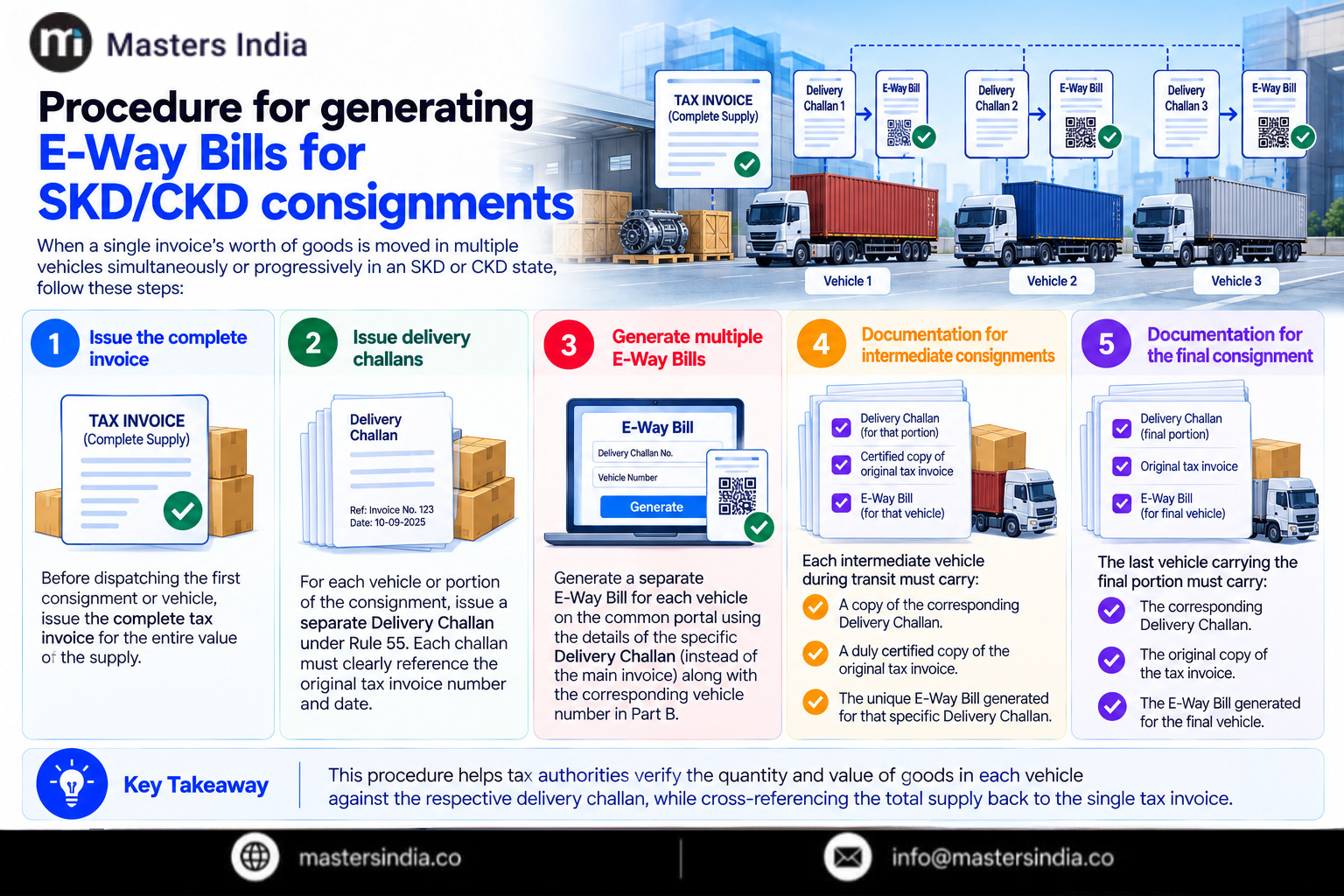 When a single invoice's worth of goods is moved in multiple vehicles simultaneously or progressively in an SKD or CKD state, the supplier and transporter must strictly adhere to the following step-by-step procedure :
Step 1: Issuance of the complete invoice
Before the dispatch of the very first consignment or vehicle, the supplier must issue the complete tax invoice for the entire value of the supply.
Step 2: Issuance of delivery challans
For each vehicle or portion of the consignment being dispatched, the supplier must issue a separate Delivery Challan (DC) in terms of Rule 55. Each delivery challan must clearly reference the original tax invoice number and date.
Step 3: Generation of multiple E-Way Bills
A separate E-Way Bill must be generated for each vehicle. The E-Way Bill for each vehicle is generated on the common portal by entering the details of the specific Delivery Challan (instead of the main invoice) along with the corresponding vehicle number in Part B.
Step 4: Documentation for intermediate consignments
Each intermediate vehicle during transit must be accompanied by:
- A copy of the corresponding Delivery Challan issued for that specific portion of goods.
- A duly certified copy of the original tax invoice.
- The unique E-Way Bill generated against that specific Delivery Challan.
Step 5: Documentation for the final consignment
- The last vehicle carrying the final portion of the consignment must be accompanied by:
- The corresponding Delivery Challan for the final portion.
- The original copy of the tax invoice.
- The E-Way Bill generated for the final vehicle.
By following this procedure, the tax authorities can easily verify the quantity and value of the goods in each vehicle against the respective delivery challan, while cross-referencing the total supply back to the single parent tax invoice.
Difference in E-Way Bill: Normal consignment vs. SKD/CKD condition
To understand the operational differences, the table below highlights how E-Way Bill compliance differs between a standard single-vehicle consignment and a multi-vehicle SKD/CKD consignment:
| Parameter | Normal Consignment (Single Vehicle) | SKD / CKD Consignment (Multiple Vehicles) |
| Primary Document for EWB | Generated directly against the Tax Invoice. | Generated against individual Delivery Challans referencing the main Invoice. |
| Number of E-Way Bills | A single E-Way Bill is generated for the entire consignment. | Multiple E-Way Bills must be generated (one for each vehicle). |
| Accompanying Documents | Original Tax Invoice and the single E-Way Bill. | Delivery Challan, certified copy of Invoice, and vehicle-specific E-Way Bill (Original Invoice with the last vehicle). |
| Part B Details | Updated with the single vehicle's registration number. | Updated with the specific vehicle number carrying that particular portion. |
| Value Declaration | Declares the total consignment value as per the invoice. | Declares the value of the specific portion of goods being transported under that delivery challan. |
Transhipment, vehicle updates, and consolidated E-Way Bills
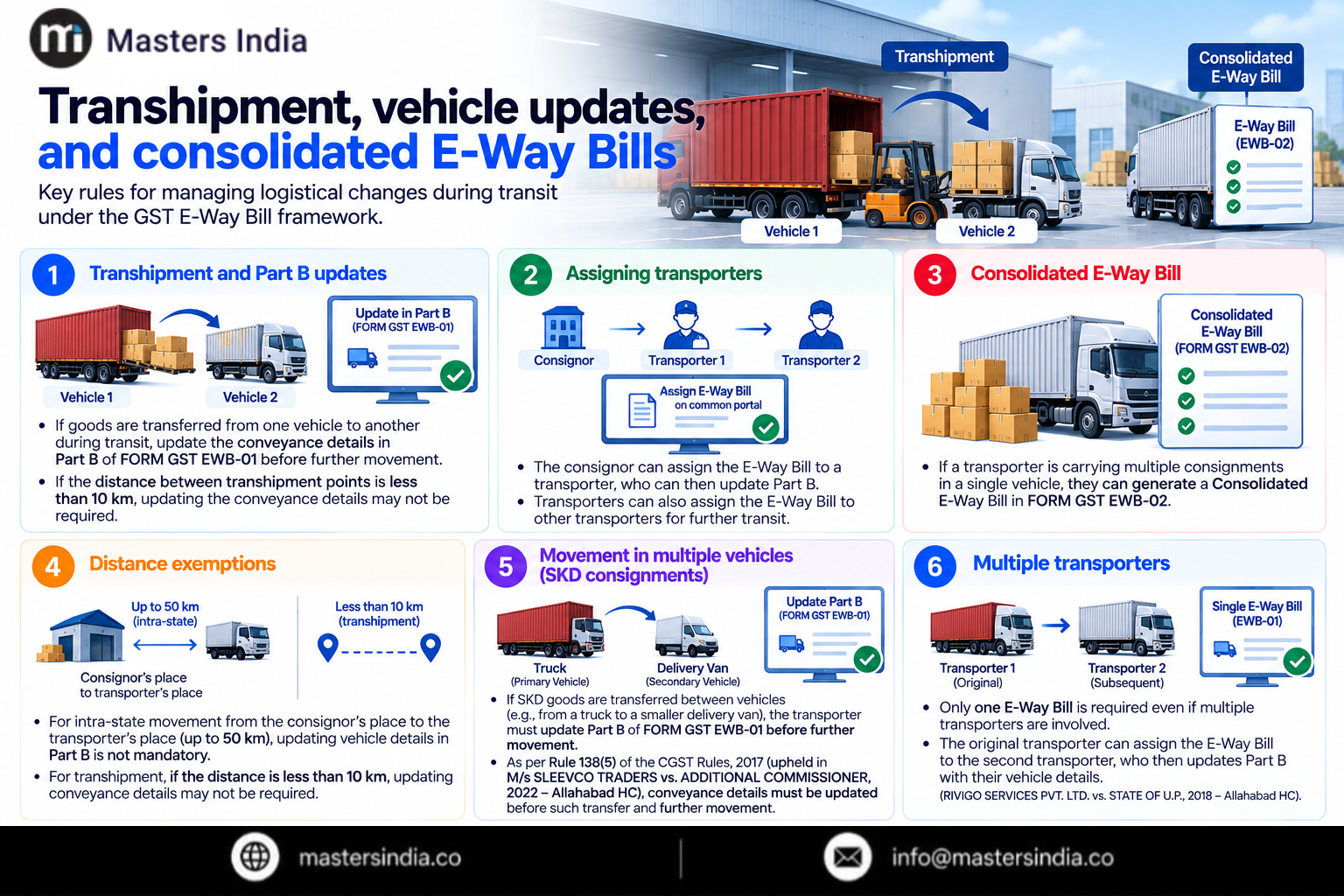 During the transit of goods, several logistical changes may occur, such as transhipment or the consolidation of multiple consignments. The following rules apply:
Transhipment and Part B updates
If a transporter transfers goods from one conveyance to another during transit, they must follow the E-Way Bill rules for transhipment by updating the conveyance details in Part B of FORM GST EWB-01 on the portal before such transfer and further movement. If the distance between the transhipment points is less than 10 kilometres, updating the conveyance details in the E-Way Bill may not be required.
Assigning transporters
The consignor can assign the E-Way Bill to a transporter, who can then update Part B. Transporters can also assign it to other transporters for further transit.
Consolidated E-Way Bill
If a transporter is carrying multiple consignments in a single vehicle, they can generate a Consolidated E-Way Bill in FORM GST EWB-02.
Distance exemptions
For intra-state movement of goods from the consignor's place to the transporter's place (up to 50 km), updating vehicle details in Part B is not mandatory. Similarly, for transhipment, if the distance is less than 10 km, updating conveyance details may not be required.
Movement in multiple vehicles (transhipment)
- If SKD goods are transferred between vehicles (e.g., from a truck to a smaller delivery van), the transporter must update the multiple-vehicle E-Way Bill details in Part B of FORM GST EWB-01 before further movement.
- Rule 138(5) of the CGST Rules, 2017 (as upheld in M/s SLEEVCO TRADERS vs. ADDITIONAL COMMISSIONER, 2022 Taxo.online 537 – Allahabad HC):
"Where the goods are transferred from one conveyance to another, the consignor or the recipient, who has provided information in Part A of the FORM GST EWB-01, or the transporter shall, before such transfer and further movement of goods, update the details of conveyance in the e-way bill on the common portal in Part B of FORM GST EWB-01."
Multiple transporters
Judicial Clarification (RIVIGO SERVICES PVT. LTD. vs. STATE OF U.P., 2018 Taxo.online 130 – Allahabad HC):
- Only one EWB is required even if multiple transporters are involved.
- The original transporter can assign the EWB to the second transporter, who then updates Part B with their vehicle details.
Judicial precedents and penalties for non-compliance
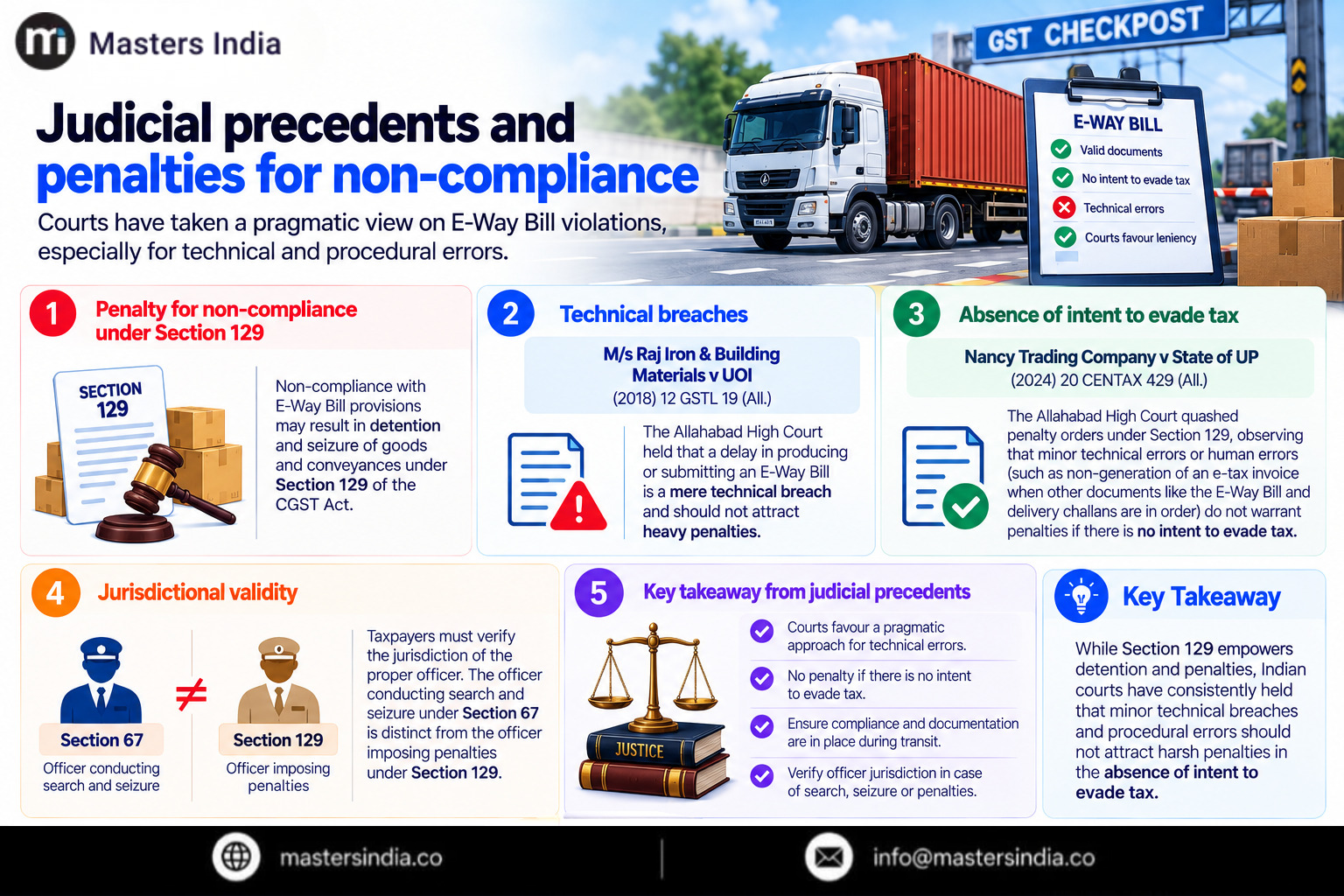 Non-compliance with E-Way Bill provisions may result in the detention and seizure of goods and conveyances under Section 129 of the CGST Act, along with penalties for E-Way Bill non-compliance. However, Indian courts have consistently taken a pragmatic view regarding technical and procedural errors where there is no intent to evade tax.
Technical breaches
In the case of M/s Raj Iron & Building Materials v UOI (2018) 12 GSTL 19 (All.), the Allahabad High Court held that a delay in producing or submitting an E-Way Bill is a mere technical breach and should not attract heavy penalties.
Absence of intent to evade tax
In Nancy Trading Company v State of UP (2024) 20 CENTAX 429 (All.), the Allahabad High Court quashed penalty orders under Section 129, observing that minor technical errors or human errors (such as non-generation of an e-tax invoice when other documents like the E-Way Bill and delivery challans are in order) do not warrant penalties if there is no intent to evade tax.
Jurisdictional validity
Taxpayers must verify the jurisdiction of the proper officer. The officer conducting search and seizure under Section 67 is distinct from the officer imposing penalties under Section 129.
What should businesses remember about E-Way Bills for multiple vehicles?
Transporting a single consignment in multiple vehicles under SKD or CKD conditions requires careful compliance with CGST Rule 55. Instead of generating a single E-Way Bill for the entire movement, businesses must issue a parent tax invoice, followed by individual delivery challans for each vehicle, and generate a corresponding E-Way Bill for each movement.
Ensuring that Part B contains the correct vehicle details and that every vehicle carries the required documents is essential to prevent transit delays, detention of goods, and unnecessary litigation. Proper documentation and adherence to the prescribed E-Way Bill process can help businesses manage multi-vehicle consignments while remaining GST compliant.
About the Author

- ★★
- ★★
- ★★
- ★★
- ★★

Check out other Similar Posts

CFO Weekly Digest
A weekly newsletter delivering sharp insights, strategic analysis, and critical updates on business, finance, and compliance — designed exclusively for CFOs and Finance Leaders
Masters India is a GST Suvidha Provider (GSP) appointed by Goods and Services Tax Network (GSTN), a Government of India enterprise.
 Procapitus Business Park, 4th Floor, D 247/4A, Sector 63 Rd, Noida, Uttar Pradesh 201301
 info@mastersindia.co




Certified