
Decoding HSN Codes: Strategic GST Compliance Guide for Finance Leaders

Decoding HSN Codes: A Strategic Guide for Finance Leaders in GST Compliance
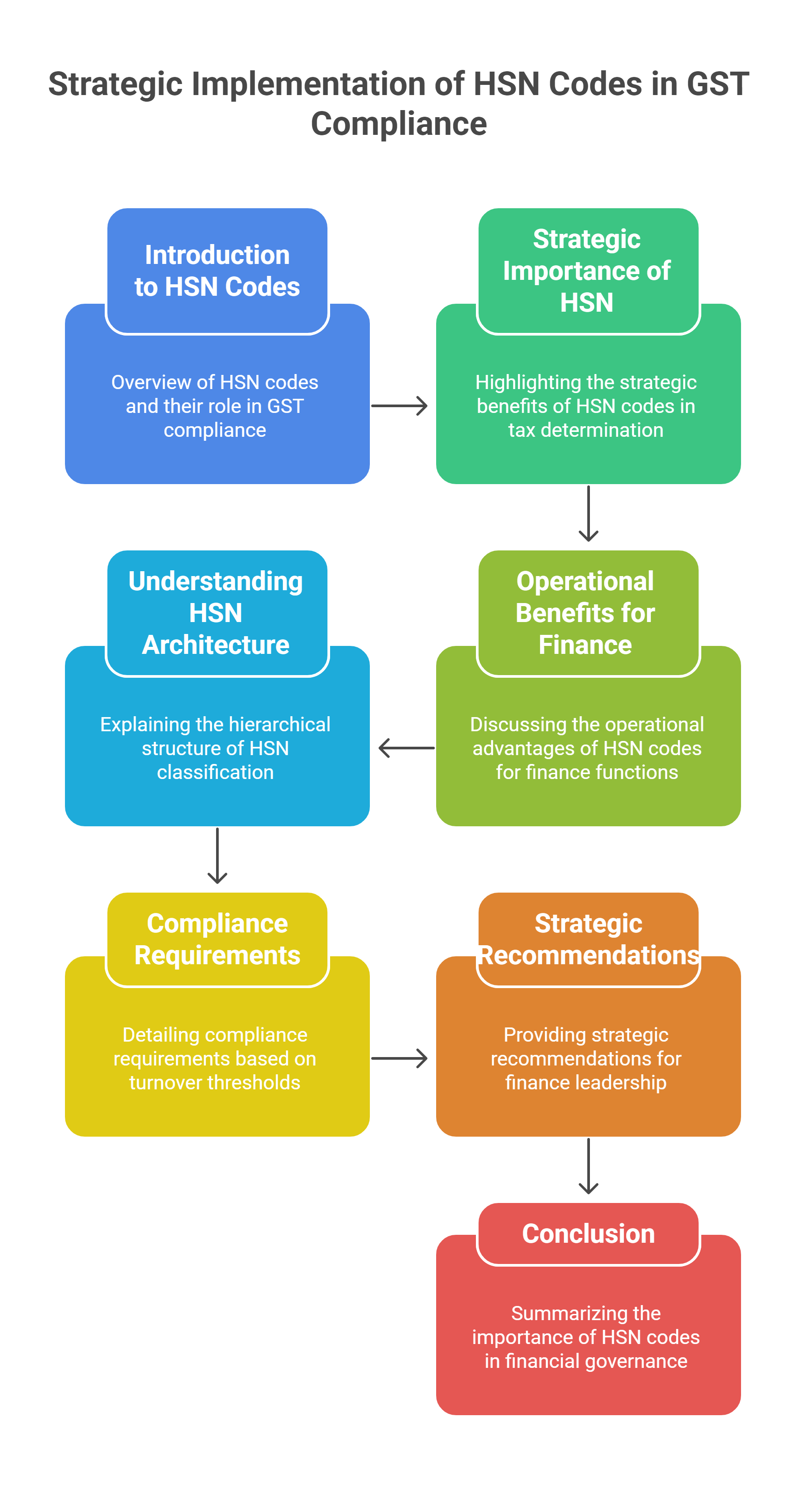
In the complex landscape of India's Goods and Services Tax regime, the Harmonized System of Nomenclature (HSN) codes stand as a cornerstone of compliance and operational efficiency. As finance leaders navigating the intricacies of GST, understanding the strategic importance and practical application of HSN code is not merely a compliance requirement—it is a critical component of financial governance that directly impacts your organization's tax efficiency and risk management framework.
The Strategic Importance of HSN Codes in GST Classification
Foundation of Tax Determination
The HSN classification system, developed by the World Customs Organization and integrated into India's GST framework through the Customs Tariff Act, 1975, serves as the primary mechanism for determining applicable tax rates across CGST, SGST, and IGST. This standardized system eliminates ambiguity in goods classification, providing finance leaders with a reliable framework for tax planning and compliance.
From a jurisprudential perspective, the Supreme Court's landmark judgment in Collector of Central Excise, Shillong v. Wood Crafts Products Ltd. (1995) 3 SCC 454 established the legal sanctity of HSN codes as a definitive tool for resolving classification disputes. This precedent underscores the importance of accurate HSN classification in mitigating litigation risks and ensuring defensible tax positions.
Operational Benefits for Finance Functions
The implementation of HSN codes delivers several strategic advantages to finance departments. First, it ensures uniformity in tax treatment across multiple jurisdictions, reducing the complexity of multi-state operations. Second, it facilitates seamless integration with enterprise resource planning systems, enabling automated tax calculations and reducing manual intervention. Third, it provides a common language for internal and external stakeholders, streamlining communication with tax authorities, auditors, and supply chain partners.
Understanding the Architecture of HSN Classification
Hierarchical Structure and Its Implications
The HSN system employs a sophisticated hierarchical structure that finance leaders must comprehend to ensure accurate classification and optimal tax positioning. The system comprises 21 sections organized by processing complexity, with natural products in early sections and technologically advanced products in later sections.
Within this framework, the 98 chapters provide the first level of specific classification, represented by the first two digits of the HSN code. Each chapter contains multiple four-digit headings, which are further subdivided into six-digit subheadings. In India, the system extends to eight digits for granular classification, enabling precise tax rate determination.
Practical Application in Financial Planning
Consider the classification of textile products under Section XI. A synthetic fiber garment might carry the HSN code 6101.30.10, where each digit level provides increasing specificity. This granular classification directly impacts GST rate determination, inventory valuation, and cost accounting processes. Finance leaders must ensure their teams understand these nuances to maintain accurate financial reporting and compliance.
Compliance Requirements Based on Turnover Thresholds
Turnover-Based Classification Requirements
The GST Council has established a pragmatic approach to HSN code requirements based on organizational scale, balancing compliance needs with administrative efficiency. Organizations with annual turnover up to Rs. 5 crores must use minimum four-digit HSN codes, while those exceeding Rs. 5 crores must employ six-digit codes. This differentiated approach recognizes the varying compliance capabilities across business scales while maintaining system integrity.
Implementation Timeline and Compliance Strategy
The phased implementation approach adopted by the GST Council demonstrates regulatory pragmatism. Phase 2, effective from November 2022, introduced mandatory HSN reporting with manual entry options. Phase 3, commencing January 2025, eliminates manual entry, requiring selection from standardized dropdowns to ensure accuracy.
For finance leaders, this evolution necessitates strategic planning. Organizations approaching the Rs. 5 crore threshold must prepare for enhanced compliance requirements, including system upgrades and team training. The transition from four-digit to six-digit codes requires careful mapping of existing product catalogs and potential reclassification exercises.
Strategic Recommendations for Finance Leadership
Building Robust Compliance Frameworks
Finance leaders should establish comprehensive HSN management protocols encompassing regular training programs for finance and operations teams, periodic reviews of product classifications in consultation with tax advisors, and integration of HSN codes into procurement and sales processes. Additionally, implementing automated validation mechanisms in ERP systems can prevent classification errors at the source.
Risk Mitigation Strategies
From a risk management perspective, organisations should maintain detailed documentation supporting HSN classifications, including technical specifications and classification rationales. Regular internal audits of HSN code usage can identify potential misclassifications before they attract regulatory scrutiny. Engaging with industry associations to understand sector-specific classification practices provides additional assurance.
Leveraging HSN for Strategic Advantage
Beyond compliance, HSN codes offer strategic opportunities. Accurate classification enables optimal tax rate application, potentially reducing tax costs through legitimate planning. The standardised system facilitates benchmarking against industry peers and supports data-driven decision-making in product portfolio management.
Conclusion: HSN as a Pillar of Financial Governance
The HSN classification system represents more than a compliance requirement—it is a fundamental element of financial governance in the GST era. For CFOs and finance leaders, mastering HSN codes is essential for ensuring compliance, optimizing tax positions, and supporting strategic business decisions.
As the GST regime continues to evolve, organisations that invest in robust HSN management capabilities will be better positioned to navigate regulatory changes, minimise compliance risks, and capitalise on legitimate tax planning opportunities. The key lies in viewing HSN codes not as an administrative burden, but as a strategic tool for financial excellence.
Finance leaders are encouraged to review their current HSN management practices, enhance team capabilities, and proactively engage with tax advisors to ensure their organisations stay aligned with GST compliance. In a landscape where regulatory scrutiny continues to rise, excellence in HSN classification acts as both a shield against non-compliance and a weapon for competitive advantage.
About the Author

- ★★
- ★★
- ★★
- ★★
- ★★

Check out other Similar Posts

CFO Weekly Digest
A weekly newsletter delivering sharp insights, strategic analysis, and critical updates on business, finance, and compliance — designed exclusively for CFOs and Finance Leaders
Masters India is a GST Suvidha Provider (GSP) appointed by Goods and Services Tax Network (GSTN), a Government of India enterprise.
 Procapitus Business Park, 4th Floor, D 247/4A, Sector 63 Rd, Noida, Uttar Pradesh 201301
 info@mastersindia.co




Certified