
Understanding Reasons to Believe for Blocking ECrL under Rule 86A

Under Rule 86A of the CGST Rules, the power to disallow debits from the Electronic Credit Ledger (ECrL) is an extraordinary and highly intrusive administrative measure. To exercise this power, the Commissioner or an authorised officer (not below the rank of Assistant Commissioner) must form "reasons to believe" that the available credit has been fraudulently availed or is ineligible.
Based on the official CBIC guidelines, statutory rules, and judicial rulings in the sources, the "reasons to believe" required for credit blocking are constituted by the following elements:
What “reasons to believe” means under Rule 86A
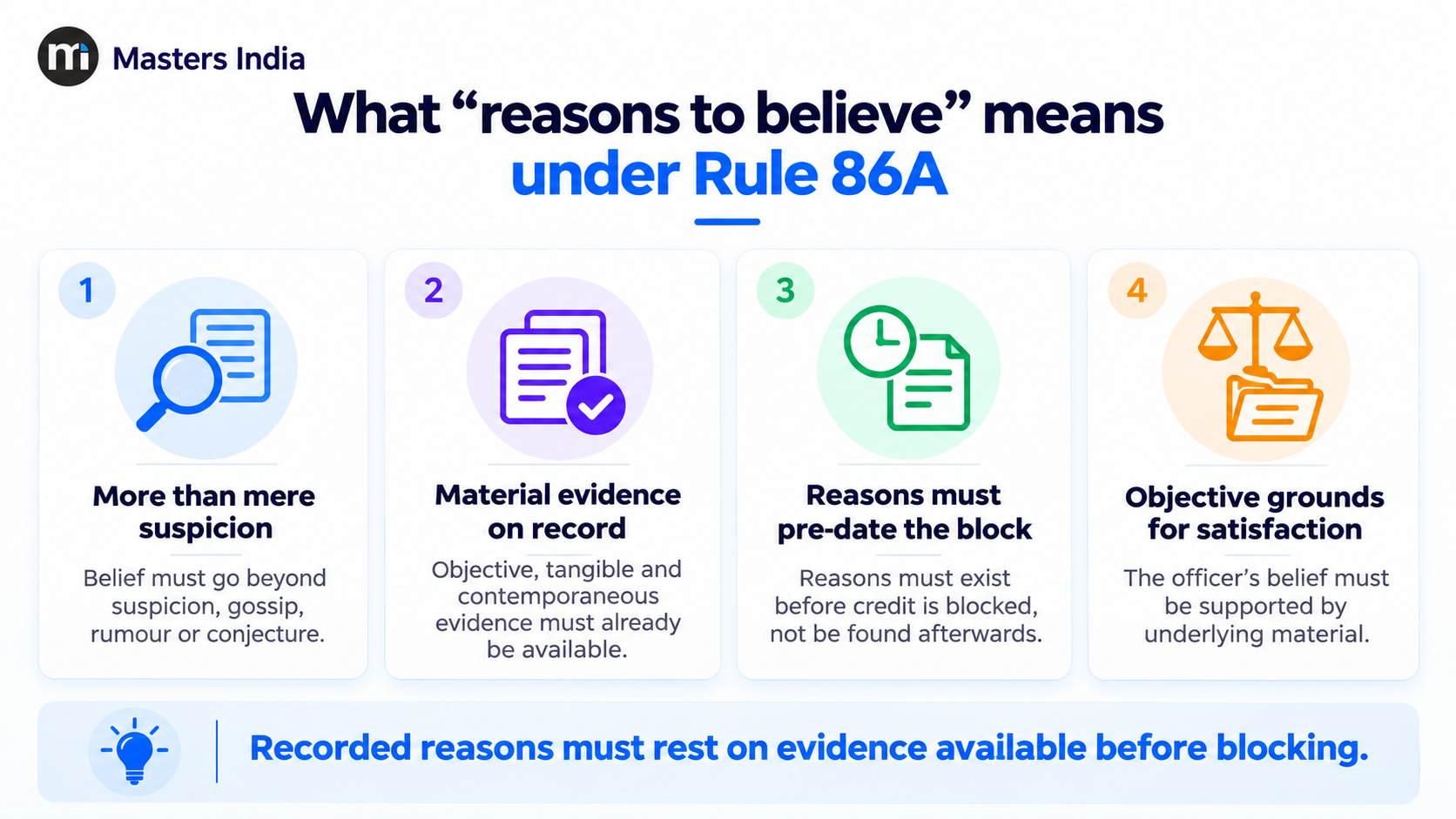 The phrase "reasons to believe" carries a precise legal meaning that prevents the arbitrary or mechanical use of Rule 86A:
More than mere suspicion
The law distinguishes "reasons to believe" from "reason to suspect," gossip, rumour, or conjecture. "Believe" is a much stronger legal word than "suspect".
Material evidence on record
The opinion must be formed based on objective, tangible, and contemporaneous material evidence already gathered or available on record.
Reasons must pre-date the block
The reasons must pre-exist and pre-date the blocking of the credit. An officer cannot block credit first based on a hunch and then search for reasons or discover them during a subsequent inquiry.
Objective grounds for the officer’s satisfaction
While the subjective opinion of the officer is not generally open to a court substituting its own wisdom, the existence of the underlying material is a mandatory prerequisite. Frivolous, implausible, or a complete absence of recorded reasons will rob the blocking of its lawful jurisdiction.
Five statutory grounds for blocking ITC under Rule 86A
Under Rule 86A(1), the "reasons to believe" cannot be based on general compliance failures. They must be strictly confined to one or more of the following five conditions [263, 281–282]:
Non-existent supplier
The credit has been availed on invoices/debit notes issued by a supplier who is found to be non-existent or not conducting business from the place declared in their registration.
No receipt of goods or services
The credit has been claimed on invoices or debit notes without the actual physical receipt of the underlying goods or services (e.g., "bogus invoices").
Non-payment of tax by the supplier
The credit is availed on invoices where the tax charged has not actually been deposited with the Government by the supplier.
Non-existent recipient
The registered person availing the credit (the recipient) is found to be non-existent or not conducting business from their own registered premises.
Lack of a valid invoice
The registered person avails input tax credit without being in physical possession of a valid tax invoice, debit note, or other prescribed document under Rule 36.
CBIC guidelines for blocking the electronic credit ledger
According to the CBIC Guidelines dated 2 November 2021*, before blocking credit, the officer must apply their mind and document the following on the official file:
Care and caution before blocking ITC
Since blocking credit severely impacts a taxpayer's working capital, the power must be exercised with maximum care, caution, and circumspection. It must never be done as a matter of routine.
Necessity to protect government revenue
The officer must record why disallowing the debit is specifically necessary to protect the interest of the government revenue (e.g., to prevent the taxpayer from quickly utilising or passing on the ineligible credit).
Reasons recorded in writing
The "reasons to believe" must be formally recorded in writing on the official file by the officer before executing the block.
Proportionate blocking of credit
The amount blocked in the ledger must be strictly equivalent to the ineligible credit identified and cannot exceed it.
*This guideline is annexed with this article.
What does not qualify as “reasons to believe”
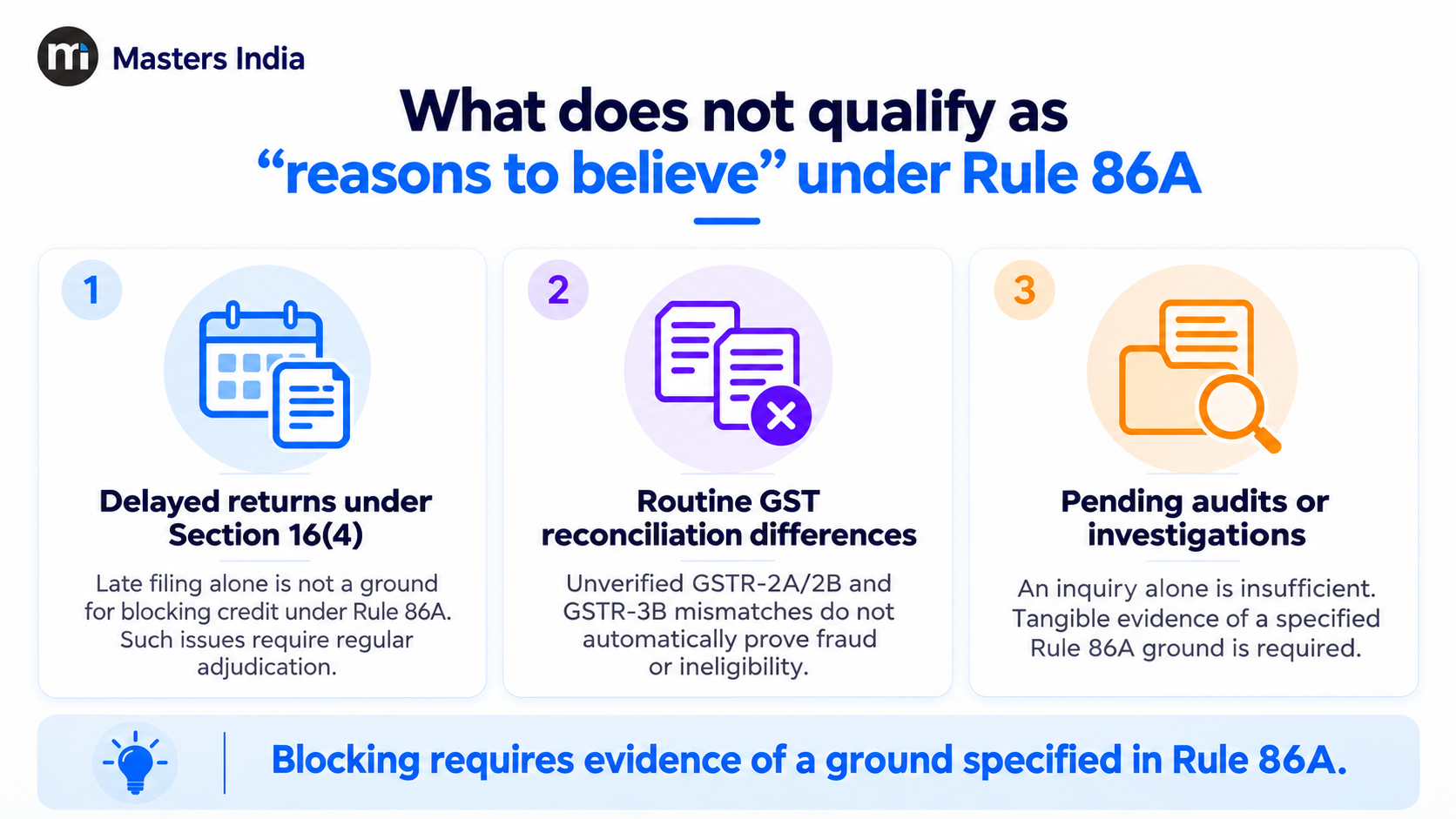 The sources highlight that tax authorities often cross legal boundaries by blocking credit for reasons not supported by Rule 86A:
Delayed returns under Section 16(4)
Blocking credit because returns were filed belatedly (in violation of Section 16(4)) is ex facie illegal and outside the scope of Rule 86A. Such timing differences must be resolved via regular adjudication (issuing an SCN), not unilateral blocking.
Routine GST reconciliation differences
Simple, unverified mismatches between GSTR-2A/2B and GSTR-3B do not automatically prove fraud or ineligibility and are not grounds for emergency blocking.
Pending audits or investigations
The mere fact that a general audit or investigation has been initiated against a taxpayer is not sufficient grounds to block credit, unless there is tangible proof of one of the five specific statutory infractions.
When can ITC be blocked under Rule 86A?
Blocking the electronic credit ledger under Rule 86A requires recorded reasons to believe that the credit is fraudulent or ineligible on one of the grounds specified in the rule. Those reasons must rest on material evidence available before the block is imposed.
The officer must also explain why blocking the credit is necessary to protect government revenue and limit the amount blocked to the credit identified. A routine mismatch or a pending inquiry alone does not establish the grounds for blocking ITC.
For businesses, the practical step is to keep invoices, receipt records and GST reconciliations ready to support their ITC claims. Masters India can support businesses with GST reconciliation and compliance workflows to help maintain consistent records and identify discrepancies.
About the Author

- ★★
- ★★
- ★★
- ★★
- ★★
Check out other Similar Posts

CFO Weekly Digest
A weekly newsletter delivering sharp insights, strategic analysis, and critical updates on business, finance, and compliance — designed exclusively for CFOs and Finance Leaders
Masters India is a GST Suvidha Provider (GSP) appointed by Goods and Services Tax Network (GSTN), a Government of India enterprise.
 Procapitus Business Park, 4th Floor, D 247/4A, Sector 63 Rd, Noida, Uttar Pradesh 201301
 info@mastersindia.co




Certified