

The GST treatment of research grants received by universities and research institutions turns on a threshold question: whether the receipt of a grant constitutes a "supply" within the meaning of the Central Goods and Services Tax Act, 2017 ("CGST Act"). This is a fact-dependent inquiry that the retrieved material does not resolve directly. However, the framework can be stated as follows.
A grant is taxable only if it constitutes consideration for a supply of services. If the grant is a pure transfer of funds - with no identifiable service rendered by the university to the grantor in return - it falls outside the scope of GST entirely, because there is no supply. If, however, the grant is structured as a contract for research services (i.e., the university undertakes to deliver specific research outputs, reports, or intellectual property to the grantor), the transaction may constitute a taxable supply of research services.
This distinction - between a grant and a contract for services - is the central issue in most GST notices issued to universities and research institutions.
Does the educational institution exemption cover research activities?
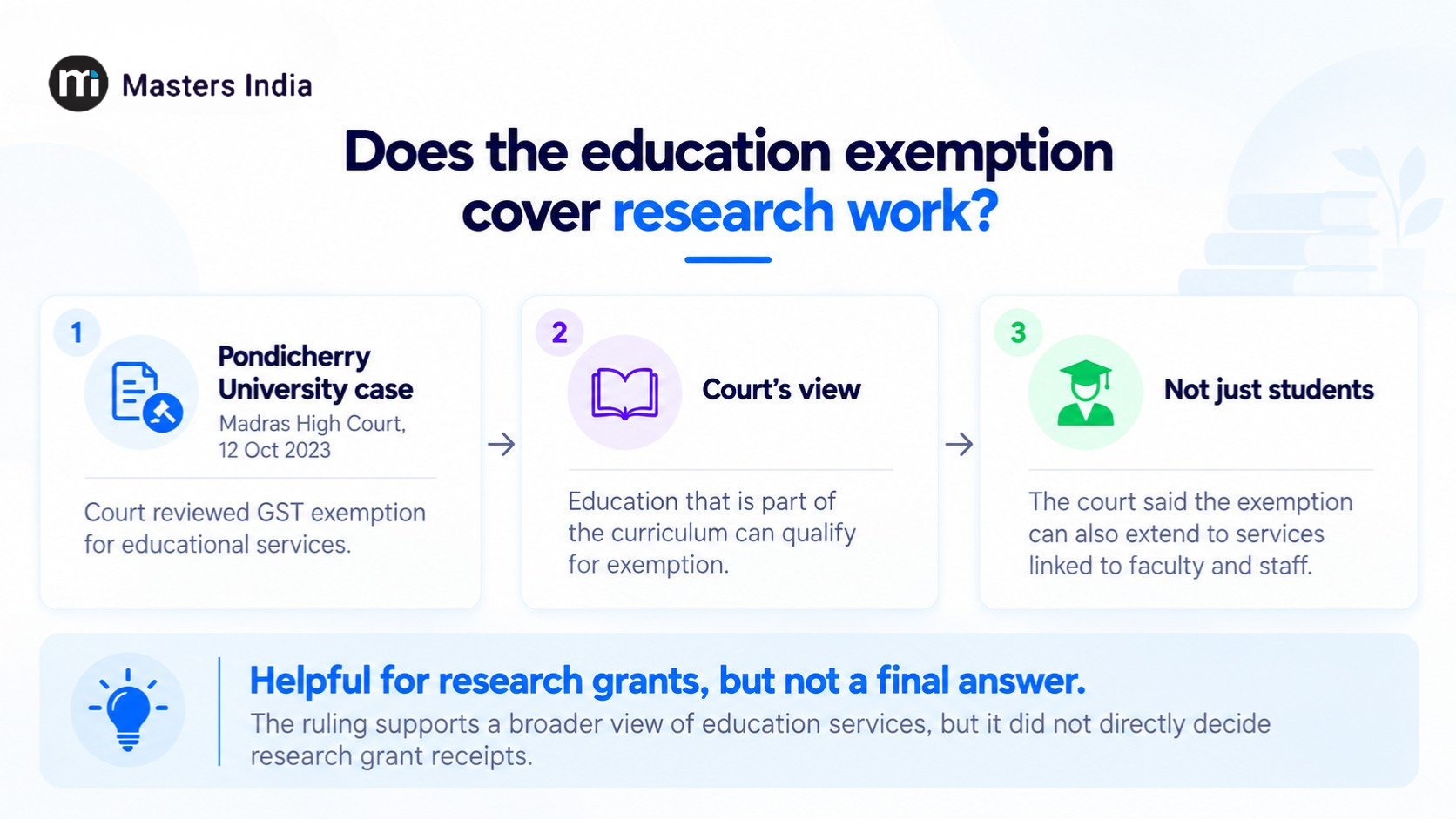 The retrieved judgment Pondicherry University vs The Joint Commissioner Of Gst Central on 12 October 2023 provides the most directly relevant judicial analysis. The Madras High Court, in that case, examined the scope of GST exemptions available to educational institutions and universities under the mega exemption notification framework.
The Court noted the following in relation to the definition of "educational institution":
"whatever be the Degree, Diploma, PG diploma, Professional Degree or Post Graduate Degree are concerned, in order to obtain such qualification, if education being imparted as a part of curriculum, that education shall be part of service for the purpose of Clause 'l' for getting exemption." Pondicherry University vs The Joint Commissioner Of Gst Central on 12 October 2023
The Court further held that the exemption is not limited to the act of imparting education to students alone:
"it is not limited to the services of imparting education to students alone for the purpose of exemption, but, it expands beyond which, where, whatever the services to be provided by the educational institution to its faculty and staff shall also form part of the activity of education being provided by way of services by the educational institution." Pondicherry University vs The Joint Commissioner Of Gst Central on 12 October 2023
Significance for research grants: This judicial interpretation supports the position that the exemption available to educational institutions under the GST framework is not narrowly confined to classroom instruction. However, the Court's analysis in Pondicherry University was directed at affiliation fees and services to students, faculty, and staff - not at research grant receipts specifically. The judgment is therefore persuasive but not directly dispositive on the research grant question.
Concessional GST on goods supplied to research institutions
Notification No. 45/2017 Central Tax (Rate), dated 14.11.2017, provides a concessional GST rate of 5% (2.5% CGST + 2.5% SGST) on specified goods supplied to research institutions. The notification covers:
"Scientific and technical instruments, apparatus, equipment (including computers); accessories, parts, consumables and live animals (experimental purpose); computer software, Compact Disc-Read Only Memory (CD-ROM), recorded magnetic tapes, microfilms, microfiches; Prototypes, the aggregate value of prototypes received by an institution does not exceed fifty thousand rupees in financial year." Notification No.45 2017 Central Tax (Rate) dated 14.11.2017
The notification distinguishes between two categories of institutions:
Category 1 - Public-funded research institutions (other than hospitals, universities, IITs, IISc Bangalore, NITs/RECs): These must be under the administrative control of the Department of Space, Department of Atomic Energy, or DRDO, or registered with the Department of Scientific and Industrial Research (DSIR).
Category 2 - Research institutions (other than hospitals): Subject to conditions including a certificate from the Head of Institution that goods are required for research purposes only.
Critical observation: Universities are expressly excluded from Category 1 of this notification. The notification text reads:
"Public funded research institution other than a hospital or a University or an Indian Institute of Technology or Indian Institute of Science, Bangalore or a National Institute Technology/Regional Engineering College." Notification No. 45/2017, Central Tax (Rate) dated 14.11.2017
This means universities cannot claim the concessional rate under Category 1. They may qualify under Category 2 (general research institutions), subject to the prescribed conditions. This is a point that is frequently overlooked in practice and can be the basis of a GST notice.
Does segregation of research grant funds support non-taxability?
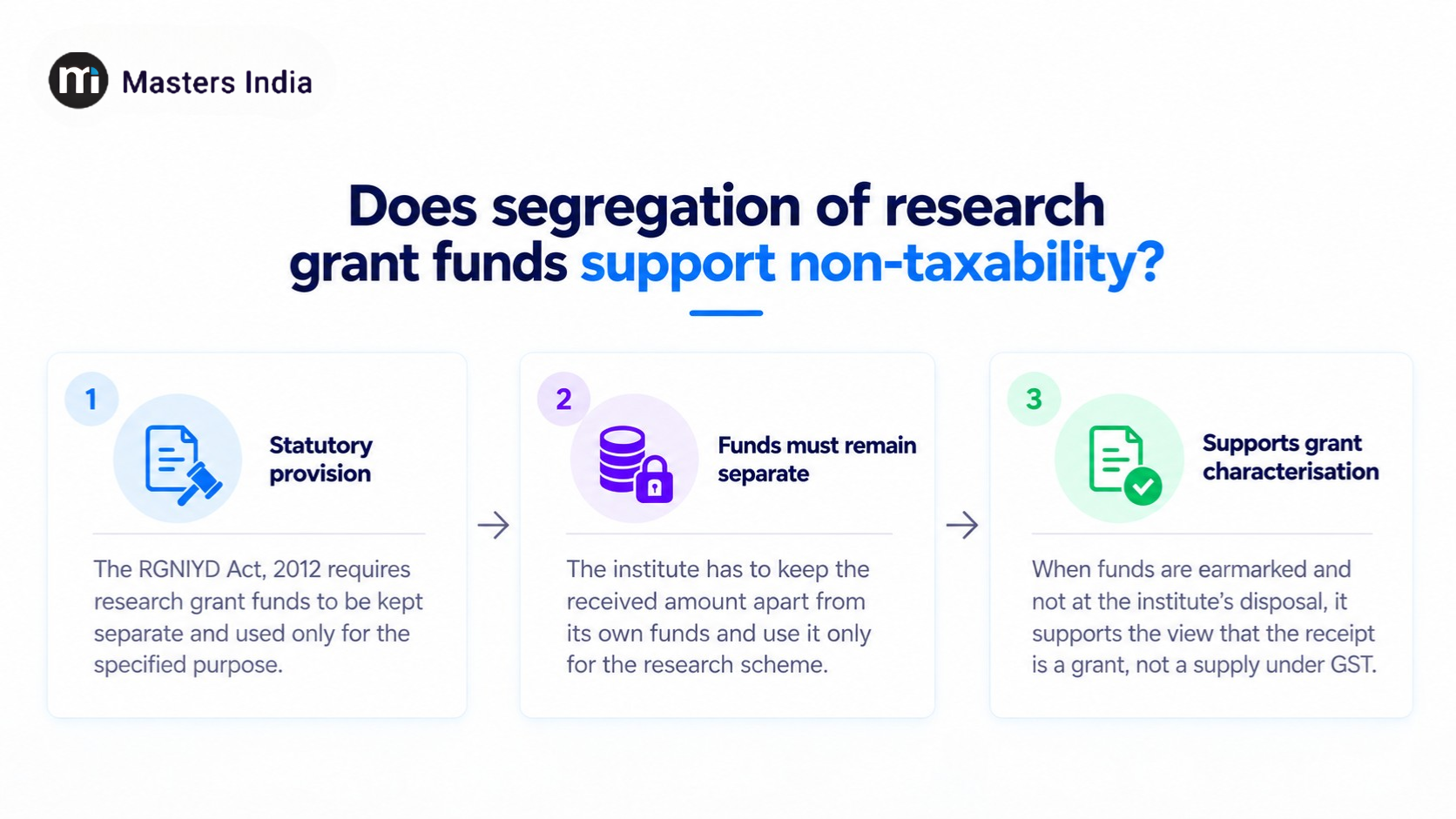 The RGNIYD* Act, 2012 (35 of 2012) - which governs a national institute - contains a provision that is instructive as a statutory model for how research grants are to be treated:
"whenever the Institute receives funds from any Government, the University Grants Commission or any other agency including industry sponsoring a research scheme, a consultancy assignment, a teaching programme or a chaired professorship or a scholarship, to be executed or endowed at the Institute - (a) the amount received shall be kept by the Institute separately from the fund of the Institute and utilised only for the purpose of the scheme." The RGNIYD Act, 2012 (35 of 2012)
This statutory framework, requiring segregation of sponsored research funds, is relevant to the GST analysis in the following way: where an institution is required by statute to keep grant funds separate and use them only for the specified purpose, this supports the characterisation of the receipt as a grant rather than as consideration for a supply. The funds are not at the institution's disposal; they are earmarked. This argument can be advanced in response to a GST notice.
*The Rajiv Gandhi National Institute of Youth Development Act, 2012
Can educational institution exemptions extend to research activities?
The retrieved circular on GST on services by Central and State Boards, Clarification regarding GST on supply of various services by Central and State Board (such as National Board of Examination ) reg. clarifies the exemption framework for educational institutions. While directed at examination boards rather than research institutions, it confirms the definition of "educational institution" under the GST exemption notification:
"educational institution means an institution providing services by way of, (i) pre-school education and education up to higher secondary school or equivalent; (ii) education as a part of a curriculum for obtaining a qualification recognised by any law for the time being in force; (iii) education as a part of an approved vocational education course." Clarification regarding GST on supply of various services by Central and State Boards (such as National Board of Examination ) reg.
Significance: A university that conducts research as part of its curriculum for obtaining a recognised qualification (e.g., PhD programmes, M.Tech research) may be able to argue that the research activity falls within the definition of "educational institution" and is therefore exempt. However, research conducted under externally sponsored projects - particularly industry-sponsored research - may not fall within this definition, because it is not necessarily "education as a part of a curriculum for obtaining a qualification."
Does Income Tax approval affect GST exemption for research institutions?
The Income Tax Act, 1961, amended by the Finance Act, 2024, provisions on approved research associations and universities are relevant as background context. Under Section 35 of the Income Tax Act, donors to approved research institutions receive deductions. The approval framework requires:
"the research association, university, college or other institution referred to in clause (ii) or clause (iii) shall make an application in the prescribed form and manner to the Central Government for the purpose of grant of approval, or continuance thereof." Income Tax Act 1961 amended by Finance Act 2024
This is relevant because a university's approval status under the Income Tax Act is sometimes cited in GST proceedings as evidence of its character as a research institution. However, Income Tax approval does not automatically confer GST exemption - the two regimes operate independently.
GST framework for universities receiving research grants
Based on the above discussion, the following framework applies:
| Issue | Legal Position | Source |
| Pure grants (no quid pro quo) | Not a "supply"; outside GST scope | CGST Act s.7 (not retrieved, but foundational) |
| Contract research (deliverables to grantor) | Potentially taxable supply of research services | Fact-dependent |
| Goods purchased for research | Concessional 5% GST if conditions met; universities excluded from Category 1 | Notification 45/2017 |
| Educational institution exemption | Available for curriculum-linked research; uncertain for sponsored research | Pondicherry University |
| Statutory segregation of grant funds | Supports "grant" characterisation | RGNIYD Act S.39 |
Key GST risks in sponsored research arrangements
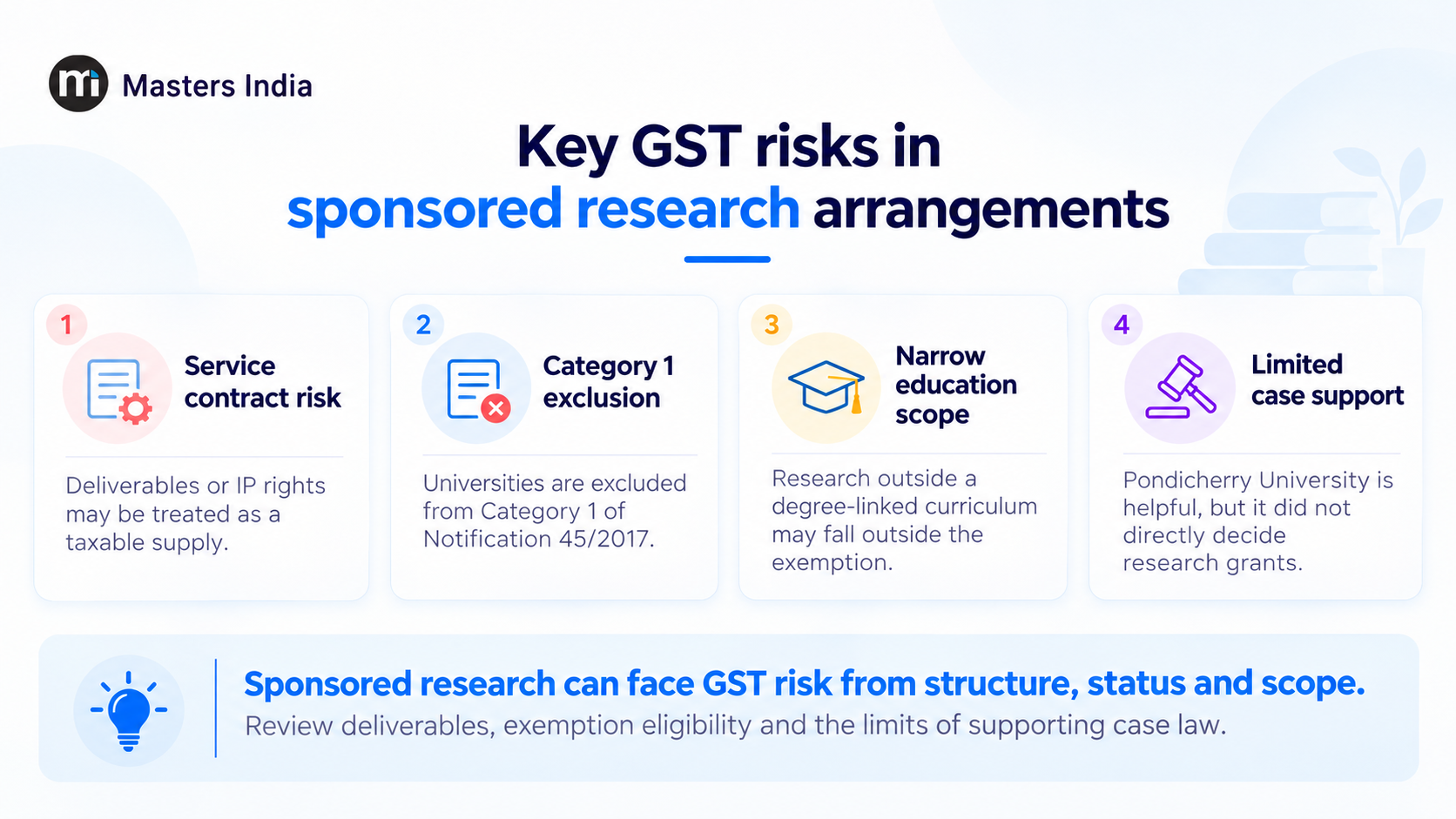 Risk 1 - Characterisation as contract for services
The Department frequently characterises sponsored research agreements as contracts for services, particularly where the sponsor receives deliverables (reports, data, IP rights). If the agreement gives the sponsor rights over research outputs, the Department will argue there is a supply.
Risk 2 - University excluded from Category 1 of Notification 45/2017
As noted above, universities are expressly excluded from the concessional rate under Category 1. A university that has been claiming this benefit may face a demand for the differential tax.
Risk 3 - Narrow definition of "educational institution"
The GST exemption for educational institutions is tied to curriculum-linked education. Industry-sponsored research that is not part of a degree programme may fall outside this definition.
Risk 4 - Limitation of Pondicherry University judgment
The Pondicherry University decision addressed affiliation fees and services to students and staff - not research grants. Its ratio does not directly cover the research grant question, though its expansive reading of the exemption is persuasive.
When are research grants taxable under GST?
The GST treatment of a research grant depends primarily on the substance of the arrangement. A pure grant with no identifiable service supplied to the funding agency can be argued to fall outside GST because there is no consideration for a supply. The position changes where the university or research institution is contractually required to provide specific research outputs, reports, data, intellectual property or other benefits to the sponsor.
Univesities should therefore review each funding agreement independently, particularly the deliverables, sponsor rights, use of funds and link with curriculum-based education. They should also verify eligibility before claiming concessional GST on research goods, since Notification 45/2017 applies subject to specific institutional conditions. Masters India can support institutions with GST compliance, reconciliation and tax technology workflows for managing such transactions.
About the Author

- ★★
- ★★
- ★★
- ★★
- ★★
Check out other Similar Posts

CFO Weekly Digest
A weekly newsletter delivering sharp insights, strategic analysis, and critical updates on business, finance, and compliance — designed exclusively for CFOs and Finance Leaders
Masters India is a GST Suvidha Provider (GSP) appointed by Goods and Services Tax Network (GSTN), a Government of India enterprise.
 Procapitus Business Park, 4th Floor, D 247/4A, Sector 63 Rd, Noida, Uttar Pradesh 201301
 info@mastersindia.co




Certified