

The Indian cement industry presents an unusually rich case study for understanding the structural tensions within the Goods and Services Tax regime. Cement manufacturing is not merely the conversion of limestone into a taxable finished product. It is an integrated industrial ecosystem involving mining rights, royalty, District Mineral Foundation contributions, National Mineral Exploration Trust contributions, environmental levies, captive mines, heavy industrial plant, civil structures, captive and renewable power, coal and petcoke, rail and road logistics, depots, stock transfers, dealer networks, trade discounts, promotional schemes, exports, waste utilisation, reverse charge obligations and substantial capital expenditure.
India's cement industry has an installed capacity approaching 700 million tonnes per annum and produced approximately 491.4 million metric tonnes during FY2025-26. Industry capacity continues to expand materially, driven primarily by infrastructure and housing demand.
The GST importance of this industry increased further after the tax on cement falling under Heading 2523 was reduced from 28% to 18%, effective 22 September 2025. The change substantially alters the output-tax economics of the industry but does not eliminate its major disputes. Indeed, the central thesis of this paper is that the GST risk of a modern cement manufacturer increasingly lies upstream and around the manufacturing process rather than in the taxability of the cement itself.
The principal areas of contemporary controversy are:
- GST on mining royalty and associated statutory payments;
- classification of payments connected with extraction of limestone;
- eligibility of input tax credit on plant, foundations and civil structures;
- impact of the retrospective amendment to section 17(5)(d);
- captive and renewable power infrastructure;
- inward freight and outward FOR transportation;
- valuation of depot and branch transfers;
- Head Office–Branch Office cross-charges and Input Service Distributor arrangements;
- dealer discounts, incentives and commercial credit notes;
- coal, petcoke and imported fuel;
- waste, fly ash and alternative raw materials;
- reverse charge transactions;
- related-party and corporate guarantee transactions;
- GST consequences of large-scale capacity expansion and acquisitions; and
- evidentiary architecture required to defend GST audits and investigations.
The paper argues that a successful GST framework for the cement industry must move from a conventional invoice-by-invoice compliance model to a transaction architecture model, under which the tax treatment follows the economic function of each component of the industrial value chain.
GST across the cement manufacturing value chain
Cement occupies a distinctive position under GST. It is simultaneously:
- a high-volume industrial commodity;
- a core infrastructure input;
- a mineral-based manufactured product;
- a freight-intensive commodity;
- a capital-intensive manufacturing activity;
- an industry dependent upon geographically distributed factories, grinding units, depots and warehouses; and
- an industry increasingly integrating captive power, renewable power, waste heat recovery and alternative fuels.
Accordingly, a cement company's GST exposure cannot be understood merely by identifying the HSN classification of cement.
The proper unit of analysis is the entire value chain:
Limestone Mine → Crusher → Raw Mill → Kiln → Clinker → Grinding → Cement → Packing → Depot/Terminal → Dealer/Project Customer → Construction Sector
Parallel chains operate simultaneously:
Coal/Petcoke/Fuel → Kiln
Fly Ash/Slag/Gypsum → Blended Cement
Electricity/Renewable Energy → Manufacturing
Corporate Head Office → Plants/Depots
Transporters/Railways/Ports → Logistics Network
GST touches almost every node, but frequently in different ways.
This produces what may be called the Cement GST Paradox:
The outward supply is relatively easy to classify, but the tax treatment of the inputs, infrastructure, mining rights, statutory payments, logistics and commercial arrangements surrounding that outward supply is highly complex.
Why the cement sector’s scale matters for GST
 India is the world's second-largest cement producer. Industry estimates indicate installed capacity of nearly 700 MTPA, with significant manufacturing concentration in limestone-rich States including Rajasthan, Andhra Pradesh, Tamil Nadu and Karnataka. Cement production reached approximately 491.4 million MT during FY26, an estimated 8.6% year-on-year increase.
Major manufacturers are undertaking substantial capacity expansion. UltraTech, for example, crossed domestic grey-cement manufacturing capacity of 200 MTPA in April 2026 after commissioning new grinding facilities in Uttar Pradesh, Jharkhand and Andhra Pradesh.
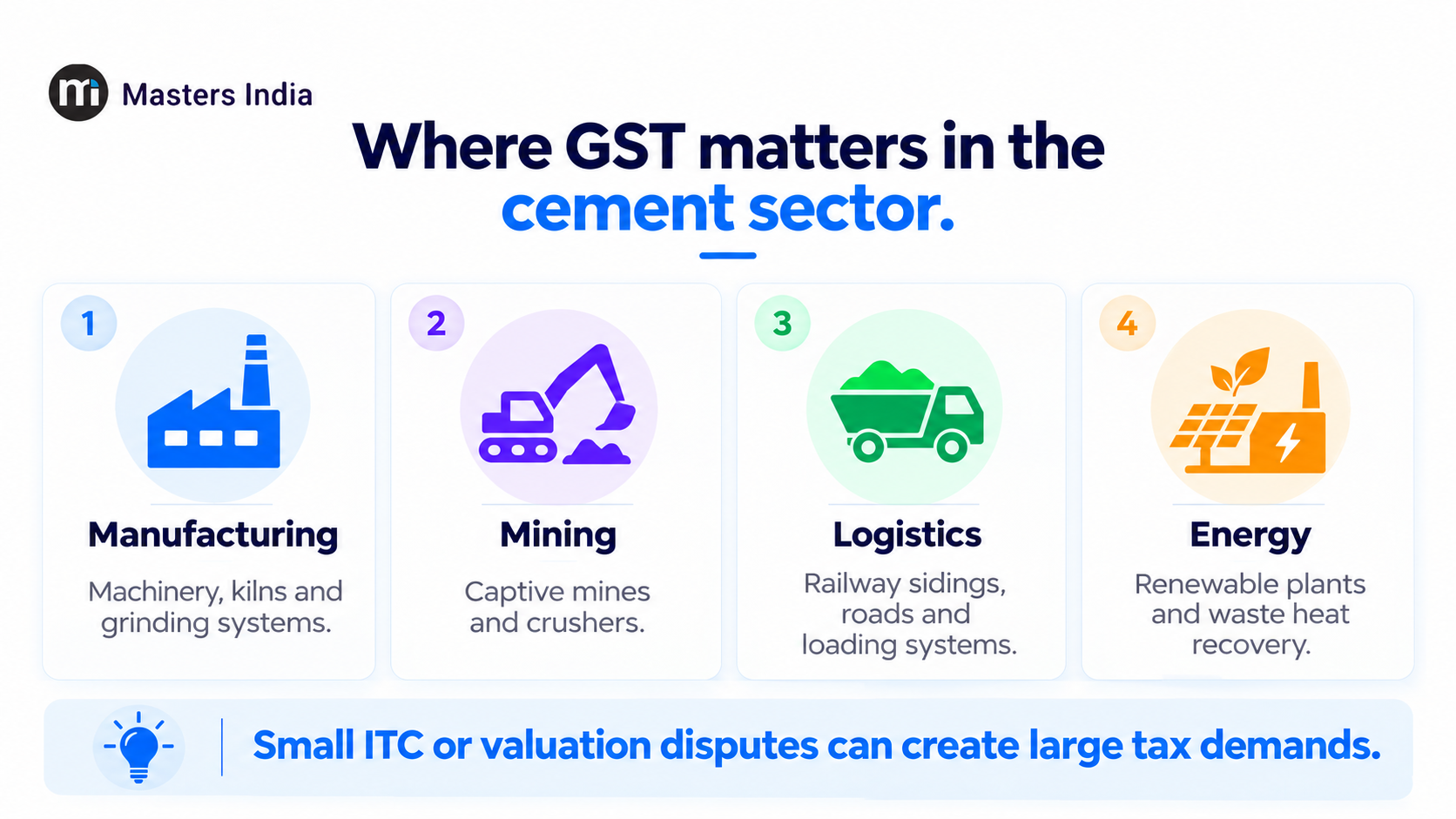
These characteristics matter for GST because cement manufacturing involves enormous expenditure on:
- industrial machinery;
- kilns;
- grinding systems;
- silos;
- conveyors;
- crushers;
- captive mines;
- railway sidings;
- roads;
- loading systems;
- warehouses;
- jetties and bulk terminals;
- renewable-energy plants;
- waste-heat recovery systems; and
- distribution infrastructure.
Consequently, even a small disagreement about ITC eligibility or valuation can produce very large tax demands.
GST rates on cement: historical and current position
3.1 ORIGINAL GST STRUCTURE
At the introduction of GST, the GST Council consciously placed cement in the 28% slab. Council records demonstrate that a proposal to place cement at 18% was considered, but the Council initially retained 28%.
This historically created an anomaly.
Cement was:
- an essential construction input;
- used extensively in housing and public infrastructure; yet
- taxed at one of the highest general GST rates.
Cement GST rate from 22 September 2025
The position materially changed in September 2025.
Heading 2523 covers:
Portland cement, aluminous cement, slag cement, super sulphate cement and similar hydraulic cements, whether or not coloured or in the form of clinkers.
These goods were moved to the 18% schedule.
Therefore:
| Period | General GST rate on Heading 2523 |
|---|---|
| 1 July 2017–21 September 2025 | 28% |
| From 22 September 2025 | 18% |
This temporal distinction is crucial for litigation.
An assessment relating to FY2019-20 cannot mechanically apply the present 18% rate.
Conversely, pricing, credit-note and contract analyses for FY2026-27 must recognise the 18% regime.
HSN classification across cement-sector products
The expression "cement sector" includes several products that do not necessarily share one classification.
Typical supplies include:
- ordinary Portland cement;
- Portland pozzolana cement;
- Portland slag cement;
- white cement;
- clinker;
- ready-mix concrete;
- wall putty;
- construction chemicals;
- adhesives;
- fly ash;
- slag;
- gypsum; and
- cement-based speciality products.
The classification inquiry must therefore begin with the actual composition and commercial identity of the product.
A manufacturer should avoid the assumption:
"If manufactured by a cement company, the product is cement."
GST classification follows the tariff description and product characteristics, not the corporate identity of the producer.
A significant audit control is therefore a SKU-to-HSN master, documenting:
- product name;
- chemical composition;
- manufacturing process;
- tariff heading;
- applicable rate;
- technical literature;
- comparable classification decisions; and
- date from which the rate applies.
GST payments under limestone mining
 Cement manufacturing normally begins not in the factory but in a limestone mine.
A manufacturer may operate captive limestone mines under mining leases granted by a State Government.
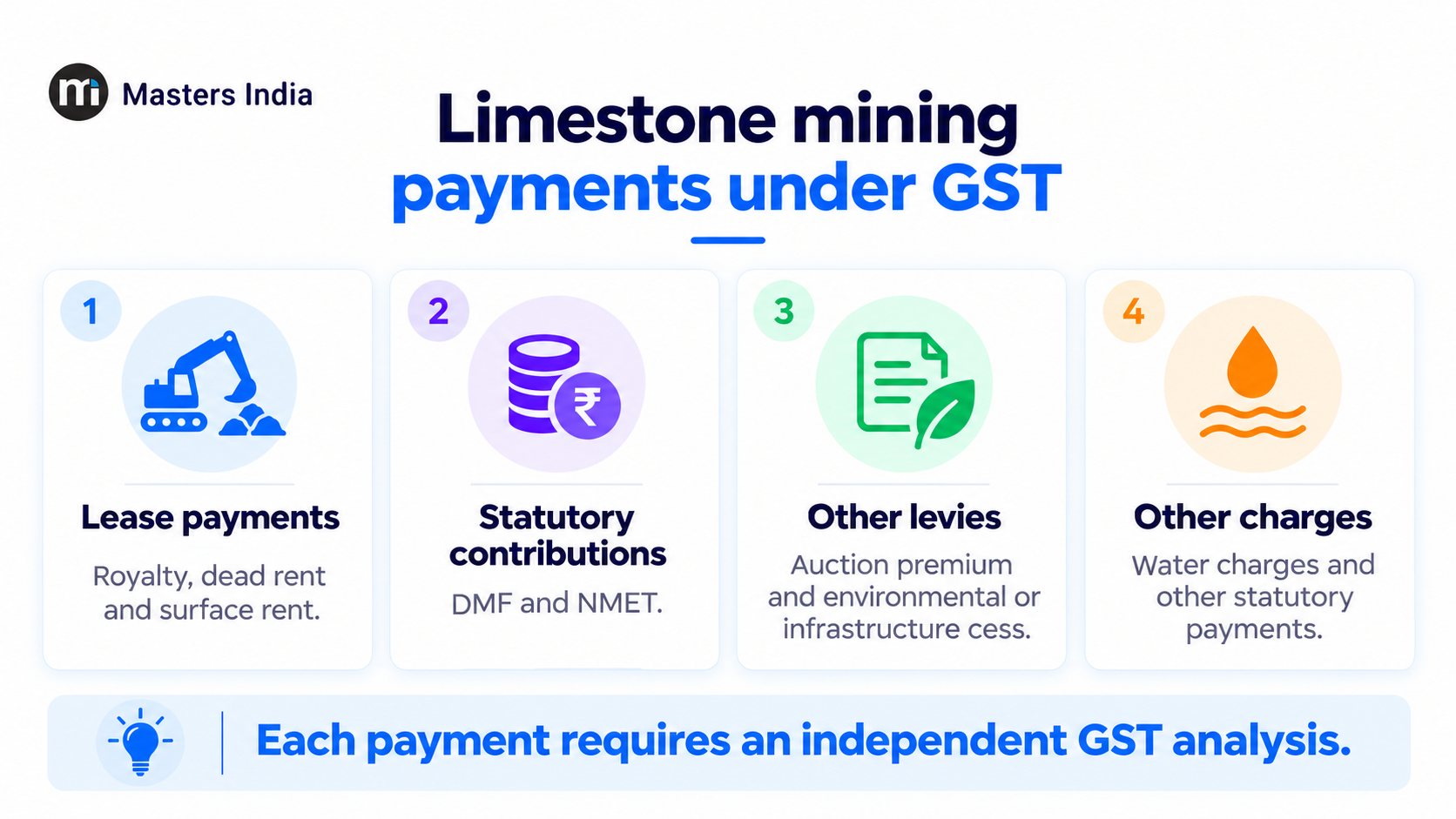
The payment architecture can include:
- royalty;
- dead rent;
- surface rent;
- District Mineral Foundation contribution;
- National Mineral Exploration Trust contribution;
- auction premium;
- environmental or infrastructure cess;
- water charges; and
- other statutory payments.
Each component requires an independent GST analysis.
GST on mining royalty and reverse charge
CBIC has consistently treated the grant of mining rights as a supply of services.
The mining-sector FAQ states that GST applies on royalty paid to Government under reverse charge and that, subject to general eligibility conditions, the recipient may avail ITC.
The conceptual chain is:
State Government grants right to extract mineral
↓
Mining company obtains licensing/mining service
↓
Royalty constitutes consideration
↓
GST payable under reverse charge
For classification purposes, licensing services concerning rights to use minerals have been associated with SAC 997337.
Circular No. 164/20/2021-GST addressed historical controversy concerning the applicable rate on mining rights and clarified the Department's position supporting 18% taxation even for the earlier disputed period.
Mining royalty after the Mineral Area Development Authority ruling
The constitutional character of royalty underwent major judicial clarification in:
Mineral Area Development Authority v. Steel Authority of India Ltd., Civil Appeal Nos. 4056-4064 of 1999, Supreme Court, Nine-Judge Bench, decided 25 July 2024.
The Supreme Court held, inter alia, that royalty is not a tax.
This conclusion is significant to GST.
Historically, assessees challenging GST on royalty frequently relied upon the proposition that royalty itself constituted a tax and therefore could not constitute consideration for a taxable service.
Once royalty is characterised as something other than a tax, a central premise of that challenge becomes materially weaker.
The Supreme Court subsequently recognised the principle that royalty is not a tax while dealing with connected mineral-law questions.
This does not automatically answer every GST issue connected with mining. It does, however, strengthen the conceptual foundation for treating royalty as consideration associated with a right granted by the Government.
GST on DMF, NMET and mining-linked payments
A more difficult issue arises with payments such as:
- District Mineral Foundation contribution;
- National Mineral Exploration Trust contribution;
- State infrastructure cess; and
- environmental cess.
The critical legal question is not merely:
Is the payment compulsory?
The correct GST question is:
Is the payment "consideration" for an identifiable supply, or does section 15 require its inclusion in the value of another identifiable supply?
The distinction is important.
A compulsory statutory payment is not automatically consideration.
There must still be a taxable supply and the required relationship between payment and supply.
The controversy is visible in UltraTech Cement Ltd. v. Union of India, Chhattisgarh High Court, W.P.(T) No. 4 of 2024, decided 19 January 2024.
A demand of approximately ₹14.35 crore plus interest and penalty had been raised on Infrastructure Development Cess and Environment Cess connected with limestone mining operations. The High Court did not finally adjudicate the substantive taxability question; the assessee was relegated to the statutory appellate remedy.
This case demonstrates an important methodological lesson:
Royalty, DMF, NMET and environmental cess should not automatically be treated as one homogeneous payment.
For each levy, examine:
- statutory source;
- person receiving the payment;
- purpose of the levy;
- whether that person supplies anything to the manufacturer;
- nexus with mining rights;
- whether the payment is consideration;
- whether it is merely a statutory burden on the lessee; and
- whether section 15 requires inclusion in value.
The KCP cement silo ruling and industrial ITC
One of the earliest cement-specific GST disputes concerned The KCP Limited, AAR Andhra Pradesh, Order AAR/AP/05(GST)/2018 dated 2 August 2018.
The questions included:
- ITC on inputs and input services used for manufacturing cement subsequently used in construction of a silo;
- bought-out items used for the silo; and
- taxability of mining royalty.
The silo question illustrates a recurring cement-industry problem.
A cement plant contains structures that are physically immovable but industrially inseparable from the manufacturing process.
Examples include:
- clinker silos;
- cement silos;
- pre-heater towers;
- kiln foundations;
- conveyor supports;
- crusher foundations;
- raw-material hoppers;
- packing plants;
- storage structures;
- pollution-control systems; and
- loading systems.
The legal inquiry cannot be resolved simply by asking whether an item is attached to earth.
Section 17(5): ITC on cement plant capital expenditure
 Sections 17(5)(c) and 17(5)(d) restrict ITC in relation to certain construction of immovable property.
At the same time, "plant and machinery" is carved out from important parts of the restriction.
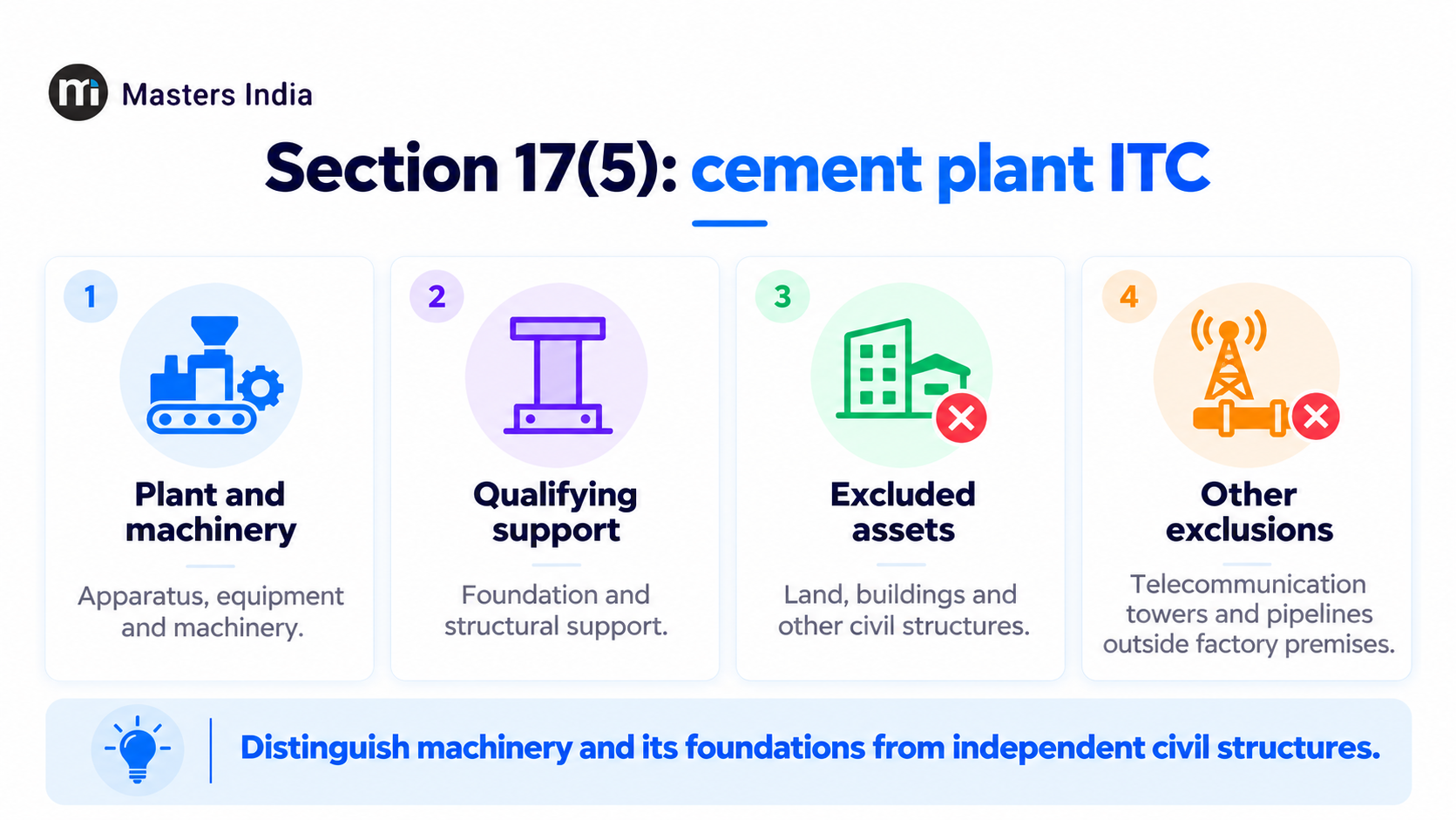
The Explanation defines plant and machinery broadly as apparatus, equipment and machinery fixed to earth by foundation or structural support, including such foundation and structural support, but excluding:
- land;
- building or other civil structures;
- telecommunication towers; and
- pipelines laid outside factory premises.
For a cement manufacturer, the boundary between:
machinery + foundation
and
civil structure
can involve enormous amounts of ITC.
Safari Retreats and the retrospective ITC amendment
In Chief Commissioner of CGST v. Safari Retreats Pvt. Ltd., Civil Appeal No. 2948 of 2023, 2024 INSC 756, decided 3 October 2024, the Supreme Court examined section 17(5)(c) and (d).
The Court emphasised the then-existing difference between:
- "plant and machinery"; and
- "plant or machinery".
It recognised a functionality-based inquiry for determining whether an immovable property could constitute a "plant".
For industrial sectors, this initially appeared highly significant.
A cement manufacturer could conceivably argue that specially engineered structures were not merely the setting in which manufacturing occurred, but functionally formed part of the manufacturing apparatus.
However, Parliament subsequently intervened.
Section 124 of the Finance Act, 2025 substituted:
"plant or machinery"
with:
"plant and machinery"
in section 17(5)(d), retrospectively from 1 July 2017.
It also inserted an overriding Explanation making the legislative intention applicable notwithstanding contrary judgments.
The amendment substantially curtails reliance upon the broader Safari Retreats interpretation for section 17(5)(d).
How to assess cement plant ITC after the amendment
Following the retrospective amendment, a cement manufacturer should classify capital projects into at least four categories.
| Category | Indicative GST position |
|---|---|
| Machinery itself | ITC ordinarily available subject to general conditions |
| Foundation/structural support specifically supporting qualifying machinery | Strong ITC position |
| General building/civil structure | ITC vulnerable to section 17(5) restriction |
| Hybrid industrial structure | Requires component-level factual analysis |
This creates what may be called the:
Functional Disaggregation Principle
Instead of asking:
Is the entire project a cement plant?
the correct inquiry is:
Which individual components constitute machinery, which components constitute its foundation/structural support, and which are independent civil structures?
Consider a kiln installation costing ₹500 crore.
The contract may include:
- kiln equipment;
- mechanical installation;
- electrical systems;
- foundation;
- structural steel;
- control room;
- roads;
- drainage;
- administrative building; and
- general civil works.
A blanket ITC claim over the ₹500 crore contract creates avoidable exposure.
A stronger position is created when engineering, procurement and accounting records separately identify each functional component.
Why capitalisation alone does not decide ITC
The accounting treatment of expenditure is relevant, but it is not the entire GST test.
Section 17(5) itself refers to capitalisation in relation to reconstruction, renovation, additions, alterations and repairs.
However:
Accounting classification cannot convert an otherwise eligible item of plant and machinery into a blocked building merely because it was capitalised.
Similarly:
Booking expenditure under "Plant & Machinery" in the fixed-asset register cannot transform an independent building into plant and machinery.
GST analysis must therefore reconcile:
Engineering Function + Contract + Fixed Asset Register + Accounting Treatment + Actual Use
ITC on mining equipment and heavy vehicles
Mining operations involve:
- dumpers;
- tippers;
- excavators;
- loaders;
- drilling equipment;
- crushing systems; and
- earth-moving machinery.
CBIC's mining-sector FAQs recognised that mining equipment such as certain tippers and dumpers may fall outside the restrictive concept of "motor vehicle" used for blocked-credit purposes and stated that GST charged on qualifying earth-moving machinery used in mining operations would be creditable.
The decisive inquiry should nevertheless remain item-specific.
For each vehicle/equipment category, the manufacturer should record:
- tariff classification;
- Motor Vehicles Act status;
- technical characteristics;
- registration requirement;
- carrying capacity;
- exclusive industrial/mining use; and
- business nexus.
GST issues in captive power and renewable energy
Energy is one of the largest components of cement manufacturing cost.
Cement plants increasingly use:
- captive thermal power;
- solar power;
- wind power;
- waste heat recovery;
- open-access electricity; and
- hybrid renewable arrangements.
GST creates a structural problem because electricity itself generally remains outside GST.
Where taxable inputs and capital goods are used partly for manufacturing taxable cement and partly in activities associated with non-GST/exempt electricity, questions of ITC attribution and reversal can arise depending upon the exact transaction structure.
The issue becomes particularly complex where one GST registration operates:
- a cement plant;
- captive renewable generation;
- power transfers;
- grid banking; and
- multiple factories.
Therefore renewable-energy projects require separate GST modelling before construction begins.
ITC evidence for waste heat recovery systems
Waste Heat Recovery Systems illustrate why traditional distinctions between "factory" and "power plant" can become artificial.
Waste heat arises from the cement manufacturing process itself.
A WHRS captures that heat and generates power that may again be consumed in cement manufacturing.
The commercial reality is circular:
Cement Manufacturing → Waste Heat → Electricity → Cement Manufacturing
Large manufacturers increasingly rely on such systems; UltraTech, for example, reported hundreds of megawatts of waste-heat recovery capacity as part of its energy portfolio.
For ITC purposes, documentary evidence should establish:
- captive consumption;
- integration with manufacturing;
- location;
- engineering interdependence;
- metering; and
- absence/presence of external electricity sale.
GST issues in coal and petcoke procurement
Coal and petcoke remain important fuels for kiln operations.
GST issues include:
- import IGST;
- compensation cess where applicable;
- domestic procurement;
- freight;
- port charges;
- handling;
- customs valuation;
- input tax credit; and
- ocean freight.
CBIC's rate FAQs historically specified a compensation cess of ₹400 per tonne on imported coal.
However, the importer must separately examine:
customs duty + IGST + compensation cess + logistics charges + ITC eligibility
rather than treating imported coal as a single tax line.
Mohit Minerals and IGST on ocean freight
 The Supreme Court's judgment in:
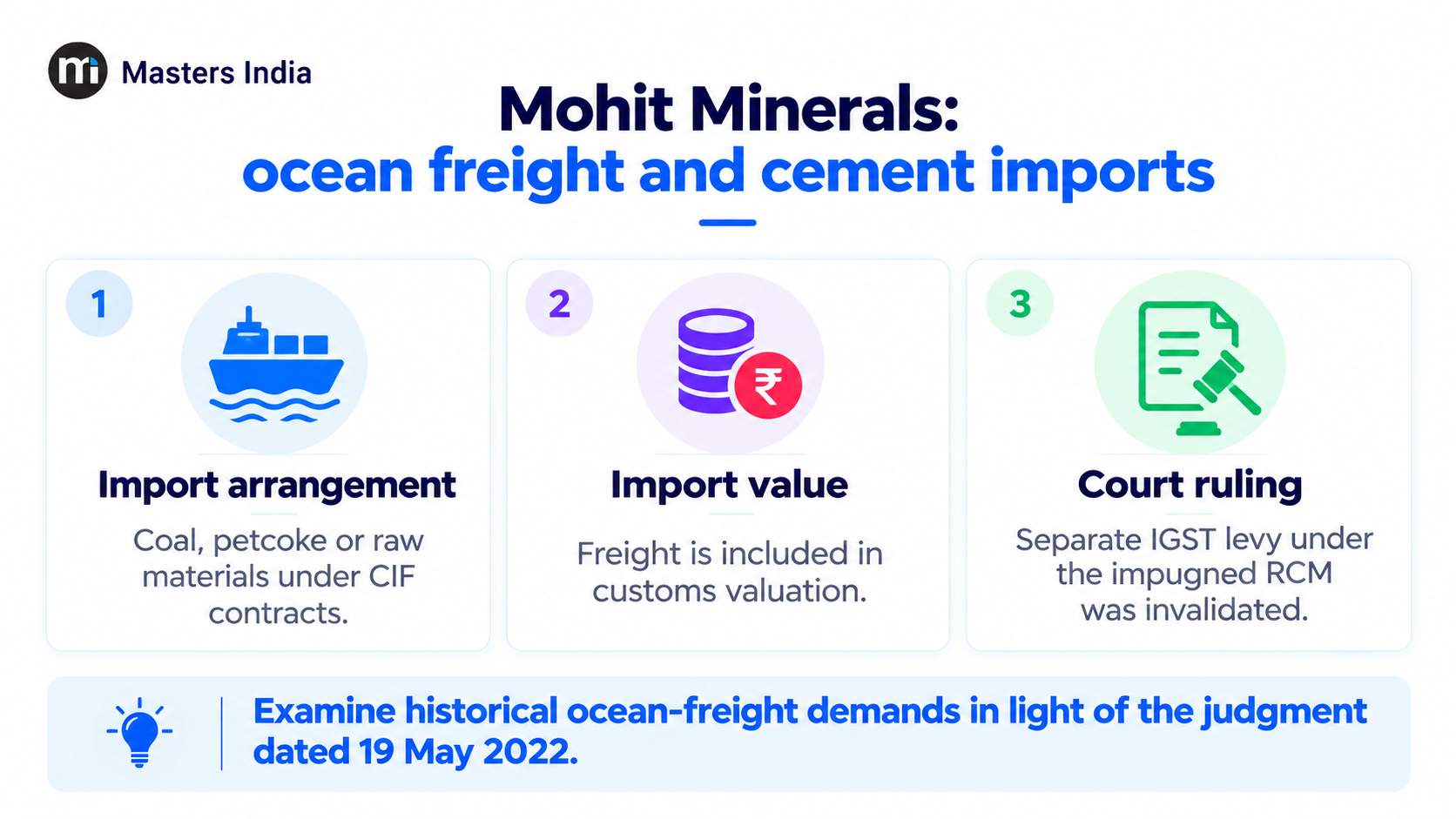
Union of India v. Mohit Minerals Pvt. Ltd., Civil Appeal No. 1390 of 2022, decided 19 May 2022
is particularly relevant to cement manufacturers importing coal, petcoke or other raw materials under CIF contracts.
The Supreme Court invalidated the separate levy of IGST on ocean freight under the impugned reverse-charge mechanism in the context of CIF imports.
The structural reasoning is commercially important.
Where import value already captures the freight element under the customs valuation mechanism, an additional tax treatment cannot be imposed merely by artificially isolating an element of the same composite import transaction without adequate statutory support.
For cement manufacturers with significant imports, historical ocean-freight demands therefore require examination in light of Mohit Minerals.
GST classification of fly ash, slag and other inputs
Modern blended cement relies extensively upon materials such as:
- fly ash;
- granulated blast furnace slag;
- gypsum;
- industrial by-products; and
- alternative mineral constituents.
This has important environmental and GST consequences.
From an industrial-policy standpoint, cement manufacture increasingly converts the waste of one industry into the raw material of another.
GST analysis must distinguish among:
- purchase of material;
- free supply of waste;
- payment by the cement company for the material;
- payment to the cement company for waste disposal/co-processing;
- transport-only arrangements; and
- waste-management services.
These are economically different transactions and can produce radically different GST outcomes.
The central question is:
Who is supplying what to whom, and who is paying whom?
This question should be answered before determining classification or rate.
GST on alternative fuels and waste co-processing
Cement kilns increasingly process industrial and municipal waste as alternative fuels.
A conventional purchase transaction is simple:
Supplier sells fuel → Cement company pays consideration
But a waste-disposal arrangement may operate differently:
Waste generator pays cement company → Cement company destroys/co-processes waste
Although physical material moves toward the cement manufacturer in both cases, the direction of the supply may be opposite.
Accordingly:
Direction of goods movement is not necessarily direction of supply.
This principle has significant relevance for GST on hazardous-waste co-processing.
Contracts should clearly establish whether the arrangement is:
- supply of fuel;
- waste-disposal service;
- job work;
- processing service;
- free material;
- barter; or
- composite commercial arrangement.
GST issues in cement transportation
Cement is freight intensive.
A bag of cement is comparatively low-value relative to its weight. Consequently, transport cost can represent a significant percentage of the delivered price.
The sector uses:
- road;
- rail;
- coastal shipping;
- bulk terminals;
- ports;
- depots;
- warehouses; and
- multimodal transportation.
GST disputes frequently begin with confusion over who actually contracted with the transporter.
Ex-works versus FOR cement supply contracts
Consider two structures.
Ex-works
Manufacturer sells cement ex-factory.
Buyer arranges freight.
The cement supply and GTA service may be independently contracted.
For destination
Manufacturer undertakes delivery to buyer's destination.
The manufacturer arranges transportation and ordinarily remains responsible for delivery.
CBIC's mining-sector clarification recognises that in an FOR arrangement, goods and transportation can constitute a composite supply where they are naturally bundled, with the goods being the principal supply.
The same conceptual analysis is highly relevant to cement.
Therefore the contractual terms:
- FOR;
- ex-factory;
- freight extra;
- freight recovered;
- ownership/risk transfer; and
- transporter engagement
must be aligned with GST invoicing.
How contract terms determine freight treatment
A common departmental approach is:
"Freight separately shown = separate transportation supply."
That proposition is too simplistic.
Section 2(30) expressly contemplates composite supplies and even provides an illustration involving goods packed and transported with insurance where goods constitute the principal supply.
The correct analysis is factual.
Relevant factors include:
- who contracts with the transporter;
- who bears risk during transit;
- point of delivery;
- price terms;
- whether buyer can refuse undelivered goods;
- whether freight recovery is actual or notional;
- whether the buyer independently receives GTA service; and
- whether transportation is naturally bundled with the sale.
ITC on railway sidings and logistics infrastructure
Large cement plants depend upon railway sidings and specialised loading infrastructure.
ITC disputes arise because such projects contain:
- tracks;
- foundations;
- civil structures;
- loading systems;
- machinery;
- signalling equipment; and
- land development.
A binary classification of the entire railway-siding project as either "plant" or "civil structure" is analytically weak.
The manufacturer should instead undertake component-wise classification and document whether each component:
- directly handles raw material or finished cement;
- supports machinery;
- is merely general infrastructure; or
- falls within an express statutory exclusion.
GST on interstate stock transfers
Large cement companies routinely operate plants in one State and depots/grinding units in another.
Under section 25, registrations in different States are treated as distinct persons.
Therefore movement of cement:
Rajasthan Plant → Delhi Depot
may constitute a taxable supply even though there is no sale to an unrelated customer.
This creates valuation issues under Rule 28.
Where the recipient registration is entitled to full ITC, the value declared in the invoice is generally deemed to be the open-market value under the Rule 28 proviso.
This principle is particularly important in cement because huge volumes move through stock transfers.
Depot valuation under Rule 28
A cement manufacturer may sell through:
- direct institutional sales;
- dealer networks;
- depots;
- consignment agents;
- project sales; and
- government contracts.
Prices may differ by:
- geography;
- freight;
- quantity;
- market demand;
- customer category;
- dealer margin; and
- competitive intensity.
Consequently, comparing depot transfer value with unrelated customer retail price without considering Rule 28 can produce misleading audit conclusions.
For full-credit transactions, the rule's deeming fiction assumes particular significance.
GST cross-charges between head office and plants
A modern cement enterprise typically has:
Corporate Head Office
providing:
- finance;
- legal;
- IT;
- procurement;
- HR;
- treasury;
- marketing;
- strategy;
- audit; and
- management services
to numerous State registrations.
GST therefore raises two separate questions:
A. Externally procured common input services
How should ITC be distributed?
B. Internally generated Head Office services
Is cross-charge required and, if so, at what value?
Circular No. 199/11/2023-GST provided important clarification concerning services between offices of the same organisation treated as distinct persons.
Where the branch is eligible for full ITC, the valuation framework is materially more liberal.
ISD requirements after statutory changes
For large multi-State cement groups, Input Service Distributor compliance should no longer be treated as an obscure administrative issue.
Corporate expenses can include:
- ERP;
- consulting;
- audit;
- cloud services;
- advertising;
- corporate insurance; and
- professional retainers.
The GST architecture should identify whether the benefit relates to:
- one specific registration;
- several identifiable registrations; or
- the entire enterprise.
A defensible allocation key should reflect the commercial benefit received.
Possible allocation metrics include:
- turnover;
- production capacity;
- headcount;
- actual usage;
- number of users;
- plant-specific identification; or
- transaction volumes.
GST on related-party transactions
Cement groups frequently contain:
- holding companies;
- subsidiaries;
- captive mining entities;
- logistics companies;
- power companies;
- overseas entities; and
- shared-service companies.
Transactions between related parties can be supplies even without conventional consideration in certain circumstances.
Risk areas include:
- management support;
- brand usage;
- employee secondment;
- procurement support;
- shared software;
- loans and guarantees;
- technical know-how; and
- group services.
The key discipline should be:
Identify the supply before attempting to value it.
GST valuation of corporate guarantees
Large capacity expansions require substantial financing.
Parent entities frequently give corporate guarantees for loans obtained by subsidiaries or related entities.
CBIC Circular No. 204/16/2023-GST addressed taxability of personal and corporate guarantees. Rule 28(2) introduced a specific valuation framework for corporate guarantees to related persons.
Circular No. 225/19/2024-GST subsequently clarified several issues relating to the application and valuation of such guarantees.
For cement groups funding multi-thousand-crore expansion projects, corporate-guarantee GST can therefore become material.
Treasury departments must consequently be incorporated into GST compliance architecture.
GST on dealer incentives and post-sale discounts
Cement is frequently distributed through dealers.
Commercial arrangements may include:
- turnover discounts;
- volume incentives;
- target incentives;
- cash discounts;
- prompt-payment discounts;
- market-support discounts;
- price-protection payments;
- dealer conferences;
- advertising support;
- freight support; and
- year-end rebates.
Historically these arrangements generated major disputes because a payment described commercially as a "discount" could potentially represent consideration for a service supplied by the dealer.
Section 15(3): GST treatment of dealer discounts
Section 15(3) recognises the exclusion of certain discounts from taxable value when statutory conditions are met.
For post-supply discounts, important requirements historically include:
- pre-existing agreement;
- linkage with relevant invoices; and
- prescribed ITC consequences.
The real issue is therefore not nomenclature.
A ₹50 per bag payment may be:
- genuine discount;
- reimbursement;
- commission;
- marketing consideration;
- performance incentive; or
- consideration for an independent service.
The contract and commercial conduct decide the character.
Commercial credit notes and GST treatment
The cement sector uses commercial or financial credit notes extensively where the supplier wishes to adjust commercial consideration without reducing GST originally charged.
The GST Council revisited post-sale discounts in 2025, specifically addressing:
- ITC reversal where financial/commercial credit notes are issued;
- whether manufacturer discounts become additional consideration in dealer-to-customer transactions; and
- whether discounts constitute consideration for promotional activities.
Circular No. 251/08/2025-GST subsequently addressed these issues, including the ITC consequences of discounted payments supported by financial/commercial credit notes.
For the cement industry, this is highly consequential because dealer incentives form an integral part of pricing strategy.
Five tests for classifying dealer incentives
Every dealer incentive should pass five tests.
Test 1-Supply test
Is the dealer merely receiving a lower purchase price, or performing something for the manufacturer?
Test 2-Obligation test
Must the dealer undertake:
- promotion;
- display;
- advertisement;
- market survey;
- exclusivity;
- sales campaign; or
- another identifiable activity?
Test 3-Documentation test
Does the scheme circular describe a discount or service consideration?
Test 4-Invoice test
Is GST adjusted through a statutory credit note or merely through a commercial credit note?
Test 5-ITC test
Does the supplier's treatment require any corresponding action by the recipient?
This framework is substantially safer than mechanically applying a single rule to all incentives.
GST on cement bags and returnable packing assets
Packing is commercially inseparable from conventional bagged cement.
GST considerations arise in relation to:
- kraft paper bags;
- polypropylene bags;
- pallets;
- reusable containers; and
- bulk transportation equipment.
Where packing accompanies the supply of cement, composite-supply principles ordinarily become relevant.
However, separately recoverable deposits for reusable packaging or independent sale of used packing material require separate examination.
Scrap generated from packaging and manufacturing operations should also be separately classified and taxed.
ITC on free samples and promotional material
A cement manufacturer may distribute:
- small sample packs;
- trial material;
- promotional merchandise;
- contractor gifts; and
- product demonstration material.
The GST analysis requires consideration of:
- Schedule I;
- whether consideration exists;
- section 17(5)(h);
- gifts/free samples;
- ITC reversal; and
- business promotion.
Promotional expenditure therefore should not be grouped into one general ledger account without tax segmentation.
Section 16: ITC and supplier compliance
The cement industry purchases enormous volumes from:
- mining contractors;
- transporters;
- machinery suppliers;
- maintenance vendors;
- manpower contractors;
- engineering contractors; and
- small local suppliers.
Supplier-default risk can therefore produce major ITC exposure.
A robust cement-sector ITC control system should integrate:
Purchase Register → GSTR-2B → Goods Receipt → Service Entry Sheet → Vendor Payment → GSTR-3B → Vendor Compliance
The question is not merely whether an invoice exists.
The evidence should establish:
- supply;
- receipt;
- tax invoice;
- statutory return matching;
- business use; and
- payment compliance.
The 180-day payment rule for ITC
Large capital and engineering contracts frequently involve:
- retention money;
- milestone payments;
- quality holdbacks;
- disputes;
- price adjustments; and
- performance guarantees.
These are commercially different from permanent non-payment.
Consequently, when examining the 180-day ITC provision, the Department and taxpayer should distinguish:
deferred contractual payment
from
non-payment of consideration.
The accounting system should separately identify:
- retention;
- disputed amount;
- withheld damages;
- payment not yet due;
- credit note;
- permanent write-back; and
- normal creditor outstanding.
A single "creditors >180 days" report is legally inadequate for determining ITC reversal.
ITC on works contracts for capacity expansion
India's cement manufacturers are currently undertaking substantial capacity additions. Industry estimates foresee very large capital expenditure through FY28.
Each expansion generates thousands of EPC and construction invoices.
Contracts may cover:
- civil work;
- structural work;
- mechanical equipment;
- erection;
- commissioning;
- electrical systems;
- pipelines;
- material handling;
- storage; and
- buildings.
The worst GST design is a single indivisible description such as:
"Civil and mechanical works for cement expansion project."
Tax defensibility improves when contracts and invoices separately identify:
- machinery;
- foundation;
- structural support;
- buildings;
- land development; and
- common civil work.
GST planning must therefore occur before tender finalisation, not after receipt of a departmental notice.
ITC on environmental infrastructure
Cement plants incur expenditure on:
- electrostatic precipitators;
- bag filters;
- pollution-control equipment;
- dust suppression systems;
- effluent systems;
- green belts;
- emission monitoring equipment;
- environmental laboratories; and
- waste-management systems.
The business nexus may be unquestionable because environmental permissions can be necessary for lawful production.
However, business necessity alone does not override section 17(5).
The correct legal inquiry remains whether the item is:
- machinery;
- foundation/structural support;
- building;
- civil structure;
- land improvement; or
- an independent service.
ITC issues for internal roads
Internal roads are a recurring industrial ITC controversy.
They may be indispensable for:
- movement of limestone;
- dumpers;
- clinker;
- cement;
- maintenance equipment; and
- finished goods.
Yet functional importance does not automatically convert a road into plant and machinery.
The statutory definition expressly excludes certain civil structures.
Thus the stronger taxpayer argument must identify a statutory basis for eligibility rather than relying merely on the proposition:
"Without the road, the factory cannot operate."
Commercial necessity and statutory classification are different inquiries.
ITC treatment of pipelines
The statutory Explanation to "plant and machinery" specifically excludes:
pipelines laid outside the factory premises.
This language creates an interpretative implication.
The legislature expressly excluded outside-factory pipelines, suggesting that pipelines inside factory premises are not automatically excluded if otherwise qualifying as part of plant and machinery.
Cement manufacturers should therefore maintain plant-layout evidence demonstrating:
- location;
- purpose;
- material transported;
- connection with machinery; and
- factory-boundary relationship.
E-way bills and cement transportation
Because cement moves continuously between factories, depots, dealers and projects, e-way bill compliance is commercially critical.
In J.K. Cement Ltd. v. State of U.P., decided 28 August 2023, goods travelling through Uttar Pradesh were intercepted in a dispute concerning absence of an accompanying e-way bill and penalty proceedings under section 129.
This illustrates the disproportionate operational impact of documentation errors.
For high-volume cement dispatches, controls should reconcile:
Invoice Number → Vehicle Number → E-Way Bill → LR/GR → Weighbridge → Destination → E-Invoice
Any break in that chain can create detention exposure.
J.K. Cement Ltd. vs State of Uttar Pradesh – Allahabad High Court
[Writ Tax No. 44 of 2023 | 28-Aug-2023 | (2023) 10 Centax 13 (All.)/2023 (77) G.S.T.L. 323 (All.)]
Quantity reconciliation for cement GST compliance
Cement manufacturing involves natural process variations.
The accounting chain may include:
Limestone
↓
Raw Meal
↓
Clinker
↓
Cement
Different conversion ratios occur because of:
- moisture;
- chemical reaction;
- burning loss;
- additives;
- fly ash;
- slag;
- gypsum;
- process loss; and
- measurement methodology.
GST audit should therefore not treat every quantitative difference as clandestine removal.
A proper reconciliation requires technical understanding of the manufacturing process.
Weighbridge records as GST evidence
In heavy industries, quantity is often more reliable than invoice count.
Cement companies should maintain integrated reconciliation among:
- mine dispatch;
- weighbridge;
- production records;
- clinker generation;
- cement grinding;
- silo records;
- packing;
- e-way bills;
- sales invoices; and
- stock.
This creates a powerful defence against allegations based solely on turnover analytics.
GST on clinker transfers
Integrated cement plants frequently manufacture clinker at one location and transfer it to grinding units elsewhere.
Because registrations in different States are distinct persons, interstate clinker transfers can constitute taxable supplies even without a conventional sale.
Key issues include:
- classification under Heading 2523;
- applicable rate for the relevant period;
- valuation under Rule 28;
- freight;
- e-way bills; and
- recipient ITC.
Following the September 2025 rate rationalisation, clinker included within Heading 2523 falls within the 18% schedule.
GST compliance for cement and clinker exports
Cement and clinker may also be exported.
India exported cement, clinker and related cement products during FY26, although domestic demand remains dominant.
Exporters must manage:
- zero-rated supply;
- LUT/bond;
- IGST route where legally available;
- refund;
- port documentation;
- shipping bills;
- foreign currency;
- freight;
- terminal charges; and
- reconciliation between GST and customs data.
Price revisions occurring after export create additional refund issues.
CBIC Circular No. 226/20/2024-GST introduced a mechanism concerning refund of additional IGST paid because of upward revision in export prices.
GST on acquisitions and business transfers
The cement industry is consolidating rapidly.
Acquisitions may involve:
- shares;
- business undertakings;
- slump sales;
- individual assets;
- mining rights;
- land;
- brands;
- plants;
- inventories; and
- contractual rights.
GST treatment differs materially depending upon transaction architecture.
A sale of shares is fundamentally different from a transfer of individual plant assets.
A transfer of a going concern can also produce a different GST outcome from an asset sale.
Tax structuring therefore cannot begin after the commercial acquisition structure has already been finalised.
Cement GST rate reduction: pricing and transition issues
The reduction of cement GST from 28% to 18% created significant pricing consequences.
Industry analysis estimated that the rate reduction could materially lower the tax burden embedded in cement pricing, including savings to consumers per bag.
For manufacturers and dealers, the transition required careful treatment of:
- old stock;
- price lists;
- MRPs;
- dealer inventory;
- credit notes;
- contracts entered before rate change;
- advances;
- time of supply; and
- tax invoices issued around 22 September 2025.
Any historical review of this transition must apply the time-of-supply provisions rather than merely comparing invoice dates.
GST notice risk map for cement companies
A sophisticated GST audit of a cement company is likely to focus on the following areas:
| Risk Area | Typical Department Theory |
|---|---|
| Mining royalty | RCM not discharged |
| DMF/NMET/cess | Amount forms part of taxable mining consideration |
| Civil construction | ITC blocked u/s 17(5) |
| EPC contracts | Excess ITC on immovable property |
| Internal roads | Civil structure |
| Railway siding | Immovable property/civil construction |
| Renewable power | Credit attributable to electricity |
| HO expenses | Undistributed/common ITC |
| Branch supplies | Undervaluation under Rule 28 |
| Dealer schemes | Dealer supplied promotional service |
| Commercial credit notes | Recipient ITC reversal |
| Freight | Incorrect composite-supply treatment |
| GTA | RCM error |
| Vendor default | Section 16 ITC denial |
| 180-day creditors | ITC reversal |
| Scrap | Undervalued/unreported outward supply |
| E-way bill | Section 129 proceedings |
| Coal/petcoke | Cess/import tax mismatch |
| Corporate guarantees | Related-party taxable service |
| Free supplies | ITC reversal |
| Quantity variance | Alleged suppressed production |
How GST authorities analyse cement-sector data
Technology-driven GST enforcement makes the cement sector particularly visible.
Authorities can compare:
- GSTR-1;
- GSTR-3B;
- GSTR-2B;
- e-invoices;
- e-way bills;
- customs data;
- electricity consumption;
- mining dispatch records;
- royalty data;
- vehicle data;
- income-tax filings; and
- financial statements.
A cement manufacturer cannot therefore defend tax positions solely through GST returns.
The underlying operational datasets must reconcile.
Why energy use alone cannot establish cement production
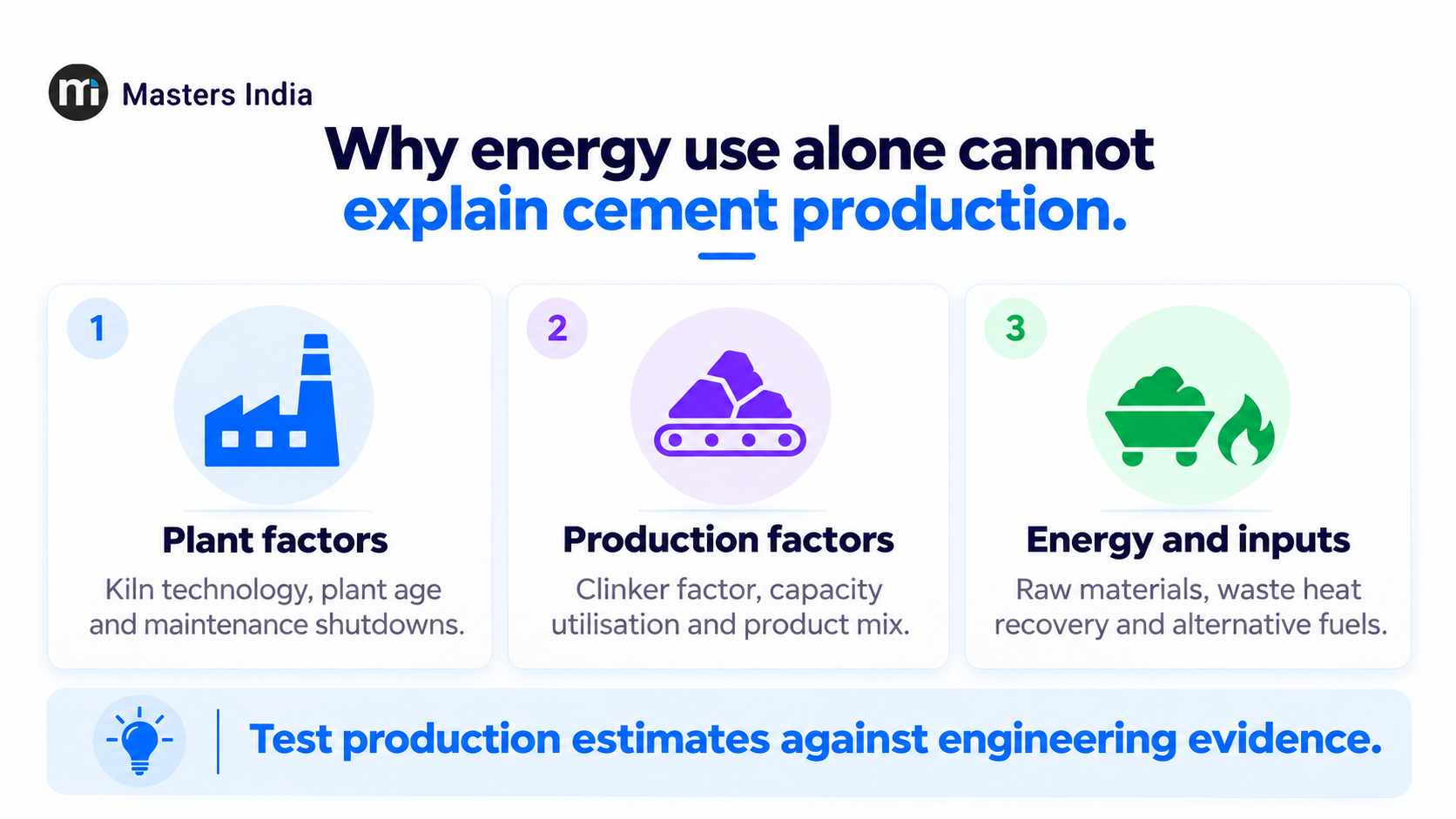 One possible departmental approach is to estimate production using electricity or fuel consumption.
This can be misleading.
Energy consumption can vary because of:
- kiln technology;
- clinker factor;
- maintenance shutdown;
- plant age;
- capacity utilisation;
- raw-material characteristics;
- waste heat recovery;
- alternative fuels; and
- product mix.
Any allegation of suppressed production based on power consumption should therefore be tested against engineering evidence.
How to prepare a cement-sector GST litigation defence
A cement GST dispute should ordinarily be defended through four layers.
Layer i : statutory interpretation
Identify:
- taxable event;
- charging provision;
- classification;
- valuation provision;
- ITC restriction; and
- relevant notification.
Layer ii : transaction characterisation
Establish:
- who supplies;
- what is supplied;
- to whom;
- consideration;
- contractual obligations; and
- commercial reality.
Layer iii : evidence
Produce:
- contract;
- purchase order;
- invoices;
- engineering drawings;
- fixed asset register;
- production records;
- mining documents;
- transport documents;
- reconciliations; and
- payment records.
Layer iv : quantification
Even where legal liability exists, independently verify:
- tax base;
- rate;
- period;
- ITC availability;
- limitation;
- interest; and
- penalty.
Many GST demands fail not because there is no legal issue but because the Department's quantification assumes every disputed transaction has identical facts.
Evidence matrix for cement GST disputes
| Issue | Best Evidence |
|---|---|
| Plant vs civil structure | Engineering drawing + asset register |
| Royalty | Mining lease + royalty challans |
| DMF/NMET | Statute + payment ledger |
| Dealer discount | Scheme circular + dealer agreement |
| Freight | Sale contract + LR + invoice |
| Branch valuation | Rule 28 analysis + ITC status |
| HO cross-charge | Cost allocation workings |
| Renewable power | Metering + captive-use data |
| 180 days | Vendor ledger + contractual due date |
| Production difference | Process flow + technical reconciliation |
| E-way bill dispute | Invoice/EWB/GR/vehicle trail |
| Corporate guarantee | Loan and guarantee documents |
Internal GST controls for cement companies
A large cement company should establish a GST Control Tower covering five verticals.
Vertical 1-Mining
Royalty, DMF, NMET, auction premium, cess and contractor payments.
Vertical 2-Manufacturing
Plant ITC, civil works, repairs, spares, scrap and production reconciliation.
Vertical 3-Energy
Coal, petcoke, captive power, renewable power and WHRS.
Vertical 4-Logistics
GTA, railway freight, coastal movement, depots and e-way bills.
Vertical 5-Commercial
Dealer discounts, credit notes, pricing, branch valuation and customer contracts.
This is preferable to a GST function that operates only from the accounting department.
A transaction matrix for cement GST compliance
Each material transaction should be mapped using the following research framework:
Transaction
↓
Economic Function
↓
Supplier
↓
Recipient
↓
Consideration
↓
Classification
↓
Rate
↓
Place of Supply
↓
Time of Supply
↓
Valuation
↓
RCM/FCM
↓
ITC
↓
Document
↓
Return Disclosure
↓
Litigation Risk
Such a matrix transforms GST from post-facto compliance into preventive tax governance.
Key judgments and circulars on cement-sector GST
The following authorities should form part of any advanced cement GST research library.
1. Chief Commissioner of CGST v. Safari Retreats Pvt. Ltd.
Civil Appeal No. 2948 of 2023, Supreme Court, 2024 INSC 756, decided 3 October 2024 | (2024) 23 Centax 62 (S.C.)
Importance: section 17(5), plant or machinery, functionality test.
Subject now requires reading together with the Finance Act, 2025 retrospective amendment.
2. Mineral Area Development Authority v. Steel Authority of India Ltd.
Civil Appeal Nos. 4056-4064 of 1999, Supreme Court, Nine-Judge Bench, 25 July 2024. | (2024) 21 Centax 378 (S.C.)
Importance: constitutional nature of royalty; royalty is not a tax.
3. Union of India v. Mohit Minerals Pvt. Ltd.
Civil Appeal No. 1390 of 2022 and connected matters, Supreme Court, judgment dated 19 May 2022. | 2022 (61) G.S.T.L. 257 (S.C.)
Importance: CIF imports and separate IGST levy on ocean freight.
4. The KCP Cements Limited, In re
AAR Andhra Pradesh, AAR/AP/05(GST)/2018 dated 2 August 2018 | (2018) 8 TLC (GST) 009
Importance: cement plant, silo ITC and mining royalty. But this application was later withdrawn.
5. UltraTech Cement Ltd. v. Union of India
Chhattisgarh High Court, W.P.(T) No. 4 of 2024, 19 January 2024, Neutral Citation 2024:CGHC:2079 | (2024) 73 TLC (GST) 100
Importance: GST demand on State Infrastructure Development and Environment Cess linked with captive limestone mining; writ disposed on alternate-remedy ground rather than final merits.
6. J.K. Cement Ltd. v. State of Uttar Pradesh
Allahabad High Court, decided 28 August 2023. (2023) 10 Centax 13 (All.)/2023 (77) G.S.T.L. 323 (All.)
Importance: movement of cement and section 129/e-way bill controversy.
Key findings on GST issues in the cement sector
The investigation supports eight principal propositions.
Finding 1 : cement GST has shifted from rate litigation to ecosystem litigation
The September 2025 reduction from 28% to 18% removes one major policy grievance.
It does not simplify the industry's GST architecture.
The major disputes increasingly involve inputs, mining, capital expenditure, logistics and valuation.
Finding 2 : mining is effectively part of the GST manufacturing chain
For integrated manufacturers with captive limestone mines, the conventional distinction between "mining activity" and "cement manufacturing activity" is economically artificial.
Royalty and mining-linked payments directly affect the tax cost of cement production.
Mining contracts should therefore fall within the cement company's central GST governance system.
Finding 3 : section 17(5) is likely to remain the largest capital-project controversy
The retrospective Finance Act, 2025 amendment materially changed the legal landscape following Safari Retreats.
Yet disputes will persist because the distinction between:
plant and machinery
and
civil structure
must still be applied to extraordinarily complex industrial installations.
The next generation of cases is therefore likely to concern component-level characterisation, not merely the broad meaning of "plant".
Finding 4 : engineering evidence will increasingly determine tax outcomes
In industrial ITC cases, accountants and lawyers cannot alone establish whether something constitutes machinery, its foundation or a civil structure.
Engineering drawings, process diagrams and technical certificates will become increasingly important tax evidence.
Finding 5 : freight is both a commercial and legal variable
Cement's high weight-to-value ratio makes logistics inseparable from pricing.
Incorrect characterisation of FOR and ex-works arrangements can therefore affect:
- taxable value;
- RCM;
- place of supply;
- ITC; and
- branch profitability.
Finding 6 : dealer schemes must be analysed transaction by transaction
The cement industry should abandon generic labels such as "dealer incentive".
Every payment must be identified as:
- discount;
- rebate;
- consideration for service;
- reimbursement; or
- price adjustment.
The 2025 clarification on post-sale discounts materially improves the analytical framework.
Finding 7 : GST risk is migrating from tax return to underlying data
E-invoicing, e-way bills and data analytics increasingly permit authorities to reconstruct operational flows independently of financial statements.
Future cement GST litigation is therefore likely to involve:
- quantity analytics;
- mining data;
- logistics data;
- power consumption;
- vendor networks; and
- production ratios.
Finding 8 : documentation architecture is more important than retrospective legal opinion
For many sector-specific disputes, the strongest defence is created before the transaction occurs.
Once an EPC contract describes a ₹500 crore integrated project as "construction of cement plant" without segregating machinery and civil structures, subsequent ITC litigation becomes substantially harder.
Tax design must therefore occur at:
Tender → Contract → Purchase Order → Invoice → ERP → Fixed Asset Register
rather than only at:
Show Cause Notice → Reply → Appeal.
Blocked ITC and the cost of cement manufacturing
The GST system seeks to tax final consumption while permitting credit of taxes incurred in business production.
Cement manufacturing exposes the tension between this principle and section 17(5).
A kiln cannot ordinarily function without foundations.
A clinker-handling system cannot function without structural supports.
A silo may economically function as industrial manufacturing/storage apparatus but legally contain substantial civil construction.
When credit is denied solely because industrial machinery requires immovable engineering infrastructure, tax can become embedded as a cost of production.
The policy problem can therefore be expressed as follows:
GST intends to tax consumption, but blocked credits can cause the tax to enter the manufacturing cost itself.
This deserves continued legislative evaluation, particularly for industrial infrastructure that has no independent commercial utility outside the manufacturing process.
A functionality test for industrial ITC claims
Even after the retrospective amendment to section 17(5)(d), the following test may assist in distinguishing machinery-supporting infrastructure from independent civil construction.
Ask five questions:
1. Manufacturing Nexus
Would the structure exist if the manufacturing machinery did not exist?
2. Functional Dependence
Can the machinery perform its intended function without the structure?
3. Independent Utility
Does the structure have meaningful commercial utility independent of the machinery?
4. Engineering Integration
Was the structure specially designed according to machinery specifications?
5. Accounting and Contractual Identity
Can the machinery, structural support and general building components be separately identified?
The test cannot override statutory exclusions, but it creates disciplined factual evidence for applying them.
Areas for further research on cement-sector GST
Several areas merit further doctrinal study.
A. DMF and NMET
Whether these payments constitute independent consideration, additional value of mining rights, or statutory obligations disconnected from supply.
B. Environmental Cess
Whether compulsory payments for broader environmental programmes possess sufficient nexus with an identifiable supply.
C. Carbon Markets
GST treatment of carbon credits and emerging environmental attributes generated by low-carbon cement production.
D. Alternative Fuels
Characterisation of waste received by cement plants where the plant is paid for co-processing.
E. Renewable Captive Power
Extent of ITC restriction where power is internally generated and consumed in taxable manufacturing.
F. Industrial Civil Structures
Post-Finance Act 2025 judicial boundaries between structural supports and excluded civil structures.
G. Cross-Border Technical Services
Royalty, technical know-how, software and engineering services obtained from overseas group companies.
H. Group Restructuring
GST implications of increasing consolidation within the Indian cement sector.
Managing cement-sector GST with clear records and controls
GST compliance in the cement sector depends on how mining, manufacturing, energy, logistics and dealer transactions are documented. Contracts, engineering records, invoices and reconciliations need to support the tax treatment adopted at each stage.
For cement manufacturers, the practical priority is to identify potential ITC, valuation and reverse-charge issues before transactions are completed. Keeping machinery and civil-work costs clearly separated, reviewing commercial terms and reconciling operational data can help teams prepare for audits and respond to queries with supporting evidence.
Masters India can support cement businesses with GST reconciliation and compliance workflows, helping teams manage their records and ITC claims more consistently.
Selected Primary and Authoritative Sources
- Notification No. 9/2025-Integrated Tax (Rate), dated 17 September 2025 - revised goods-rate schedules including Heading 2523 at 18%.
- GST Council/PIB, September 2025 rate-rationalisation announcement - reduction of GST on cement from 28% to 18%.
- CBIC Circular No. 164/20/2021-GST - mining rights and rate clarification.
- CBIC Sectoral FAQs - mining royalty, mining machinery and transportation.
- Chief Commissioner of CGST v. Safari Retreats Pvt. Ltd., 2024 INSC 756.
- Finance Act, 2025 - retrospective amendment to section 17(5)(d).
- Mineral Area Development Authority v. Steel Authority of India Ltd., Supreme Court, Nine-Judge Bench.
- Union of India v. Mohit Minerals Pvt. Ltd., Supreme Court, 19 May 2022.
- Circular No. 199/11/2023-GST - services between Head Office and Branch Offices/distinct persons.
- Circular Nos. 204/16/2023-GST and 225/19/2024-GST - corporate guarantees between related persons.
- Circular No. 251/08/2025-GST - post-sale discounts and commercial credit notes.
- India Brand Equity Foundation, Cement Industry Report, updated 2026 - production, capacity, investment and industry trends.
About the Author

- ★★
- ★★
- ★★
- ★★
- ★★
Check out other Similar Posts

CFO Weekly Digest
A weekly newsletter delivering sharp insights, strategic analysis, and critical updates on business, finance, and compliance — designed exclusively for CFOs and Finance Leaders
Masters India is a GST Suvidha Provider (GSP) appointed by Goods and Services Tax Network (GSTN), a Government of India enterprise.
 Procapitus Business Park, 4th Floor, D 247/4A, Sector 63 Rd, Noida, Uttar Pradesh 201301
 info@mastersindia.co




Certified